


Irish Proverbs: Traditional Sayings, Meanings, and English Translations
by Teresa Finn on Jun 30, 2026
Table of Content
What Is a Good Irish Proverb?
The most memorable Irish proverbs share more than clever wording—they offer practical wisdom that's easy to remember and still relevant today. Passed down through generations, these traditional sayings reflect everyday experiences and enduring values such as resilience, kindness, family, community, and perseverance.
Unlike quotations attributed to a single person, Irish proverbs evolved through oral tradition. Their simple language and universal themes have helped them remain meaningful for centuries, whether spoken in Gaeilge (Irish) or translated into English.
Most authentic Irish proverbs have these characteristics:
Practical wisdom that offers guidance for everyday life.
Simple, memorable language that's easy to recall and share.
Strong cultural roots, often inspired by Irish farming, family life, faith, and community.
Timeless relevance, with lessons that still apply across generations.
The collection below features some of the best-known Irish proverbs, each with its English translation, meaning, and the occasions where it's most commonly used.
Top 10 Most Famous Irish Proverbs
Some Irish proverbs have been passed down for centuries, while others are quoted so often that they've become part of everyday conversation. These are the sayings most closely associated with Irish wisdom, each offering practical advice that's just as meaningful today as when it first emerged.
Irish Proverb |
English Translation |
Meaning |
Best Use |
Ar scáth a chéile a mhaireann na daoine. |
People live in one another's shelter. |
We rely on one another, and communities grow stronger through mutual support. |
Friendship, teamwork, family |
Ní neart go cur le chéile. |
There is no strength without unity. |
Success comes from working together rather than alone. |
Leadership, collaboration |
Tús maith leath na hoibre. |
A good start is half the work. |
Careful preparation makes any task easier to complete. |
New projects, study, work |
Mol an óige agus tiocfaidh sí. |
Praise the young and they will flourish. |
Encouragement helps people develop confidence and reach their potential. |
Parenting, education |
Is fearr lúbadh ná briseadh. |
It's better to bend than to break. |
Being adaptable is often wiser than being stubborn. |
Resilience, personal growth |
Ní mar a shíltear a bhítear. |
Things are not always as they seem. |
Avoid making quick judgments based on appearances. |
Everyday wisdom |
Níl aon tinteán mar do thinteán féin. |
There's no hearth like your own hearth. |
Home is a source of comfort, belonging, and security. |
Family, homecoming |
A good laugh and a long sleep are the two best cures. |
— |
Laughter and rest can help restore both body and mind. |
Well-being, encouragement |
You'll never plough a field by turning it over in your mind. |
— |
Success comes from action rather than endless planning. |
Motivation, achieving goals |
Ní bhíonn saoi gan locht. |
There is no wise person without faults. |
Even the wisest people have imperfections, so humility and continuous learning matter. |
Personal growth, leadership, humility |

The sayings above represent only a small part of Ireland's rich tradition of wisdom. In the next section, you'll discover more Irish proverbs organized by themes such as life, love, friendship, family, and success, making it easier to find the right saying for any occasion.
Irish Proverbs by Theme
Wisdom and Action
These proverbs encourage thoughtful decisions while reminding us that real progress comes through action.
Irish Proverb |
English Translation |
Meaning |
Best Use |
Ní dhéanfaidh smaoineamh an treabhadh duit. |
Thinking won't plough the field for you. |
Success comes from taking action rather than overthinking. |
Motivation, productivity |
Is minic a bhris béal duine a shrón. |
A person's mouth has often broken their nose. |
Think before you speak because careless words have consequences. |
Personal growth, communication |
An rud is annamh is iontach. |
What is rare is wonderful. |
Rare things are often the most valuable. |
Appreciation, gratitude |

Life and Happiness
These Irish proverbs remind us that a happy life is built on gratitude, good health, curiosity, and finding joy in everyday moments rather than material success.
Irish Proverb |
English Translation |
Meaning |
Best Use |
Bíonn siúlach scéalach. |
A traveler has many stories. |
New experiences broaden our perspective and become the stories we carry through life. |
Travel, adventure, personal growth. |
Maireann croí éadrom i bhfad. |
A light heart lives long. |
Optimism, laughter, and a positive outlook help people face life's challenges with resilience. |
Encouragement, gratitude, well-being. |
Is fearr an tsláinte ná na táinte. |
Health is better than wealth. |
Good health is more valuable than material possessions or financial success. |
Wellness, gratitude, life priorities. |
Friendship and Community
Community has always been central to Irish culture, and these proverbs celebrate the importance of supporting one another.
Irish Proverb |
English Translation |
Meaning |
Best Use |
Ní neart go cur le chéile. |
There is no strength without unity. |
Working together creates greater strength than working alone. |
Teamwork, leadership, community projects. |
Is fearr cara sa chúirt ná punt sa sparán. |
A friend at court is better than a pound in the purse. |
Loyal friendships are often more valuable than money. |
Friendship, appreciation, loyalty. |
Ní hé lá na gaoithe lá na scolb. |
A windy day isn't the day for thatching. |
Good judgment includes choosing the right time to act. |
Planning, teamwork, collaboration. |
Home, Family, and Heritage
Irish proverbs don't only celebrate love and family—they also reflect a deep connection to home, heritage, and the traditions that have shaped Irish identity across generations.
Irish Proverb |
English Translation |
Meaning |
Best Use |
Níl aon tinteán mar do thinteán féin. |
There's no hearth like your own hearth. |
Home is a place of comfort, belonging, and emotional security. |
Family, homecoming, Irish heritage. |
Is iad na daoine a dhéanann an baile. |
People make the home. |
A home is defined by the people who live in it rather than the building itself. |
Family, weddings, relationships. |
Beatha teanga í a labhairt. |
A language lives by being spoken. |
Irish traditions and cultural identity are preserved when language is actively used and passed from one generation to the next. |
Cultural heritage, language preservation, Irish identity. |

Hard Work and Perseverance
These proverbs reflect Ireland's agricultural heritage and emphasize determination, patience, and resilience.
Irish Proverb |
English Translation |
Meaning |
Best Use |
Ní bhíonn an rath ach mar a mbíonn an smacht. |
Prosperity comes with discipline. |
Lasting success comes through discipline, consistency, and self-control. |
Career, leadership, personal growth |
Is minic a bhaineann duine súil as cloch. |
Many a person has injured an eye on a stone. |
Success often comes through perseverance and overcoming hardship. |
Resilience, determination |
Is fearr lúbadh ná briseadh. |
It's better to bend than to break. |
Flexibility is a sign of strength. |
Resilience, change |
Humor and Wit
Irish humor often uses clever observations to express deeper truths about human nature.
Irish Proverb |
English Translation |
Meaning |
Best Use |
An té nach bhfuil láidir ní foláir dó bheith glic. |
He who is not strong must be clever. |
Intelligence often succeeds where strength cannot. |
Encouragement, strategy |
Is minic a bhíonn ciúin ciontach. |
The quiet one is often guilty. |
Appearances can be misleading. |
Humor, conversation |
Ní bhíonn saoi gan locht. |
There is no wise person without faults. |
Everyone has imperfections. |
Humility |
Nature and the Seasons
Inspired by Ireland's landscapes, changing seasons, and farming traditions, these proverbs reflect the rhythms of nature and the passing of time. They remind us that growth, change, and patience are part of everyday life.
Irish Proverb |
English Translation |
Meaning |
Best Use |
Bíonn blas ar an mbeagán. |
Even a little has its own sweetness. |
Appreciate what you have. |
Gratitude |
Ní bhíonn dhá earrach in aon bhliain. |
There are not two springs in one year. |
Every season has its proper time. |
Patience |
An té a bhíonn siúlach, bíonn scéalach. |
Those who travel have stories to tell. |
Experience comes through exploring the world. |
Travel |
|
Ní bhíonn in aon rud ach seal. |
Nothing lasts forever. |
Life constantly changes, reminding us to appreciate each moment and remain hopeful during difficult times. |
Resilience, life transitions |

Traditional Irish Proverbs in Gaeilge: Original Text, Pronunciation, and Meanings
Many traditional Irish proverbs were first spoken in Gaeilge, Ireland's native language, long before they were written down. While English translations capture the central message, the original Irish often preserves the rhythm, imagery, and cultural nuances that make these seanfhocail unique.
The examples below include the original Gaeilge, a simplified pronunciation guide for English speakers, English translations, and notes explaining why these proverbs continue to resonate in Irish life today.
Pronunciation note: Irish pronunciation varies across regional dialects. The phonetic guides below are simplified for English-speaking readers and are intended as general pronunciation aids rather than exact linguistic transcriptions.
Ar scáth a chéile a mhaireann na daoine
Pronunciation: Air skaw a HAY-luh a VAR-un na DEE-nee
Literal translation: People live in one another's shelter.
Meaning: Communities thrive when people support one another.
Why it still matters: Frequently quoted in Irish schools, community organizations, and public speeches as a reminder that cooperation and mutual support strengthen society.
Common use: Community projects, family celebrations, teamwork, and leadership.
Ní neart go cur le chéile
Pronunciation: Nee NART guh kur leh HAY-luh
Literal translation: There is no strength without unity.
Meaning: Success is achieved through cooperation rather than individual effort alone.
Why it still matters: A well-known motto in Irish sport, volunteer organizations, and workplaces where teamwork is essential.
Common use: Leadership, sports, business, education, and community initiatives.
Why it still matters: The proverb continues to resonate in leadership, business, education, and everyday problem-solving, where creativity is often more valuable than force.
Common use: Leadership, entrepreneurship, education, and personal development.

Tús maith leath na hoibre
Pronunciation: Toos mah leh na HIV-ra
Literal translation: A good start is half the work.
Meaning: Careful preparation makes every task easier to complete.
Why it still matters: Still commonly quoted by Irish parents, teachers, and employers when encouraging someone beginning a new challenge.
Common use: Starting a new job, school, business, or personal goal.
Níl aon tinteán mar do thinteán féin
Pronunciation: Neel ayn TIN-chan mar duh HIN-chan fayn
Literal translation: There is no hearth like your own hearth.
Meaning: Home provides comfort, belonging, and emotional security.
Cultural note: For many members of the Irish diaspora, this proverb symbolizes the enduring connection to home, family, and heritage, even when living abroad.
Common use: Family gatherings, homecomings, Irish heritage celebrations, and messages about home.
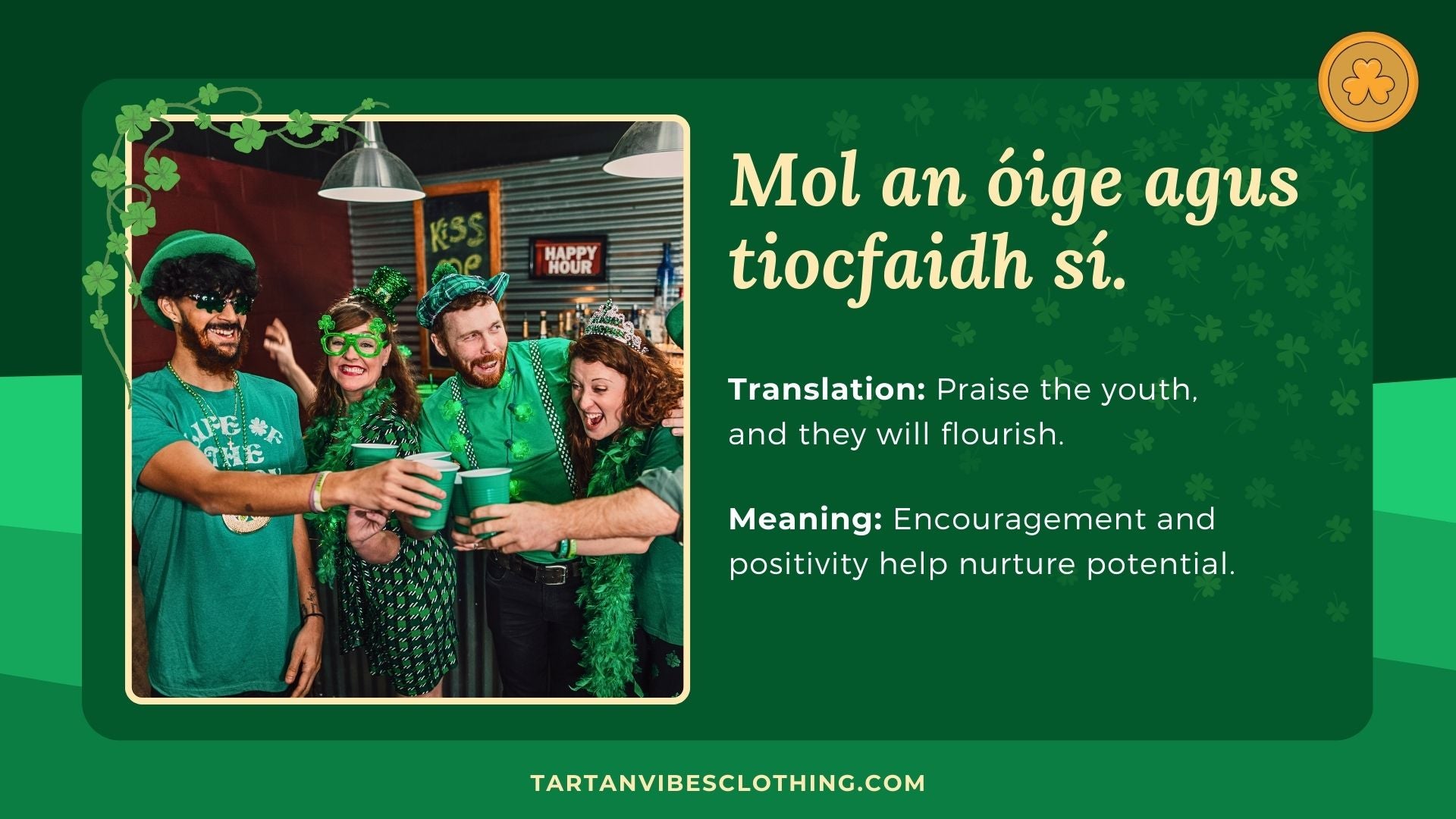
Mol an óige agus tiocfaidh sí
Pronunciation: Mul an OH-guh ah-gus CHUCK-ee shee
Literal translation: Praise the young and they will flourish.
Meaning: Encouragement helps people develop confidence and reach their potential.
Why it still matters: Closely associated with Irish education and youth development, reflecting the belief that positive reinforcement helps young people succeed.
Common use: Parenting, teaching, coaching, and mentoring.
An té nach bhfuil láidir ní foláir dó bheith glic
Pronunciation: An tay nach will LAW-dir nee fuh-LAWR doh veh GLICK
Literal translation: Whoever is not strong must be clever.
Meaning: Intelligence and resourcefulness often matter more than physical strength.
Why it still matters: The proverb continues to resonate in leadership, business, education, and everyday problem-solving, where creativity is often more valuable than force.
Common use: Leadership, entrepreneurship, education, and personal development.
Traditional Irish proverbs have survived for centuries because their wisdom remains relevant across generations. Reading them in both Gaeilge and English offers a deeper appreciation of Ireland's language, storytelling traditions, and cultural heritage while revealing meanings that translations alone cannot always fully convey.
Irish Proverbs, Irish Blessings, and Irish Sayings: What's the Difference?
It's easy to confuse Irish proverbs, blessings, and sayings because they're often quoted together. In reality, each serves a different purpose—from sharing practical wisdom to offering good wishes or simply reflecting the way people speak in everyday Ireland.
Type |
Purpose |
Example |
Irish proverb |
Shares practical wisdom or life lessons. |
You'll never plough a field by turning it over in your mind. |
Irish blessing |
Offers goodwill, protection, or hope for the future. |
May the road rise to meet you. |
Irish saying |
A familiar expression or everyday phrase used in conversation. |
What's the craic? |
What Is an Irish Blessing?
An Irish blessing expresses goodwill, encouragement, or hope rather than offering practical advice. Blessings are commonly shared at weddings, birthdays, funerals, graduations, and other important milestones. Although many have become closely associated with Irish culture, they are different from proverbs because their purpose is to wish someone well rather than teach a life lesson.
Example:
May the road rise to meet you.
May the wind be always at your back.
Everyday Irish Sayings (Hiberno-English)
Not every well-known Irish expression is a traditional proverb. Many familiar phrases belong to Hiberno-English, the distinctive variety of English spoken in Ireland that has been shaped by centuries of interaction with the Irish language.
Unlike proverbs, these expressions don't usually teach a life lesson. Instead, they reflect Ireland's conversational style, humor, and local culture.
Some common examples include:
What's the craic? — How are you? What's happening?
I'm grand. — I'm fine or everything's okay.
Give it a lash. — Give it a try.
Sure, it'll be grand. — Everything will work out.
These expressions are widely used in everyday conversation, while traditional Irish proverbs continue to preserve generations of wisdom and cultural values.
Irish Blessings for Every Occasion
Farewells and Travel
Whether someone is setting off on a journey or saying goodbye, these blessings wish them safety, good fortune, and a smooth path ahead.
May the road rise to meet you.
May the wind be always at your back.
May the sun shine warm upon your face,
and the rains fall soft upon your fields.
Best for: Farewell cards, retirement, travel, graduation, moving abroad.

Weddings
Irish wedding blessings celebrate love, commitment, and a lifetime of happiness together.
May your love be modern enough to survive the times,
and old-fashioned enough to last forever.
Best for: Wedding speeches, anniversary cards, bridal showers.
Friendship
Irish blessings often celebrate loyalty, laughter, and the joy of true friendship.
May good friends be near you wherever you are,
and all the good things in life be yours.
Best for: Birthday cards, friendship gifts, thank-you notes.
New Beginnings
Whether starting a new career, moving into a new home, or beginning a new chapter, these blessings offer hope for the future.
May your home always be too small to hold all your friends.
Best for: Housewarming gifts, family celebrations, new homes.
Sympathy and Remembrance
These traditional blessings offer comfort during times of grief and remembrance.
May God hold you in the palm of His hand.
Best for: Sympathy cards, funerals, memorial services.
Irish blessings continue to be shared because they express kindness, hope, and compassion in a simple yet memorable way. Whether you're celebrating a joyful milestone or offering comfort during a difficult time, choosing the right blessing helps make your words more personal and meaningful.
How to Choose the Right Irish Proverb or Blessing
Choosing the right Irish proverb depends on the occasion and the message you want to share. The guide below recommends some of the best-known sayings and blessings for common situations.
Occasion |
Recommended Proverb or Blessing |
Why It Fits |
Speech |
Is fearr cara sa chúirt ná punt sa sparán. |
Highlights friendship, gratitude, and the importance of community. |
Wedding |
May your love be modern enough to survive the times, and old-fashioned enough to last forever. |
Celebrates lasting love and commitment. |
Graduation |
Tús maith leath na hoibre. |
Encourages a strong start and careful preparation for the future. |
Tattoo |
Ní bhíonn saoi gan locht. |
A short, timeless reminder that no one is perfect. |
Greeting Card |
Go n-éirí an bóthar leat. |
Offers encouragement and good wishes for many occasions. |
Memorial |
May God hold you in the palm of His hand. |
A traditional blessing expressing comfort and peace. |
Social Media |
An rud is annamh is iontach. |
A concise saying that pairs well with travel, milestones, or memorable moments. |
The best Irish proverb isn't necessarily the most famous one—it's the one whose message matches the occasion. Whether you're giving a speech, celebrating a milestone, or remembering a loved one, choosing the right words makes your message more meaningful and authentic.
Origins and History of Seanfhocail
Oral Tradition
The Irish Language

Everyday Life in Rural Ireland
From Irish to English
Further Reading
To learn more about traditional Irish proverbs (seanfhocail) and the Irish language, explore these trusted resources:
National Folklore Collection (University College Dublin) – Irish folklore, oral traditions, and historical collections.
Dúchas – Ireland's National Folklore Collection, preserving stories, customs, and traditional sayings.
Foras na Gaeilge – Official organization promoting the Irish language.
Teanglann – Comprehensive Irish–English dictionary and pronunciation resource.
Conclusion
Irish proverbs have endured for centuries because their wisdom is simple, practical, and timeless. Whether you're looking for words of encouragement, a meaningful blessing, or a glimpse into Ireland's rich storytelling tradition, these seanfhocail offer insights that remain relevant today. From themes of resilience and community to love, family, and heritage, each saying reflects values that continue to resonate across generations.
If you'd like to explore Irish culture further, discover our collection of Irish blessings, Celtic-inspired apparel, and heritage stories that celebrate the spirit of Ireland every day.
FAQs About Irish Proverbs
Are Irish proverbs still used in everyday conversation?
Yes. While some traditional seanfhocail are more common in literature or cultural settings, many Irish proverbs are still used in speeches, schools, family gatherings, and everyday conversations. Others continue to appear in greeting cards, social media, and community events, helping keep Ireland's storytelling traditions alive.
Are all Irish sayings considered Irish proverbs?
No. Although the terms are often used interchangeably, they are not the same. Irish proverbs share practical wisdom or life lessons, Irish blessings express goodwill and encouragement, and modern Irish sayings reflect everyday speech and humor. Understanding the difference makes it easier to choose the right expression for each occasion.
Do Irish proverbs lose meaning when translated into English?
English translations preserve the main message of most Irish proverbs. Still, they don't always capture the rhythm, wordplay, or cultural nuances found in the original Gaeilge. Reading both versions provides a deeper appreciation of Ireland's language, history, and storytelling traditions.
Can Irish proverbs be used in speeches, cards, or tattoos?
Yes. Irish proverbs are popular choices for wedding speeches, graduation messages, greeting cards, personalized gifts, and tattoos. Before using one, it's worth checking both the original Irish wording and its English meaning to ensure it accurately reflects the message you want to share.
Where can I find authentic Irish proverbs?
Traditional Irish proverbs are preserved through collections of seanfhocail, folklore archives, and Irish-language resources. Trusted references include Dúchas, Foras na Gaeilge, Teanglann, and the National Folklore Collection, which help distinguish authentic traditional proverbs from modern quotations or Irish-inspired sayings.

Teresa Finn
As someone with a deep passion for clan heritage, especially the intriguing world of tartans and their rich traditions, I'm here to be your companion on this exciting journey. Together, we'll delve into the depths of clan history, uncovering the stories behind these vibrant tartans and making every connection to your heritage more meaningful.


