



The Ultimate Guide to an Irish Valentine’s Day: Symbols, Sayings, and the Shrine of the Saint
by Teresa Finn on Jan 28, 2026
Table of Content
If you’re afraid of celebrating Irish Valentine’s Day with a gift that looks Irish but feels fake, you’re not alone.
Every February, Irish romance gets buried under plastic shamrocks, generic Claddagh knockoffs, and “Celtic-style” gifts with no real meaning. The result? A Valentine’s Day that looks festive—but feels empty.
An authentic Irish Valentine’s Day is something very different.
Rooted in centuries-old Irish love traditions, it isn’t about luck, novelty, or spending more. It’s about place, symbol, language, and ritual—from the shrine of Saint Valentine in Dublin to the logic of the Claddagh ring, the soul-language of Gaeilge, and traditions that mark real intention.
This guide shows you how to celebrate Valentine’s Day the Irish way in 2026—without falling into the plastic shamrock trap.
The Heart of the Saint: Why Dublin Is the True Home of Romance
While Valentine’s Day is celebrated worldwide, Irish Valentine’s Day is rooted in a real, physical connection to Saint Valentine himself.
What makes Dublin different is simple and verifiable.
In 1836, the relics of Saint Valentine arrived in Dublin
They were a gift from Pope Gregory XVI
The relics were entrusted to an Irish Carmelite friar, Father John Spratt
Today, they are kept at Whitefriar Street Carmelite Church, in the center of Dublin
The shrine contains small bone fragments and a vessel tinged with the saint’s blood.
This is documented religious history, not folklore.
In Irish and Catholic devotional tradition, relics are understood as physical links to the life of a saint. Because of this, Whitefriar Street Church is not just a romantic landmark. It is a living place of prayer.
Every year, especially on February 14, couples and individuals visit the shrine to pray for love, marriage, or fidelity. Many leave handwritten notes near the reliquary, quietly asking for Saint Valentine’s intercession.
This is what sets Dublin apart. It is one of the few places in the world where Valentine’s Day is experienced as a pilgrimage, not a performance.

The Blessing of the Rings: Ireland’s Living Valentine’s Tradition
One of the most distinctive Irish Valentine’s Day traditions is the blessing of rings at Whitefriar Street Church in Dublin.
On or around February 14, couples are invited to bring engagement rings, wedding rings, or promise rings to be blessed during special services or moments of devotion. Unlike standard liturgical ceremonies, this practice has evolved into a uniquely Irish Valentine’s ritual. It is quiet, reverent, and deeply symbolic.
What does the blessing signify?
Commitment: not just a romantic feeling, but a chosen responsibility
Intention: entering or continuing a relationship with clarity
Legacy: honoring love as something meant to endure
For many visitors, especially those who value experience over material gifts, this ritual offers something no shop can provide. It marks love in time.
Even for those who cannot attend in person, understanding this tradition changes how Valentine’s Day is viewed. Love becomes something participated in, not merely exchanged.
The Claddagh Ring: Decoding the Language of the Heart
No Irish symbol is more closely associated with love than the Claddagh ring—and no symbol is more commonly misunderstood.
Originating in Ireland over 400 years ago, the Claddagh is not ornamental. It is logical. Understanding the Claddagh ring meaning is essential, because every part of its design communicates a specific relationship value.
Its design forms a trinity:
The Heart → Love
The Hands → Friendship
The Crown → Loyalty
Together, these elements describe not just a feeling, but the structure of a relationship.

How to Wear a Claddagh Ring Correctly (The Status Mechanism)
The Claddagh communicates relationship status through hand placement and orientation:
Right hand, crown inward: single, open to love
Right hand, crown outward: in a relationship
Left hand, crown inward: engaged
Left hand, crown outward: married
This system turns the ring into a form of symbolic literacy. Wearing it incorrectly doesn’t make it invalid. Wearing it correctly shows understanding.
For couples who care about authenticity, knowing how the Claddagh works is what turns a simple ring into a meaningful tradition.
Beyond “I Love You”: Authentic Gaelic Phrases for Your Soul Friend
Mo Anam Cara (My Soul Friend)
Perhaps the most profound Irish term of endearment, Mo Anam Cara comes from a pre-Christian spiritual concept. It describes a bond where two souls recognize and accompany one another beyond the physical.
It does not mean “soulmate” in a romantic cliché sense. Historically, an anam cara could be a spiritual guide, a confidant, or a companion in faith. In modern romance, using this phrase signals depth, trust, and shared interior life.
Pronunciation: Ah-num Kor-ah

A Stór & A Thaisce (My Treasure)
These affectionate phrases are commonly used in Ireland and carry emotional warmth without grandiosity. They suggest care, value, and closeness. This makes them ideal for Valentine’s messages that feel intimate rather than performative.
Pronunciation:
A Stór → uh store
A Thaisce → uh hash-ku
A Note on “Is breá liom tú”
While often translated as “I love you”, this phrase more closely means “I like you very much” and is commonly used for objects or preferences. For heritage-focused romance, the phrases above carry stronger cultural weight.
Pronunciation: iss brah lum too

Providing pronunciation matters. Without it, Gaeilge feels intimidating. With it, the language becomes accessible and deeply personal.
Ogham: The Ancient Alphabet of Trees in Modern Romance
Ogham is one of the most misunderstood elements of Irish heritage.
The Ogham script dates back to the 4th century and was used as a functional writing system carved along the edges of standing stones, not as decoration.
Rather than letters, Ogham characters are formed by strokes arranged along a central line. These inscriptions are traditionally read from bottom to top, following the vertical edge of the stone.
Today, Ogham is often used in jewelry or personalized gifts. This is where problems begin.
The Common Mistake
Most mass-produced Ogham jewelry treats the script as decoration. It is engraved horizontally or without regard to orientation. This breaks the logic of the script and results in inscriptions that look Celtic but are functionally incorrect.
For heritage-minded buyers, this is often the point where a meaningful gift becomes “plastic.”

How to Spot Authentic Ogham Use (Quick Check)
- A clear central stemline
Consistent strokes on one side
Orientation explained by the maker
Used correctly, Ogham becomes a ritual inscription, not a trend.
Planning Your Heritage Romance Experience
Authentic Irish Valentine’s Day celebrations are situational, not generic.
Rooted in Irish romantic traditions, meaningful experiences align heritage, place, and ritual with the stage of the relationship.
An Irish Date Night at Home
This kind of Irish date night reflects traditional Irish romantic values: presence, storytelling, and shared atmosphere over spectacle.
Films: Irish cinema with emotional depth (romance, identity, memory)
Menu: seafood, lamb, or regional dishes with provenance
Drinks: Irish whiskey or stout—not as na ovelty, but as a craft
This approach turns Valentine’s Day into an evening of shared atmosphere, not distraction.

Symbolic Rituals by Relationship Stage
New relationship: Exchange a Claddagh ring worn with the crown outward, accompanied by a short spoken blessing.
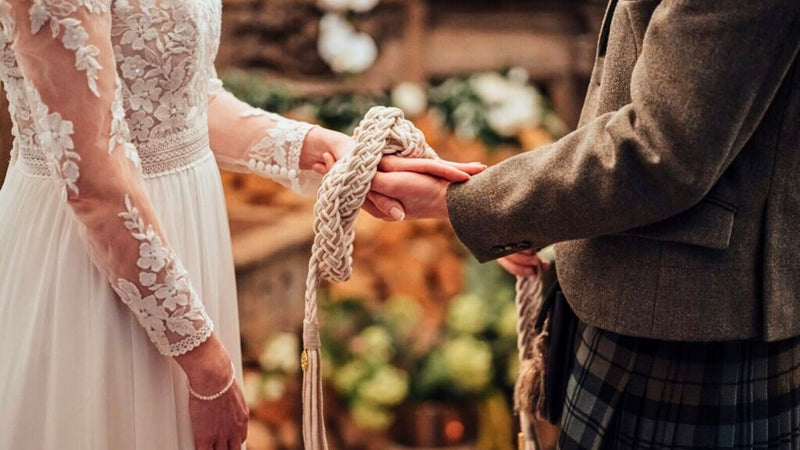
Engaged: Introduce a handfasting cord or explain the symbolism behind an engagement ring.
Anniversary: Share poetry, renew vows, or exchange a Gaelic inscription meaningful to both partners.
Ritual gives love shape. It creates memory.
Avoiding the “Plastic Shamrock” Trap: Gifts for the Heritage Lover
Symbolic Jewelry
In Irish romantic traditions, symbolic jewelry communicates meaning before appearance.
Claddagh rings worn correctly
Ogham inscriptions with clearly explained orientation

Heritage Whiskey & Provenance Gifts
Here, authenticity is about origin, not packaging.
Real Irish distilleries
No novelty or tourist-style branding

Aran & Traditional Irish Knitwear
These patterns are not decorative. They carry meaning.
Cable: life’s journey
Diamond: prosperity
Honeycomb: work and reward

Irish Clan & Irish Tartan — Wearing Ancestry, Not a Costume
When combined with Celtic symbols, clan tartans can become powerful Valentine’s gifts, especially for the Irish diaspora. Instead of a generic pattern, the gift becomes a story about origin, identity, and connection.
For those looking for personalized Irish Valentine gifts, authenticity matters more than customization. A meaningful gift should connect to real Irish symbolism, clear provenance, and lasting value beyond February 14.


Making Your 2026 Irish Valentine’s Day Authentic
An authentic Irish Valentine’s Day is not about how much you spend. It’s about what you understand.
When you ground romance in place, honor symbolic logic, speak with soul-centric language, and choose ritual over novelty, Valentine’s Day becomes something rare in modern life: meaningful.
In 2026, let Irish Valentine’s Day be less about display and more about intention.
Start with one thing. Learn its meaning. Use it well.
FAQs About Irish Valentine’s Day
Do the Irish celebrate Valentine's Day?
Yes. Valentine’s Day is celebrated in Ireland on February 14, with couples exchanging cards, gifts, and meals, alongside a unique heritage connection to St. Valentine’s shrine in Dublin.
Is Valentine’s Day or St. Patrick’s Day first?
Valentine’s Day comes first on February 14, followed by St. Patrick’s Day on March 17, which focuses on Irish culture and national identity rather than romantic love.
How do the Irish express love?
The Irish often express love through poetic language, blessings, and Gaelic phrases such as 'Mo Ghrá' or 'Mo Anam Cara,' emphasizing emotional depth and connection.
What is the most famous Irish tradition?
The most famous Irish tradition is St. Patrick’s Day, celebrated on March 17 with parades, music, festivals, and global celebrations of Irish culture.
What do Irish people call their lovers?
Common Irish terms of endearment include A ghrá (my love), A chroí (my heart), Mo stór (my treasure), and A mhuirnín (my darling).

Teresa Finn
As someone with a deep passion for clan heritage, especially the intriguing world of tartans and their rich traditions, I'm here to be your companion on this exciting journey. Together, we'll delve into the depths of clan history, uncovering the stories behind these vibrant tartans and making every connection to your heritage more meaningful.


