



Table of Content
I. Who Are Clan Menzies?
Clan Menzies (Scottish Gaelic: Clann Mèinnear, anglicized as “Ming‑iss”) is a Highland Scottish clan with Norman origins, tracing back to Robert de Maineriis of Mesnières in Normandy, who settled in England and then Scotland in the 12th century. The first well‑documented chief was Sir Robert de Meyneris, who rose to become Chamberlain of Scotland under King Alexander II in 1249 and was granted lands in Atholl and Glen Lyon, beginning the clan’s rise in Perthshire and the central Highlands.
Over the centuries, Clan Menzies in Scotland became a powerful landholding family, owning estates such as Weem, Glen Lyon, and Rannoch. They were loyal supporters of the Scottish Crown during the Wars of Independence and later took part in major historical events, including the Jacobite risings. Today, the clan Menzies is recognized under the leadership of the Menzies of Culdares' line.

Their ancestral home, Castle Menzies, still stands in Highland Perthshire and serves as a proud symbol of the clan's enduring legacy.
II. Branches of Clan Menzies
The septs of Clan Menzies represent the extended families and branches that have long been part of the clan’s proud history across Scotland.
1. Menzies of Weem (Main Line)
The principal line and holders of the Baronetcy of Nova Scotia (created 1665), ending with the death of Sir Neil, 8th Baronet, in 1910. Estates, castles, and archives were sold after his death
2. Menzies of Culdares (Cadet Branch / Chiefly Line since 1957)
A cadet line descending from Colonel James Menzies of Culdares (1529–1573), a Covenanting officer. They introduced the larch tree to Scotland from Tyrol in 1737; saplings still stand near Dunkeld. After the extinction of the main line in 1910, Ronald Steuart Menzies of Culdares was recognised in 1957 by Lyon Court as Menzies of Menzies, with his descendants—including Robert R. S. Menzies—the current hereditary chiefs.
3. Menzies of Pitfoddels
A recognised branch, noted for having at least one member carry the Royal Standard at the Battle of Invercarron (1650). A later Menzies of Pitfoddels founded the Roman Catholic College of Blairs near Aberdeen
4. Menzies of Shian (Shian in Glenquaich)
A cadet branch that actively supported the Jacobite rising (1715 and possibly 1745); members fought and some were killed in the conflicts. Additional sept names associated with Clan Menzies include MacMenzies, MacMinn, MacMonies, McMenzies, and many more variants listed in clan records
III. Where the Menzies Surname Comes From?
This well-known Scottish Clan Menzies surname traces its roots back to a Norman knight from the 11th century. After William the Conqueror took control of England in 1066, it is said that he received assistance from Scotland. Indeed, several Norman nobles and knights were granted land in Scotland.
One of these was a knight named "de Meyners," who hailed from the town of Mesnières in the Seine-Maritime region. In England, the surname is Manners, associated with the Dukes of Rutland. The place name derives from the Latin word manere, which means to stay or dwell, a clue that helps you better understand the Menzies surname meaning in its historical context.

- 1214: The earliest recorded spelling of the family name is believed to be Arketil de Mannvers, noted at the Abbey of Holyrood in Scotland during the reign of King Alexander II (1214–1249).
1224: Robert de Meyners was appointed Great Chamberlain of Scotland by King Robert I.
1248: David de Meyness is recorded as a knight in the entourage of the Queen of Scotland.
1255: Robert de Mesnere is documented as a supporter of King Henry III of England.
1385: Alexander de Meinzeis obtained a charter for lands in Durisdeer, marking the first recorded use of the near-modern form Menzies.
1850s: Sir Robert Menzies’ grandfather emigrated from Scotland to Australia during the gold rush and traced his ancestry back to the Great Chamberlain.
1894: The Book of Menzies was published, incorrectly claiming descent from King Fergus in 333 B.C.—a myth widely accepted at the time.
The name Menzies rose to prominence without the need for legendary origins. Its true legacy is rooted in historical achievements. Among the most notable figures bearing the name is Sir Robert Menzies (1894–1978), who served as Prime Minister of Australia from 1939 to 1941 and again from 1949 to 1966.
IV. Where did Clan Menzies originate?
The Manners family, who eventually became the Dukes of Rutland in England, originally came from Mesnières in Normandy. This connection plays a fascinating role in the origin of the Menzies clan, as the Menzies surname evolved when members of that Norman lineage settled in Scotland and established a distinct identity.

- 1249: Sir Robert de Myneris gained royal favour at the court of King Alexander II of Scotland and was appointed Chamberlain. He received landholdings in Glen Lyon and Atholl.
1296: These land grants were confirmed by a royal charter to his son, Alexander, who was granted property in Strathtay.
Alexander also gained possession of the lands of Weem and married Egida, a daughter of James Stewart, the 5th High Steward of Scotland.
1330: The clan’s motto is believed to have originated at the Battle of Teba, where Chief Lord Robert, the Menzies clan reportedly responded to a summons from Sir James Douglas. The clan’s crest is also said to stem from this event. However, historical records do not confirm the presence of Sir Robert Menzies at Teba.
V. The History of Clan Menzies in Scotland
Wars of Scottish Independence
15th and 16th centuries
Another Sir Robert Menzies, the eighth chief of the clan, played an important role in the clan’s development during the late 15th century.
- 1488: He built Weem Castle near the site of the present-day Castle Menzies.

About a hundred years earlier, Janet Menzies had married into the Stewart family. This connection later became the basis for a land dispute, as Stewart of Garth claimed that the lands of Fothergill had been part of her dowry.
1502: Stewart of Garth invaded Weem Castle in an attempt to assert his claim over the disputed lands.
In response, Menzies brought the case before the Crown. The king ruled in favor of Clan Menzies and took further action to protect their holdings.
1510: King James IV ordered Stewart to return the lands and elevated the Menzies estate to the free barony of Menzies.
1540: James Menzies of Menzies married Barbara Stewart, daughter of John Stewart, 3rd Earl of Atholl, and cousin to Henry Stuart, Lord Darnley.
17th century and the Civil War
During the Wars of the Three Kingdoms, despite their connections to the royal family and the Stewarts, Clan Menzies opposed King Charles I. This stance made them a target of James Graham, the 1st Marquess of Montrose. Montrose attempted to gain their support by sending a messenger, who was mysteriously injured. In response, Montrose launched attacks that led to the death of the clan chief. His son, a Major in the Covenanter army, also perished during the same conflict.

- 1645: The chief’s son was killed at the Battle of Inverlochy while fighting for the Covenanters. Independent Menzies families in the north, however, sided with Montrose. Among them, Sir Gilbert Menzies of Pitfolds remained by Montrose’s side and was also present at Inverlochy when the Menzies chief’s son was killed.
1651: Another brother of Sir Alexander Menzies died fighting at the Battle of Worcester.
1665: Sir Alexander Menzies was granted the title of Baronet of Nova Scotia. His brother, Colonel James Menzies of Culdares, claimed to have survived nine major injuries. James became the ancestor of the current line of Menzies chiefs.
The chiefs of Clan Menzies later opposed the rule of King James VII of Scotland (also James II of England). When he was deposed during the Glorious Revolution, the Menzies leadership aligned itself with the new monarchs, Mary II and William of Orange.
1689: Major Duncan Menzies of Fornock led a Highland charge during the Battle of Killiecrankie, contributing to a Jacobite victory. Ironically, many of their Perthshire relatives were on the opposing side, serving in an Independent Highland Company supporting the Government.
1690: The Menzies Independent Company took part in the Battle of Cromdale, where the Jacobite forces suffered a decisive defeat.
18th century and Jacobite risings
The leaders of Clan Menzies did not endorse the Jacobite uprising of 1745; nevertheless, the Jacobite commander, Charles Edward Stewart, stayed at the castle for two nights. Subsequently, four days later, it was taken over by British-Hanoverian troops, commanded by the Duke of Cumberland. During the Jacobite uprising of 1715, Clan Menzies of Culdares supported the Jacobite movement. He was apprehended and sent into exile in Maryland, America.
Although he returned to Scotland later, he was no longer able to take part actively in the Jacobite uprising of 1745; still, he sent a splendid horse to Prince Charles Edward Stuart. The clan mobilized under Menzies of Shian, who, along with his son, lost his life during the campaign. The Menzies estates in Glen Lyon offered refuge to those fleeing from the Battle of Culloden, including members of Prince Charles's personal entourage.
VI. Clan Menzies Crest and Coat of Arms
1. Clan Menzies Crest
The Clan Menzies crest features the heraldic image of a savage’s head erased proper. This striking motif commemorates a legendary act at the Battle of Teba in Spain, when a Menzies warrior joined Sir James Douglas in recovering Robert the Bruce’s heart from a Saracen soldier.
Clan Menzies
Gaelic Name: Mèinnearach
Crest: A savage head erased, Proper
Motto: Vil God I Zal (With God I shall)
Origin of Name: Norman, de Meyners
Badge: Menzies’ health
Lands: Atholl, Weem, Aberfeldy, and Glendochart
Clan Chief: David Menzies of Menzies

As the Clan Menzies motto attests, the response—Vil God I Zal (“God willing I shall”)—marks the moment of courageous engagement. The crest remains a key symbol of allegiance and identity for clan members, often worn within a belt and buckle badge encircling the chief’s crest and motto. Held under the regulation of the Lord Lyon Court, this crest is a personal emblem of the Chief of Menzies and not owned by the wider clan
2. Clan Menzies Coat of Arms
The Coat of Arms of Clan Menzies is a minimalist and historically significant design featuring a silver shield with a bold red chief. In heraldic language, it is described as Argent, a chief Gules. This color pairing of red and white reflects the visual identity of the clan, echoed in both its war cry and tartan patterns. As is the case under Scottish heraldic law, this Menzies coat of arms belongs to the Chief of Clan Menzies and represents his personal authority and lineage. Its simplicity highlights the antiquity of the clan and the enduring strength of its symbol through generations.

VII. Clan Menzies Tartan
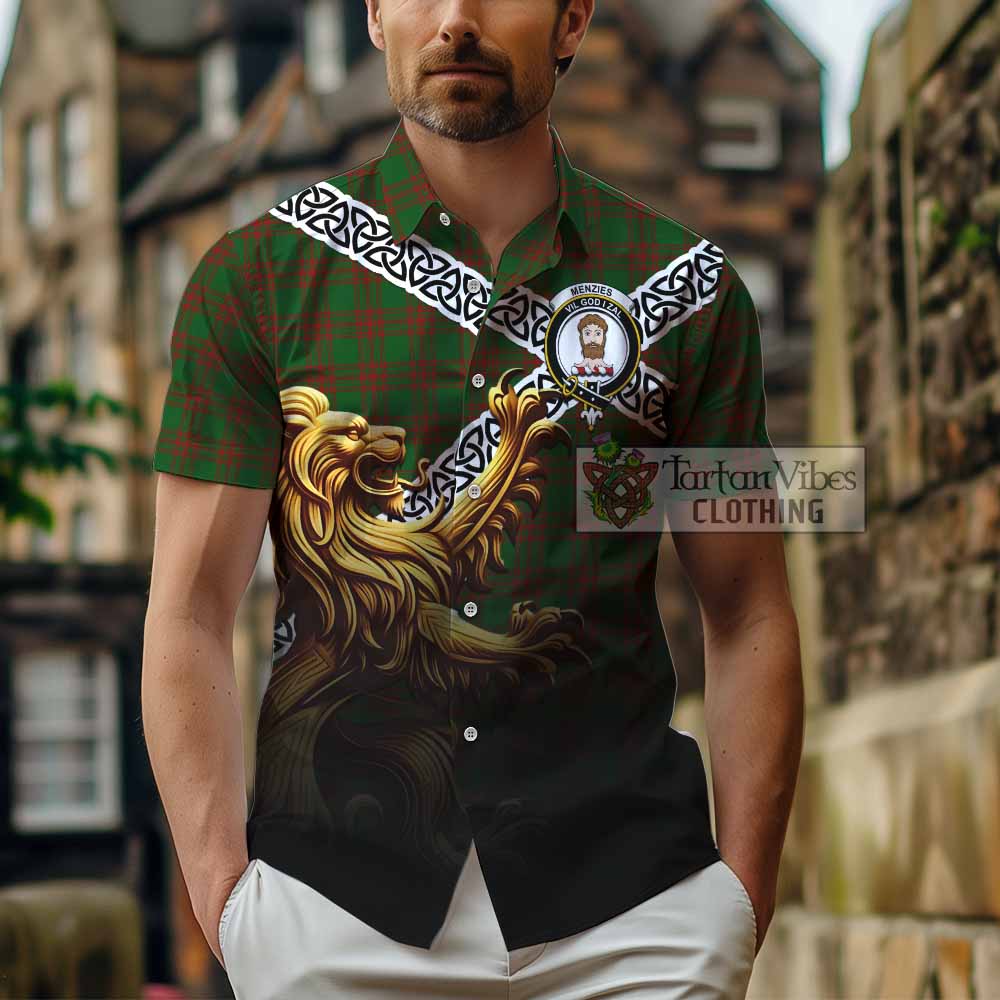
Clan Menzies Tartan reflects centuries of Highland heritage and symbolism tied to the Perthshire-based Menzies family. The clan officially recognizes four principal tartans: Modern Hunting, Ancient Hunting, Full Dress, and Mourning.


The Modern Hunting pattern features a rich green background with vivid red checks inspired by the mountain ash tree, the clan’s plant badge. A lighter version known as Ancient Hunting uses softer tones evocative of traditional plant‑dye hues. Full Dress tartan presents striking red and white stripes believed to date back to early clan registries, matching the colours of the clan shield and heather flower petals. The Mourning tartan employs black and white checks reflecting a historical border‑region variant tied to funerary attire or shawls.


Beyond these main tartans, authoritative records note up to seven or more associated patterns and variants, such as weathered, navy, blue, or purple versions, often reflecting ancient or modern dyeing approaches.
VIII. Where Can I Buy a Clan Menzies Tartan Product?
The Clan Menzies tartan is a proud expression of Scottish heritage, recognized for its timeless color palette and rich clan history. If you are searching for authentic and beautifully crafted Menzies tartan items, Tartan Vibes Clothing is the perfect place to begin. Our store offers a carefully curated selection of Clan Menzies products, including polo shirts, hoodies, dresses, throw blankets, tote bags, pillow covers, and more. Each piece is designed with care to reflect the legacy of Clan Menzies while offering comfort and style for everyday life.
Explore our collection and bring the spirit of Clan Menzies into your wardrobe and home with pride.


Frequently Asked Questions
What is the origin of the Menzies surname?
The Clan Menzie name comes from the Norman "de Meyners," tracing back to Mesnières in Normandy. It entered Scotland via England during the 12th century.
Who was the first recorded chief of Clan Menzies?
Sir Robert de Meyneris, who became Chamberlain of Scotland under King Alexander II in 1249, is recognized as the first documented chief.
What is the Clan Menzies motto, and what does it mean?
The clan motto is "Vil God I Zal," which translates to "With God I shall," symbolizing divine guidance and determination.
What tartans are associated with Clan Menzies?
Clan Menzies officially recognizes four tartans: Modern Hunting, Ancient Hunting, Full Dress, and Mourning—each symbolizing different aspects of the clan’s identity.
Where can I buy authentic Menzies tartan products?
Tartan Vibes Clothing offers a curated collection of Clan Menzies tartan items, including apparel, accessories, and home décor, designed to honor your heritage.

Aimee Li
An author dedicated to exploring the rich history, vibrant culture,... of the Scottish clans. As an avid historian and fashion enthusiast, I have always been fascinated by Scotland's heritage and the timeless elegance of its traditional attire. Join me on this journey through the highlands and lowlands, as we delve into the heart of Scottish legacy together.


