



Exploring Clan Duncan: Historical Roots, Power and Legacy
by Aimee Li on Jun 18, 2025
Table of Content
Clan Duncan stands out as one of Scotland's remarkable families, blending ancient heritage with a spirit of resilience and unity. Throughout the centuries, the Clan Duncans have made their mark through proud traditions, iconic symbols, and contributions that echo across Scottish history. In this article, you'll explore the origins of Clan Duncan, discover the meaning behind their tartan and crest, and meet the figures and places that have shaped their enduring legacy. The journey of this clan offers a deeper look into Scotland's rich cultural tapestry and the timeless values that define its people.
I. Who Are Clan Duncan?
Clan Duncan is a historic Scottish family whose roots trace back to the Gaelic name “Donnchadh,” meaning “brown warrior” or “dark-skinned chief.” As you learn more about the Scottish Clan Duncan, you’ll notice its story is woven throughout Scottish history. While Clan Duncan does not have a single ancestral territory or an officially recognized chief, its members have long been associated with regions such as Angus, Perthshire, and Fife. These areas remain significant for many descendants, especially those who identify with the proud tradition of the Scottish Highlands Duncan family.

The clan’s heritage is linked to early Scottish royalty, including King Duncan I, famously depicted in Shakespeare’s “Macbeth.” Known for their resilience and adaptability, clan Duncans have contributed to Scottish society as farmers, soldiers, and scholars. Today, Clan Duncan descendants celebrate their legacy with a distinct tartan and the proud motto “Disce pati”—meaning “Learn to endure”—honoring centuries of tradition and Scottish spirit.
Branches of Clan Duncan
Throughout history, several notable branches of Clan Duncan in Scotland have emerged, each representing unique lineages, ancestral estates, and lasting contributions to Scottish society. As you explore the diversity and heritage of the Duncan family clan, you’ll see how these main branches highlight the widespread influence of the Duncan name across different regions of Scotland.
1. Duncan of Seaside & Lundie (Camperdown)
This distinguished branch stands out in the story of the Duncan clan of Scotland, most famous for Admiral Adam Duncan, 1st Viscount Duncan of Camperdown, who led the British fleet to victory at the Battle of Camperdown in 1797. The family seat was at Lundie, near Dundee, and later at Camperdown House, reflecting the family’s prestige and their impressive naval legacy.
2. Duncan of Jordanstone
Based in Perthshire, the Duncans of Jordanstone were influential landowners and played a significant role in local governance. Their estate, Jordanstone, is a fine example of the heritage upheld by Clan Duncan Perthshire, becoming well known for its ties to agriculture and support of the local parish community.
3. Duncan of Ardownie
Duncan of Ardownie is a documented territorial branch of Clan Duncan, located in Angus. However, historical records regarding this branch remain scarce.
4. Duncan of Sketraw
Duncan of Sketraw is a recognized territorial branch of Clan Duncan from Aberdeenshire. The family has historical ties to the northeast of Scotland, where it maintained a local presence across several generations.
5. Duncan of Mott
Duncan of Mott is recognized as one of the territorial branches of Clan Duncan in the Scottish Lowlands. However, historical records regarding this branch remain scarce.
6. Duncan of Parkhill
Duncan of Parkhill refers to a branch of the Duncan family in Angus. According to Canmore, Parkhill House was built in 1804 by Alexander Duncan. It served as the family residence and remained in Duncan's ownership into the 20th century. Valuation rolls from 1842 and 1902 list John Duncan of Parkhill among the principal landowners in the parish of St Vigeans, now part of Arbroath.
7. Beveridge-Duncan of Damside
Beveridge-Duncan of Damside is a branch of Clan Duncan based in Damside, Fife. The name refers to James Beveridge, a descendant of the Duncan family, who adopted the surname Beveridge-Duncan upon inheriting the estate through a will.
8. Gomme-Duncan of Dunbarney
Gomme-Duncan of Dunbarney was a branch of Clan Duncan based at Dunbarney House in Perthshire, Scotland. The family name was adopted by Alan Gomme-Duncan in 1938. They owned Dunbarney House until 1989 and were prominent local landowners.
II. Where Did the Last Name Duncan Come From?
The Duncan surname origin traces back to Anglo-Scottish heritage. It originates from the Gaelic moniker "Donnchad," a name dating back to the 7th century. This name is linked to "Donncatus," an ancient Celtic personal name. The name's foundations lie in "donn," signifying brown, and the element "cath," referring to a warrior.
Remarkable evidence of the name appears on the 4th-century Turpillian Stone in Wales; inscribed in Ogham (an early form of Celtic writing), the stone also carried the Latin translation “TURPILLI IC IACIT PUUERI TRILUNI DUNOCATI”, which roughly translates as The Fort Warrior.

Notable Early Appearances (Chronological Highlights)
- 717: Abbot Dunchad of Iona passed away.
- 965: Dunchad, Abbot of Dunkeld, died in the Battle of Dorsum Crup, Perthshire.
- 1040: King Duncan I of Scotland was murdered by Macbeth — a key event later immortalized by Shakespeare.
- 1094: King Duncan II of Scotland was assassinated.
- 1275: Hugh Dunkan appears in the Hundred Rolls of Lincolnshire, England — considered the earliest recorded spelling of the surname.
- 1280: Ralf Donekan is documented in Somerset.
- 1332: William Donekyn is recorded in Sussex.
- 1367: John Dunkan, a landowner, is noted in Berwick-on-Tweed.
- 1842: John Duncan, a notable African explorer, took part in the Niger expedition as master-at-arms aboard HMS Albert.
The widespread use of the clan Duncan surname was further solidified when governments introduced personal taxation systems, such as the Poll Tax in England, which required fixed surnames for administrative purposes.
III. The History of Clan Duncan in Scotland
For anyone exploring the history of Clan Duncan, it’s important to note that historical documentation from this early period is quite limited. However, the broader appearance of the Duncan name across Scotland only became evident after Kenneth MacAlpin united the Celtic Scots of Dalriada with the native Pictish people around 843 AD.
One of the earliest known mentions of “Dunchad” or “Donchad” can be found in the margins of the 11th-century Book of Deer—a collection of manuscripts written in Scots Gaelic by early Christian monks at the Abbey of Deer in Aberdeenshire. This ancient text stands as one of the oldest surviving examples of Gaelic writing in Scotland and is a real treasure if you love learning about famous Scottish clans and their stories.
By the 11th century, Duncan I ascended to the Scottish throne, setting the stage for the legendary tales later immortalized by Shakespeare. Over time, the Clan Duncans established themselves as prominent landowners and leaders across regions such as Aberdeenshire, Angus, and Fife. Linked to the broader Clan Donnachaidh (Robertson) through shared ancestry, the Duncans developed their own identity, most notably through prominent families such as the Duncans of Lundie in Forfarshire, whose legacy includes naval hero Admiral Adam Duncan, 1st Viscount Camperdown. Today, the name Duncan remains a proud symbol of ancient Scottish heritage and resilience.
IV. Clan Duncan Crest and Coat of Arms
The crest and coat of arms of Clan Duncan are powerful symbols of the clan’s heritage, reflecting centuries of tradition, honor, and the unique identity of the Duncan family in Scottish history. If you’ve ever wondered about the Duncan family crest's meaning, you’ll find that these emblems hold deep significance for every descendant.
Clan Duncan Crest
The Clan Duncan Crest features a traditional Scottish galley, or lymphad, sailing on silver waves with gold accents, white sails, and red flags, representing the clan’s maritime heritage and resilience. Encircled by a black and gold belt, the crest proudly displays the Duncan clan motto “Disce pati” (“Learn to Endure”).
Clan Duncan
Gaelic Name: Mac Dhonnchaidh
Crest: On waves of the sea, Argent, a lymphad proper under sail, Or, flagged, Gules, the sail charged with a clarion, Gules
Motto: Savour The Moment
Lands: Lundie, Gourdie, Dunbarney, Ardownie, Sketraw

As you learn more about this symbol, you’ll realize that the Duncan clan motto isn’t just a phrase—it captures the family’s enduring spirit and their proud Scottish identity. This powerful motto emphasizes the importance of perseverance and strength in the face of adversity, serving as a lasting reminder of the Clan Duncan's determination to overcome challenges throughout their history.
Clan Duncan Coat of Arms
The Duncan family coat of arms is a vibrant and symbolic heraldic shield that reflects the clan’s proud lineage and values. The shield features a bold red background, representing courage and strength. Prominently displayed across the center is a gold chevron adorned with three blue buckles, symbolizing loyalty, protection, and steadfastness. Above the chevron are five silver quatrefoils, which are traditional emblems of hope and prosperity. The shield is topped with a knight’s helmet and framed by intricate gold and red mantling, further emphasizing nobility and honor.

Altogether, the Duncan coat of arms embodies the family’s enduring spirit, commitment to their heritage, and the core virtues that have defined Clan Duncan for centuries.
V. Clan Duncan Tartan
The Duncan clan tartan is a classic Scottish pattern that beautifully reflects the clan’s heritage and identity. Although the designer remains unknown, the Duncan tartan pattern is believed to have originated before 1880. It is sometimes referred to as the “Leslie of Wardis” tartan due to its strong resemblance to the Leslie Hunting tartan. This deep connection with the Leslie family, particularly those of Wardis in Aberdeenshire, remains a mystery but has become an enduring part of the Duncan story.


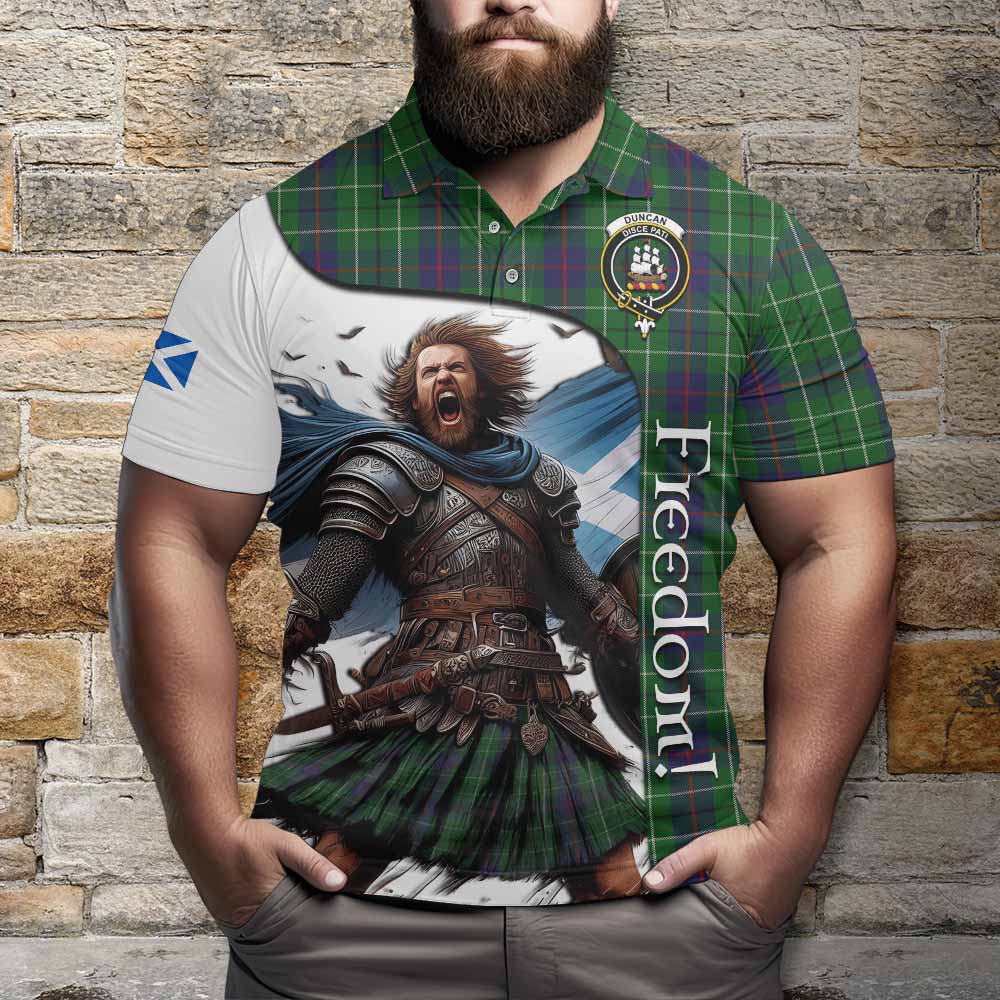
Traditionally, Duncan tartan colors feature a striking combination of green, blue, black, and fine red lines, as seen in both the Modern and Ancient versions of the design. The vibrant green and blue create a bold yet harmonious background, while thin red and white stripes add visual interest and contrast, making this tartan easily recognizable. In addition to the main sett, a unique Duncan of Sketraw tartan was designed in 2005 by Brian Wilton of the Scottish Tartans Authority, offering a contemporary twist on the clan’s iconic pattern. Today, if you’re a proud descendant, wearing the Duncan tartan is a meaningful way to honor your roots, symbolizing both your Duncan Scottish heritage and the enduring legacy of Clan Duncan.
VI. Where Can I Buy Clan Duncan Tartan Products?
If you're seeking high-quality Clan Duncan tartan products, Tartan Vibes Clothing offers a diverse selection of items that celebrate Scottish heritage. Their collection includes apparel, home décor, and accessories, all featuring authentic Duncan tartan patterns. Explore our full collection of Duncan tartan products at Tartan Vibes Clothing and embrace your Scottish heritage with pride!



Frequently Asked Questions
What is the origin of Clan Duncan in Scotland?
Clan Duncan traces its origins to the Gaelic name “Donnchadh,” meaning “brown warrior,” with roots dating back to early Celtic migrations from Ireland to Scotland in the 4th century AD.
What does the Clan Duncan crest symbolize?
The Clan Duncan crest features a traditional Scottish galley and the motto “Disce Pati,” representing resilience, maritime heritage, and the enduring spirit of the family.
What are the main branches of Clan Duncan?
Notable branches include Duncan of Seaside & Lundie (Camperdown), Duncan of Jordanstone, Duncan of Ardownie, Duncan of Sketraw, Duncan of Mott, Duncan of Parkhill, Beveridge-Duncan of Damside, and Gomme-Duncan of Dunbarney.
What does the Clan Duncan tartan look like?
The Duncan tartan features a combination of green, blue, black, and fine red lines. It is sometimes referred to as the Leslie of Wardis tartan due to historical connections with the Leslie family.

Aimee Li
An author dedicated to exploring the rich history, vibrant culture,... of the Scottish clans. As an avid historian and fashion enthusiast, I have always been fascinated by Scotland's heritage and the timeless elegance of its traditional attire. Join me on this journey through the highlands and lowlands, as we delve into the heart of Scottish legacy together.


