



Clan MacLeod History: From Norse Roots to Scottish Legacy
by Aimee Li on Mar 31, 2026
Table of Content
Clan MacLeod isn’t just another Scottish clan—it’s one of the few with roots that may reach back to the Vikings. Rooted in the Norse-Gaelic world of the Hebrides, Clan MacLeod traces its origins to Leod (Leòd), traditionally linked to Olaf the Black, King of Mann and the Isles. This blend of Norse and Gaelic heritage shaped a clan that would rise to power across Skye, Harris, and Lewis, anchored by the enduring stronghold of Dunvegan Castle.
Through centuries of conflict, political change, and the upheaval of the Highland Clearances, the MacLeods did more than survive—they adapted. Today, their legacy extends far beyond Scotland, united by history, heritage, and a simple, enduring motto: “Hold Fast.”
I. The Origins of Clan MacLeod: Norse-Gaelic Beginnings
The origins of Clan MacLeod are inseparable from the unique cultural landscape of the western Isles—a region shaped by both Norse expansion and Gaelic tradition, and deeply tied to the Norse-Gaelic roots of the MacLeods.
1. The World of the Hebrides in the Age of Norse Rule
Between the 9th and 13th centuries, the Hebrides and surrounding seas formed part of a hybrid political and cultural zone shaped by Norse expansion. The Kingdom of Mann and the Isles, ruled by figures like Olaf the Black, controlled key maritime routes across the Sea of the Hebrides, linking Scotland, Ireland, and Scandinavia.

Over generations, Norse settlers intermarried with local Gaelic populations, creating what historians now describe as a Norse-Gaelic society—a fusion visible in language, naming traditions, and systems of power. It’s within this world, closely tied to the Isle of Skye clan origins, that Clan MacLeod emerged.
Unlike many mainland Scottish clans that developed within a feudal framework tied to the Crown, the MacLeods grew out of a seafaring, island-based culture, where control of territory depended as much on ships and alliances as on land. This distinction helps explain why their identity—and their origin story—feel different from those of other clans.
2. Leod, Son of Olaf the Black? Tradition, Genealogy, and Debate
At the center of Clan MacLeod’s origin is Leod (Leòd), the figure linked to the Viking ancestry MacLeod, and from whom the clan takes its name—MacLeod meaning “son of Leod.” According to long-standing clan tradition, Leod was a son (or possibly a grandson) of Olaf the Black, linking the clan to Norse royal lineage. This claim has been preserved through oral tradition, medieval genealogies, and later clan histories, reinforcing the idea of a Viking-rooted ancestry.
However, modern research paints a more nuanced picture. Recent genetic genealogy studies—particularly those examining Y-DNA haplogroup R1b among MacLeod descendants—suggest a broader North Atlantic lineage, rather than a purely Norse one. This doesn’t disprove the Norse connection; instead, it supports the idea that the clan emerged from a mixed Norse-Gaelic elite, where identity was shaped as much by culture and power as by bloodline.

3. From Personal Ancestor to Clan Identity
Whether historical figure or semi-legendary ancestor, Leod represents more than a name—he marks the beginning of a structured kinship group that would evolve into a powerful Highland clan. Over time, his descendants divided into two major lines:
Siol Thormoid (Seed of Tormod)
Siol Thorcaill (Seed of Torquil)
These lineages would later become the foundations of the two great branches of Clan MacLeod—those of Harris (and Dunvegan) and Lewis. This transition—from a single ancestor to a multi-branch clan—was a critical step. It allowed the MacLeods to expand their influence across multiple territories, consolidate power, and adapt to the shifting political landscape of the Isles.
II. Clan MacLeod History by Century
Clan MacLeod’s history spans several centuries, shaped by shifting power, conflict, and cultural change, including notable Highland clan conflicts. From its medieval origins in the Hebrides to its role in national events, the clan evolved in response to both internal dynamics and wider historical forces.
1. 14th Century: Growth and Early Conflicts
Tormod, Leod's son, is not found in contemporary records, but 19th-century tradition notes that he was a significant soldier at the Battle of Bannockburn. His son Malcolm is the first documented clan member in a royal charter from around 1343, identified alongside Torquil. Malcolm succeeded Tormod and was followed by his son Iain Ciar, who is described in tradition as a harsh leader, with a similarly cruel wife. He was reportedly ambushed in Harris and died from his injuries at Rodel, with his death dated to 1392.

In 1395, Iain's grandson, William MacLeod, confronted the Lord of the Isles' forces at Sligachan, forcing them back to Loch Eynort, where the invaders were killed after their galleys were moved by the MacAskills. The spoils were shared at Creag an Fheannaidh or Creggan ni feavigh, sometimes linked to the Bloody Stone—one of the earliest recorded Clan MacLeod battles.
2. 15th Century: Clan Feuds and Alliances
The 15th century was marked by intense inter-clan rivalries, particularly with Clan MacDonald, forming part of the wider Scottish clan feuds in the Highlands. Clan MacLeod played a role in major regional conflicts, including:

- Battle of Harlaw (1411) – where MacLeods fought as part of the Highland forces supporting Domhnall of Islay, Lord of the Isles
Battle of Bloody Bay (1481) – in which the MacLeod chief was killed during an internal conflict within Clan Donald
These events illustrate how Clan MacLeod’s fortunes were closely tied to shifting alliances and the ongoing MacLeod clan wars within the Lordship of the Isles.
3. 16th Century: Cultural Flourishing
The 16th century saw both consolidation and continued conflict. Influential chiefs such as:
Alasdair Crotach MacLeod
Ruairidh Mòr (Roderick MacLeod)
helped strengthen the clan’s authority and reputation.
While this period is sometimes portrayed as culturally rich—with developments at Dunvegan Castle, including the Fairy Tower—it was not a time of sustained peace. Instead, Clan MacLeod remained deeply involved in ongoing MacLeod vs MacDonald conflicts, reflecting the volatile political landscape of the Hebrides. Cultural traditions such as Gaelic poetry, music, and oral storytelling likely flourished, but these coexisted with frequent warfare and instability.
4. 17th Century: Peace and Civil War
The early 17th century marked a turning point in Highland clan warfare. The Battle of Coire na Creiche (1601)—fought on the Isle of Skye—was the culmination of a long-standing feud between Clan MacLeod and Clan MacDonald of Sleat. The MacLeods were defeated, and the battle is often considered the last major clan battle on Skye.

Following decades of conflict, the Scottish Crown increasingly intervened in Highland affairs, imposing greater political control over the region. Later in the century, Clan MacLeod became involved in the Wars of the Three Kingdoms (Civil War period):
Many MacLeods supported the Royalist cause
Around 500 clan members fought at the Battle of Worcester (1651)

5. 18th Century: Jacobite Risings and Aftermath
The 18th century brought significant political upheaval during the Jacobite Risings. In 1715, Clan MacLeod supported the Jacobite cause. However, during the 1745 Rising, the clan was divided:

- The chief of Dunvegan supported the British Government
A branch (MacLeods of Raasay) supported the Jacobites and fought at Culloden (1746)
This division reflects the broader fragmentation of Highland loyalties during this period. The aftermath of the Jacobite defeat accelerated the decline of the traditional clan system and increased state control over the Highlands.
6. 19th and 20th Centuries: Modernization and Preservation
During the 19th century, Clan MacLeod—like other Highland clans—underwent a transition from a traditional kinship-based system to a more modern estate structure. Despite social and economic changes, including the wider impact of the Highland Clearances, the clan identity persisted.
Members of Clan MacLeod served in various military roles, including during the World Wars, reflecting continued loyalty and martial tradition. In the late 19th and 20th centuries, there was a revival of clan heritage:
- Formation of Clan MacLeod Societies
Preservation of historical sites such as Dunvegan Castle

7. 21st Century: Contemporary Clan MacLeod
Today, Clan MacLeod remains an active global community. The current chief, Hugh Magnus MacLeod (30th Chief), continues the Dunvegan Castle lineage. Modern clan activities include:
International gatherings and clan events
Cultural preservation of Gaelic traditions
Maintenance of historic landmarks
Clan MacLeod today represents a blend of historical legacy and global cultural identity, connecting members worldwide through shared ancestry.
III. Power, Lands, and Structure of Clan MacLeod
As Clan MacLeod expanded across the Hebrides, its strength came not only from lineage but from a carefully balanced system of territory, kinship, and leadership rooted in the wider network of Scottish island clans. This structure allowed the clan to control key regions, maintain internal cohesion, and adapt to the shifting political landscape of the Isles.
1. The Two Branches of Clan MacLeod: Harris and Lewis
The internal structure of Clan MacLeod was defined early by its division into two major lineages:
Siol Thormoid (the line of Tormod) → associated with Harris and Dunvegan
Siol Thorcaill (the line associated with Torquil, a later descendant of Leod) → associated with Lewis
This division was not simply genealogical—it shaped how power was distributed across the clan’s territories. The MacLeods of Harris and Dunvegan established their base on the Isle of Skye, forming the core of the Isle of Skye MacLeod territory, with Dunvegan Castle as their seat. Over time, this branch developed greater political stability and continuity, eventually becoming the dominant line that carried the clan identity into the modern era.

In contrast, the MacLeods of Lewis controlled extensive lands across the Isle of Lewis, including Stornoway, and at times rivaled the Harris line in influence. However, internal conflicts and external pressures weakened their position, leading to their decline in the early 17th century. Together, these two branches illustrate how a single ancestral line could evolve into distinct centers of power—each shaping the broader history of Clan MacLeod in different ways.
This table compares the two main branches of Clan MacLeod, highlighting their differences in territory, leadership, and historical development.
Aspect |
MacLeods of Harris & Dunvegan (Siol Thormoid) |
MacLeods of Lewis (Siol Thorcaill) |
Primary Territories |
Isle of Skye, Isle of Harris |
Isle of Lewis, Stornoway |
Political Stability |
Relatively stable leadership across generations |
Frequent internal disputes and succession conflicts |
Seat of Power |
Dunvegan Castle (continuous stronghold) |
Various seats, less centralized over time |
Historical Trajectory |
Gradual consolidation and adaptation |
Periods of strength followed by decline |
Turning Point |
Maintained influence after the fall of the Lordship of the Isles |
Lost lands in the early 17th century |
Modern Legacy |
Surviving chiefly through the present day |
Line fragmented, no continuous chiefship |
2. Strategic Lands: Skye, Harris, and Lewis
Clan MacLeod’s authority was deeply tied to its control of strategically important territories in the Hebrides—key parts of the broader MacLeod lands in Scotland. These included:
Isle of Skye → political and symbolic center of the clan
Isle of Harris → resource-rich extension of MacLeod influence
Isle of Lewis → major territorial stronghold, particularly under the Lewis branch

Positioned along the Sea of the Hebrides, these lands were not isolated—they were part of an active maritime network connecting Scotland, Ireland, and the wider Norse-Gaelic world. Control over these territories allowed Clan MacLeod to:
dominate key sea routes
access to vital resources such as fishing and land
defend against rival clans
This geographic advantage was a defining factor in the clan’s rise to regional power.
3. Clan Leadership and the Structure of Power
At the center of Clan MacLeod’s system was the clan chief, based at Dunvegan for the Harris line. However, authority within the clan was not purely hierarchical. It was built on a network of kinship ties, alliances, and mutual obligations, where leadership depended as much on loyalty as on title. The chief’s role included:
maintaining alliances within and beyond the clan
organizing defense and military response
managing land distribution among followers
Unlike the more rigid feudal structures developing in mainland Scotland, Clan MacLeod operated within a flexible, negotiated system of power. The Chiefs had to constantly balance:
internal clan relationships
rivalries with neighboring clans
shifting political dynamics tied to entities like the Lordship of the Isles
IV. Dunvegan Castle and the Continuity of Clan MacLeod Power
Unlike many Highland clans whose power rose and fell with shifting politics, Clan MacLeod maintained an unusual degree of continuity. Central to that continuity was Dunvegan Castle—not just a residence, but the foundation of MacLeod authority for over eight centuries, closely tied to Dunvegan Castle's history.
1. The Strategic Role of Dunvegan in Clan MacLeod History
Established on the Isle of Skye, Dunvegan Castle—one of the most iconic MacLeod castles in Scotland—gave Clan MacLeod a critical advantage: control over key maritime routes across the Sea of the Hebrides. From this position, the MacLeod chiefs could:
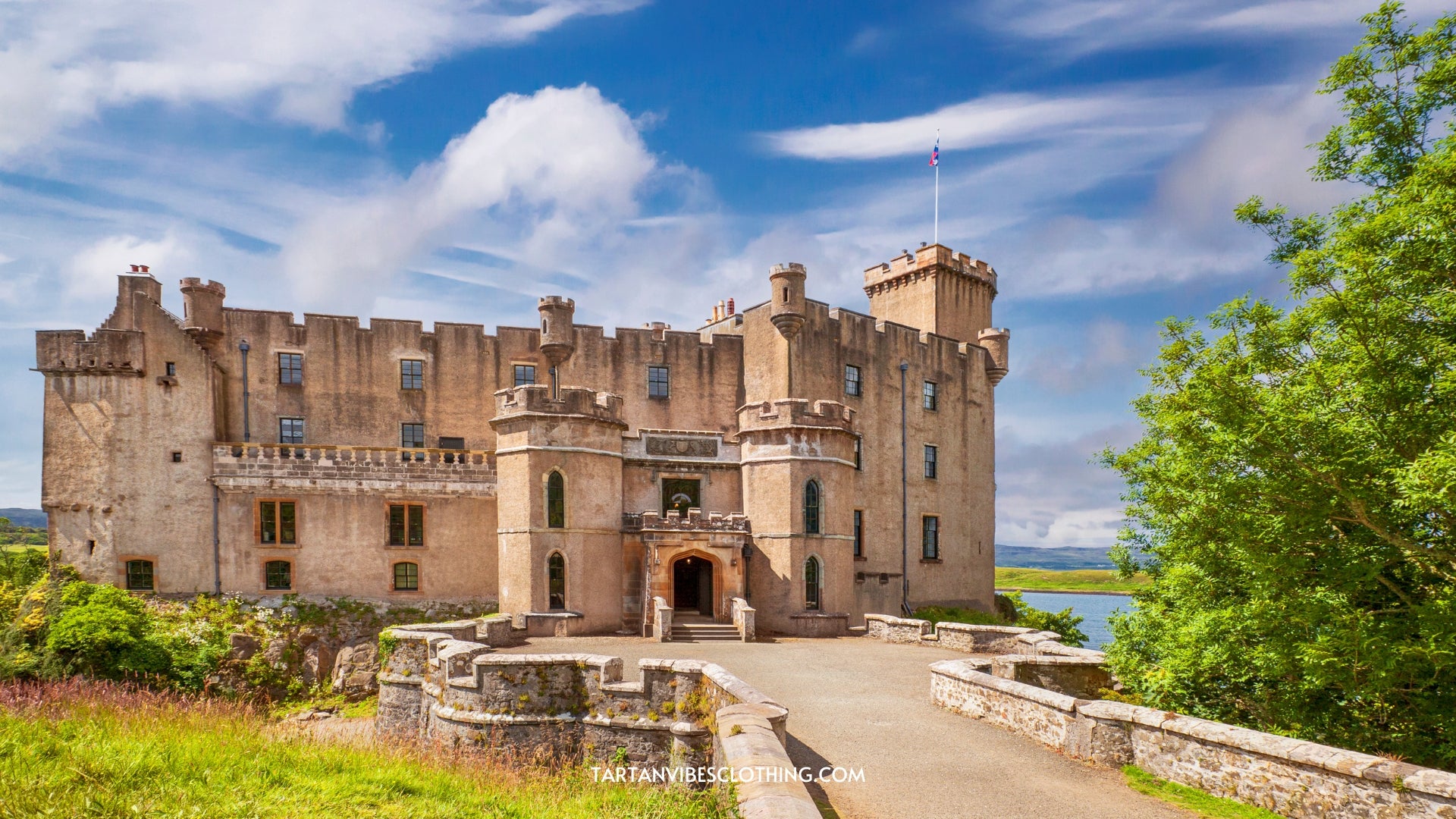
- Monitor movement between Scotland and the Isles
defend against rival clans
reinforce their territorial claims
This strategic placement allowed the MacLeods of Harris and Dunvegan to consolidate power beyond land—into the sea-based networks that defined the region, strengthening their position among key MacLeod strongholds.
2. Continuity of Leadership and Authority
More importantly, Dunvegan provided something rare in Highland history: an unbroken seat of leadership. While many clans lost their strongholds due to warfare, political pressure, or confiscation, Clan MacLeod retained Dunvegan through major transitions—including the decline of the Lordship of the Isles and the increasing control of the Scottish Crown. This continuity reinforced the legitimacy of the MacLeod chiefs. It allowed leadership to pass across generations without the disruptions that weakened other clans, helping preserve both authority and identity over time.
3. Relics, Symbolism, and the Preservation of Clan Identity
Dunvegan also played a key role in preserving the symbolic identity of Clan MacLeod. Artifacts such as the Fairy Flag (Am Bratach Sith), the Dunvegan Cup, and Sir Rory Mor’s Horn were not merely ceremonial—they reinforced the clan’s sense of heritage and continuity. Modern research has added further depth to this legacy.
Some analyses have suggested that the Fairy Flag may be connected to Mediterranean textiles, possibly originating in regions such as Rhodes or Syria, indicating that Clan MacLeod’s history may have been shaped by wider cultural exchanges than previously assumed.

V. The MacLeod Diaspora and Global Legacy
The transformation of Clan MacLeod from a regional Highland power to a global community was not a sudden shift—but the result of displacement, adaptation, and continuity across generations.
1. From the Highland Clearances to Global Migration
The roots of the MacLeod diaspora lie in the Highland Clearances of the 18th and 19th centuries. As economic pressures reshaped land use across the Highlands, many tenants on MacLeod lands in Skye and Harris were forced to leave. What had once been a kin-based society tied to land and loyalty began to fragment, pushing families to seek new opportunities abroad. Large numbers of MacLeod descendants emigrated to:

- North America (Canada and the United States)
Australia and New Zealand
other parts of the British Empire
This movement marked a profound transition—from a geographically rooted clan to a diaspora spread across continents.
2. Clan MacLeod in the 21st Century
Today, Clan MacLeod exists not as a territorial power, but as a living global heritage community. Cultural trends such as:
Ancestral tourism
The influence of historical media like Outlander
The revival of the Gaelic language and traditions
have further renewed interest in clan history.
Meanwhile, places like Dunvegan Castle remain central to this identity—serving as both a historical anchor and a destination for descendants reconnecting with their roots. In this modern context, Clan MacLeod continues to embody its enduring motto: “Hold Fast”—not to land alone, but to history, identity, and shared heritage across generations.
Explore the timeless traditions of the Clan MacLeod through our collection of tartan products on our website. And bring a piece of the clan's history into your present.


Conclusion: Holding Fast in the Modern Age
The history of Clan MacLeod is defined not just by its Norse-Gaelic origins or its power in the Hebrides, but by its ability to endure. From Leod to Dunvegan Castle, through conflict, division, and diaspora, the clan has continuously adapted while preserving its identity. Today, that legacy lives on not in territory, but in a global community connected by shared heritage. In that sense, the MacLeod motto still holds true: “Hold Fast.”
Frequently Asked Questions
Where did the McLeod clan come from?
The MacLeod clan comes from the western part of Scotland, particularly from the Isle of Skye.
What is Clan MacLeod known for?
Clan MacLeod is best known for its long association with Dunvegan Castle, the oldest continuously inhabited castle in Scotland, and for its rich heritage, including the Fairy Flag, clan tartans, and the motto “Hold Fast.”
What are the two branches of Clan MacLeod?
The clan split into two main branches:
MacLeods of Harris and Dunvegan (Siol Thormoid)
MacLeods of Lewis (Siol Thorcaill)
These branches had different historical paths, with the Harris line continuing to the present day.
How did the Jacobite Risings affect Clan MacLeod?
The Jacobite Risings brought major political changes to Scotland, weakening traditional clan structures and increasing British state control, which affected Clan MacLeod’s authority and way of life.
Why is Dunvegan Castle important in Clan MacLeod history?
Dunvegan Castle has served as the seat of Clan MacLeod chiefs for over 800 years, making it a central symbol of the clan’s continuity and long-term survival.

Aimee Li
An author dedicated to exploring the rich history, vibrant culture,... of the Scottish clans. As an avid historian and fashion enthusiast, I have always been fascinated by Scotland's heritage and the timeless elegance of its traditional attire. Join me on this journey through the highlands and lowlands, as we delve into the heart of Scottish legacy together.


