

120 Celtic Surnames: Meanings, Origins and Regional History
by Aimee Li on Aug 05, 2026
Table of Content
Celtic surnames are family names associated with the Celtic nations of Ireland, Scotland, Wales, Brittany, and Cornwall. Many originated from ancestors' names, occupations, places, or personal traits, with well-known examples including Murphy, O'Brien, Kelly, MacDonald, and Campbell.
Whether you're researching your family history, exploring Celtic heritage, or simply curious about the meaning behind a surname, understanding how these names developed offers valuable insight into centuries of language, migration, and regional traditions. While many Celtic last names have Gaelic roots, others reflect Welsh, Cornish, Breton, or even Norman influences that became part of Celtic history over time.
This guide explores 120 Celtic surnames, their meanings, origins, and regional histories. You'll also learn about common surname prefixes, traditional naming practices, and the key differences between Irish, Scottish, Welsh, Breton, and Cornish surnames.
What Are Celtic Surnames?
Celtic surnames developed across the Celtic-speaking regions of Ireland, Scotland, Wales, Brittany, and Cornwall. Some are linguistically Celtic, while others became closely associated with these regions through centuries of migration, settlement, and cultural exchange.
Their origins commonly reflect ancestry, occupations, places, or personal characteristics, making them an important part of Celtic history and family identity.
Celtic vs Gaelic Surnames
The terms Celtic and Gaelic are closely related but not interchangeable.
Celtic surnames include family names from the Celtic nations of Ireland, Scotland, Wales, Brittany, and Cornwall. Gaelic surnames form a subset of this broader group, referring specifically to names derived from Irish Gaelic and Scottish Gaelic.
As a result, surnames such as O'Brien, Murphy, and MacGregor are Gaelic in origin, while Welsh, Breton, and Cornish surnames belong to other branches of the Celtic language family.
Are All Surnames From Celtic Regions Linguistically Celtic?
Not necessarily.
A surname commonly found in a Celtic region is not always Celtic in linguistic origin. Over centuries, Norman French, Old English, Norse, and other naming traditions became firmly established in Ireland, Scotland, and other Celtic regions.
For example, Fitzgerald is Norman in origin despite its long history in Ireland, while Stewart and Bell are strongly associated with Scotland without deriving from Gaelic.
Throughout this guide, surnames are grouped according to both their linguistic origins and their historical connections with Celtic communities, providing a broader view of how Celtic family names developed over time.
Celtic Surname Prefixes, Origins and Naming Traditions
Many Celtic surnames follow recognizable naming patterns that reveal a family's ancestry, occupation, homeland, or social identity. While these traditions vary across Ireland, Scotland, Wales, Brittany, and Cornwall, they share a common purpose: identifying a person's lineage or connection to a particular community.
Understanding these prefixes and naming conventions makes it easier to interpret the meaning behind a Celtic surname and recognize how family names evolved.
Mac, Mc, Ó, O', Nic and Ní
Some of the most recognizable Celtic surnames begin with traditional Gaelic prefixes that indicate family relationships. Although many remain in use today, their meanings originated in early Irish and Scottish naming traditions.
Prefix |
Meaning |
Commonly Used In |
Example |
Mac / Mc |
Son of |
Irish & Scottish Gaelic |
MacDonald, McCarthy |
Ó / O' |
Descendant of |
Irish Gaelic |
O'Brien, O'Neill |
Nic |
Daughter of the son of |
Scottish Gaelic |
Nic Dhòmhnaill |
Ní |
Daughter of the descendant of |
Irish Gaelic |
Ní Bhriain |

Mac and Mc
Ó and O'
Nic and Ní
Unlike Mac and Ó, the prefixes Nic and Ní are feminine forms used in traditional Gaelic naming conventions.
Nic is the Scottish Gaelic equivalent, meaning "daughter of the son of."
Ní is the Irish Gaelic equivalent, meaning "daughter of the descendant of."
Although these forms remain part of modern Gaelic usage, they appear less frequently in English-language records than Mac, Mc, or O'.
Welsh ap/ab and Cornish Tre-, Pen- and Pol-
Welsh ap and ab
In traditional Welsh naming, ap (or ab before vowels) means "son of." Over time, many of these combinations merged into single surnames through everyday usage.
Examples include:
ap Rhys → Price
ap Hywel → Powell
ap Richard → Pritchard
These historical changes explain why many modern Welsh surnames no longer visibly contain the original prefix.
Cornish Tre- , Pen- and Pol-
Cornish surnames often reflect the local landscape rather than family relationships.
Some of the most common Cornish place-name elements include:
Element |
General Meaning |
Example |
Tre- |
Farm, settlement, or homestead |
Trelawny, Tremayne |
Pen- |
Head, hill, or end of land |
Penrose, Penhale |
Pol- |
Pool, pond, or water feature |
Polglase, Polkinghorne |
These place-based elements highlight Cornwall's close connection to its geography and distinguish many Cornish surnames from Gaelic naming traditions.
Patronymic, Clan, Occupational and Place-Based Surnames
Celtic surnames developed in several different ways, reflecting how communities identified individuals before hereditary family names became firmly established.
Naming Type |
Description |
Examples |
Patronymic |
Derived from a father's or ancestor's name |
MacDonald, O'Brien, Davies |
Clan or Kinship |
Associated with a family group or clan |
MacGregor, Campbell, O'Neill |
Occupational |
Based on a trade or profession |
Smith, Stewart, Baxter |
Place-Based (Topographic) |
Derived from a landscape or place of origin |
Douglas, Penrose, Nancarrow |
Descriptive |
Based on a physical trait or personal characteristic |
Campbell ("crooked mouth"), Cameron ("crooked nose"), Lloyd ("gray") |
Most Celtic surnames fit into one of these categories, although some evolved through multiple influences as families migrated, languages changed, and spellings became Anglicized. For example, a surname may have originated as a Gaelic patronymic but later adopted an English spelling while remaining closely associated with a particular clan or region.
Surname origins can vary by family, region, and historical source. Where an etymology remains uncertain or multiple interpretations exist, this guide distinguishes traditional explanations from more widely accepted linguistic evidence while noting long-standing historical associations.
120 Celtic Surnames by Region and Meaning
Celtic surnames developed across several distinct regions, each with its own language, naming traditions, and historical influences. While Irish and Scottish surnames are often associated with Gaelic heritage, Welsh, Breton, and Cornish family names reflect other branches of the Celtic language family and preserve unique regional identities.
The following list groups 120 Celtic surnames by region, highlighting their meanings and historical origins. Keep in mind that some surnames are linguistically Celtic, while others became closely associated with Celtic communities through centuries of migration, cultural exchange, and local history.
Irish Celtic Surnames
Ireland was one of the earliest European regions to adopt hereditary surnames. Many Irish surnames derive from Irish Gaelic personal names and use prefixes such as Ó ("descendant of") and Mac ("son of"), while others reflect Norse, Old English, or Anglo-Norman influence. Although many spellings have been Anglicized over time, these surnames continue to preserve Ireland's rich linguistic and cultural heritage.
# |
Surname |
Origin & Meaning |
1 |
O'Brien |
From Ó Briain, meaning "descendant of Brian." The surname is historically associated with the dynasty of Brian Boru, one of medieval Ireland's best-known High Kings. |
2 |
MacCarthy |
From Mac Cárthaigh, meaning "son of Cárthach." The personal name Cárthach is generally interpreted as "loving" or "affectionate." |
3 |
O'Sullivan |
From Ó Súilleabháin, meaning "descendant of Súilleabhán." The personal name is traditionally interpreted as "dark-eyed" or "hawk-eyed," although its exact etymology remains uncertain. |
4 |
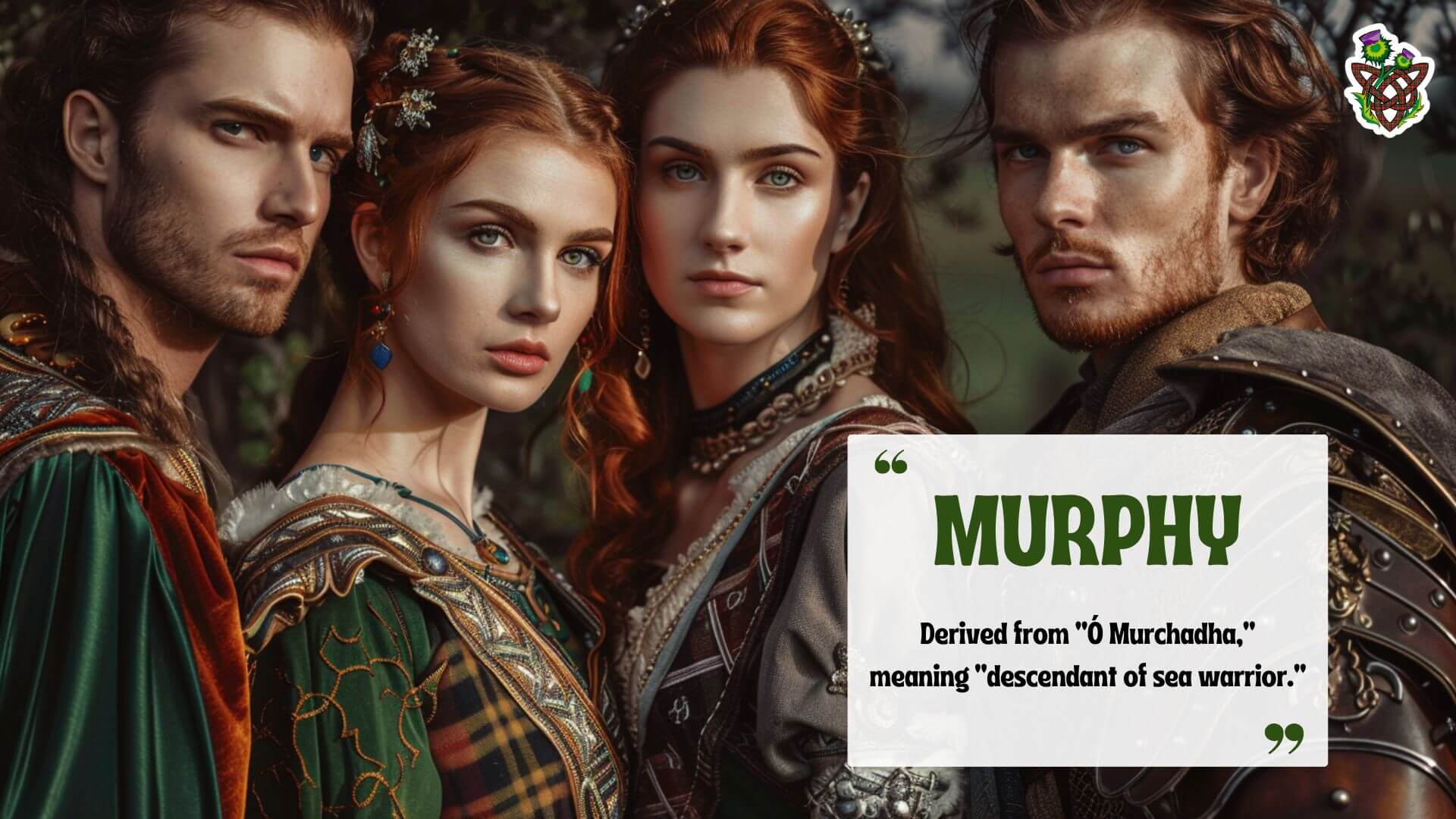
Murphy |
From Ó Murchadha, meaning "descendant of Murchadh." The personal name combines Gaelic elements meaning "sea" and "warrior." |
5 |
Kelly |
From Ó Ceallaigh, meaning "descendant of Ceallach." The exact meaning of Ceallach remains uncertain, although traditional interpretations include "bright-headed," "strife," and "war." |
6 |
Ryan |
From Ó Riain, meaning "descendant of Rian." The personal name Rian has an uncertain etymology, although "little king" is a well-known traditional interpretation. |
7 |
Walsh |
Derived from the Old English word wealh, meaning "Welshman" or "foreigner." It originally identified Welsh settlers who came to Ireland during the medieval period. |
8 |
Doyle |
From Ó Dubhghaill, meaning "descendant of Dubhghall." The personal name literally means "dark foreigner" and was historically associated with Norse settlers. |
9 |
Fitzgerald |
A Norman surname meaning "son of Gerald." Although it became one of Ireland's most prominent family names, its linguistic origin is Anglo-Norman rather than Gaelic. |
10 |
O'Connor |
From Ó Conchobhair, meaning "descendant of Conchobhar." The personal name is traditionally interpreted as "lover of hounds." |
11 |
Flynn |
From Ó Floinn, meaning "descendant of Flann." The personal name Flann means "ruddy" or "red-haired." |
12 |
Donovan |
From Ó Donnabháin, meaning "descendant of Donnabhán." The personal name is derived from donn, meaning "brown" or "dark," with a diminutive ending. |
13 |
Regan |
From Ó Riagáin, meaning "descendant of Riagán." The personal name is generally interpreted as "little ruler" and is related to the Gaelic word rí ("king"). |
14 |
O'Neill |
From Ó Néill, meaning "descendant of Niall." The personal name Niall has an uncertain etymology, with several traditional interpretations proposed by scholars. |
15 |
O'Carroll |
From Ó Cearbhaill, meaning "descendant of Cearbhall." The personal name is commonly interpreted as "fierce in battle" or "warlike." |
16 |
McMahon |
From Mac Mathghamhna, meaning "son of Mathghamhain." The personal name literally means "bear." |
17 |
Coughlan |
Usually from Ó Cochláin, and in some families Mac Cochláin, meaning "descendant" or "son of Cochlán." The personal name is thought to be related to the Gaelic word for a cloak or hood. |
18 |
McGee |
Usually derived from Mac Aodha, meaning "son of Aodh." The personal name Aodh means "fire," although several unrelated Gaelic surnames have also been Anglicized as McGee. |
19 |
O'Houlihan |
From Ó hUallacháin, meaning "descendant of Uallachán." The personal name derives from uallach, meaning "proud" or "arrogant." |
20 |
McManus |
From Mac Mághnais, meaning "son of Magnus." Magnus is an Old Norse personal name meaning "great." |
21 |
Scully |
From Ó Scolaidhe, meaning "descendant of Scolaidhe." The personal name is thought to relate to a scholar or student, although its exact origin remains uncertain. |
22 |
Kearney |
From Ó Catharnaigh, meaning "descendant of Catharnach." The personal name is derived from catharn, meaning "warrior." |
23 |
McGovern |
From Mag Samhradháin, meaning "son of Samhradhán." The personal name is derived from samhradh, meaning "summer." |
24 |
Colgan |
From Ó Colgáin, meaning "descendant of Colgán." The personal name comes from colg, meaning "sword" or "sharp." |
25 |
McKeogh |
From Mac Eochaidh, meaning "son of Eochaidh." The personal name derives from each, meaning "horse." |

Scottish Celtic Surnames
Scottish surnames reflect the country's diverse linguistic and historical heritage. Some derive from Scottish Gaelic personal names, while others originated through Norse, Anglo-Norman, Scots, English, or French influence. As a result, a surname may be closely associated with Scotland without being Gaelic in linguistic origin.

# |
Surname |
Origin & Meaning |
26 |
MacDonald |
From Mac Dhomhnaill, meaning "son of Dòmhnall." The personal name Dòmhnall is traditionally interpreted from Celtic elements associated with "world" and "rule" or "power." |
27 |
Campbell |
From the Scottish Gaelic Caimbeul, traditionally meaning "crooked mouth," from cam ("crooked") and beul ("mouth"). |
28 |
MacLeod |
From Mac Leòid, meaning "son of Leòd." The personal name Leòd is generally linked to the Old Norse name Ljótr, reflecting the Norse-Gaelic heritage of the clan. |
29 |
Fraser |
A surname of probable Norman origin that became firmly established in medieval Scotland. Its exact etymology remains uncertain, although a traditional connection with the French word for "strawberry" has long been suggested. |
30 |
MacKenzie |
From Mac Coinnich, meaning "son of Coinneach." The personal name Coinneach is commonly interpreted as "handsome," "fair," or "comely." |
31 |
Cameron |
From the Scottish Gaelic Camshròn, traditionally meaning "crooked nose." It likely began as a descriptive nickname before becoming a hereditary surname. |
32 |
Stewart |
An occupational surname meaning "steward" or estate manager. Although not Gaelic in origin, it became one of Scotland's most influential royal family names. |
33 |
Smith |
An occupational surname for a blacksmith or metalworker. Germanic in origin, it became one of the most widespread surnames in Scotland. |
34 |
MacFarlane |
From Mac Phàrlain, meaning "son of Parlan." Parlan is the Gaelic form of Bartholomew, from which the surname ultimately derives. |
35 |
MacIntyre |
From Mac an t-Saoir, meaning "son of the craftsman" or "son of the carpenter." It originated as an occupational surname. |
36 |
Robertson |
A patronymic surname meaning "son of Robert." The personal name Robert comes from Germanic elements meaning "bright fame" and is closely associated with Clan Donnachaidh in Scotland. |
37 |
Murray |
A territorial surname referring to the historic region of Moray in northeastern Scotland. The deeper meaning of the place-name remains uncertain. |
38 |
Clark |
An occupational surname derived from clerk, originally referring to a cleric, scholar, or literate official. It developed through Latin and Old English rather than Gaelic. |
39 |
MacGregor |
From Mac Griogair, meaning "son of Griogar." Griogar is the Gaelic form of Gregory, a name ultimately derived from Greek meaning "watchful" or "vigilant." |
40 |
Miller |
An occupational surname for someone who operated or worked in a grain mill. It became widespread throughout Scotland during the medieval period. |
41 |
Hamilton |
A territorial surname associated with the influential Hamilton family of Scotland. It originated from an English place-name, although its exact etymology remains debated. |
42 |
Martin |
Derived from the personal name Martin, from Latin Martinus, meaning "of Mars" or "belonging to Mars." The surname spread through Christian naming traditions. |
43 |
Ferguson |
A patronymic surname meaning "son of Fergus." The Gaelic personal name Fearghas is traditionally interpreted from elements meaning "man" and "strength" or "vigor." |
44 |
Marshall |
An occupational surname from Anglo-Norman French mareschal, originally referring to a person responsible for horses. The title later became associated with senior military and court offices. |
45 |
Bell |
A Scottish and English surname with multiple possible origins. It may derive from the medieval personal name Bell, from Old French bel ("fair" or "beautiful"), or from names associated with a bell or bell-related location. |
46 |
Wallace |
Derived from an Anglo-Norman term meaning "Welshman" or "Briton." Although its linguistic origin is not Gaelic, the surname is closely associated with Scotland through Sir William Wallace and his family. |
47 |
Duncan |
From the Gaelic personal name Donnchadh, traditionally interpreted from elements meaning "brown" and "warrior" or "battle." |
48 |
MacKay |
From Mac Aoidh, meaning "son of Aodh." The personal name Aodh means "fire," and the surname has long been associated with the northern Highlands of Scotland. |
49 |
Russell |
From the Old French diminutive Roussel, meaning "red-haired" or "ruddy." It likely began as a descriptive nickname before becoming hereditary. |
50 |
Douglas |
A territorial surname derived from the place name Douglas in Lanarkshire. It comes from the Gaelic elements dubh ("dark") and glas ("stream"), traditionally interpreted as "dark stream." |
51 |
Graham |
A territorial surname traditionally linked to Grantham in Lincolnshire, England. It was introduced to Scotland by an Anglo-Norman family and later became one of the country's best-known surnames. |

Welsh Celtic Surnames
Welsh surnames often preserve historic personal names rather than literal Welsh vocabulary. While many developed within Welsh naming traditions, others ultimately derive from Hebrew, Latin, Germanic, Anglo-Norman, or English personal names that became established in Wales over time.
# |
Surname |
Origin & Meaning |
52 |
Jones |
A patronymic surname meaning "son of John." The personal name John ultimately comes from the Hebrew Yōḥānān, meaning "God is gracious," and became one of Wales' most common surnames. |
53 |
Evans |
A patronymic surname meaning "son of Evan." Evan is an Anglicized form of the Welsh personal name Ifan, itself a Welsh form of John. |
54 |
Morgan |
Derived from the Old Welsh personal name Morcant, later Morgan. Its exact etymology remains uncertain, although "sea-born" is a popular traditional interpretation. |
55 |
Price |
A contracted form of ap Rhys, meaning "son of Rhys." The personal name Rhys is traditionally associated with "ardor" or "enthusiasm," although its deeper etymology remains uncertain. |
56 |
Lloyd |
From the Welsh adjective llwyd, meaning "gray." It likely originated as a descriptive nickname referring to gray hair, a pale complexion, or gray clothing. |
57 |
Griffiths |
A patronymic surname meaning "son of Griffith," from the Welsh personal name Gruffudd. The name's exact linguistic origin remains debated, although traditional interpretations include "strong lord." |
58 |
Owens |
A patronymic surname meaning "son of Owen," from the Welsh personal name Owain. Its ultimate etymology remains uncertain despite several traditional interpretations. |
59 |
Jenkins |
A patronymic surname meaning "son of Jenkin." Jenkin developed as a medieval diminutive of John and became especially common in Wales. |
60 |
Thomas |
Derived from the personal name Thomas, ultimately from the Aramaic word t'oma, meaning "twin." Although not Welsh in origin, it became one of Wales' most common surnames. |
61 |
Davies |
A patronymic surname meaning "son of David," corresponding to the Welsh personal name Dafydd. David comes from Hebrew and is traditionally interpreted as "beloved." |
62 |
Awbrey |
A Welsh and English variant of Aubrey, derived from an Anglo-Norman personal name of Germanic origin. It developed directly from the ancestor's given name rather than a patronymic form. |
63 |
Baughan |
Generally associated with the Welsh word bychan, meaning "small" or "little." It likely originated as a descriptive nickname or from a personal name containing that element. |
64 |
Beavin |
Usually derived from ab Ifan, meaning "son of Ifan." Ifan is the Welsh form of John, making Beavin an example of an Anglicized Welsh patronymic surname. |
65 |
Craddock |
An Anglicized form associated with the Welsh personal name Caradog. The name is traditionally linked to a Celtic root meaning "beloved" or "dear." |
66 |
Gwalchmai |
Derived from the Welsh personal name Gwalchmai. The first element, gwalch, means "hawk," while the meaning of the second element remains uncertain. |
67 |
Hier |
In some Welsh families, the surname is associated with the Welsh word hir, meaning "long" or "tall." However, it can also have unrelated origins in other regions. |
68 |
Hopkins |
A patronymic surname meaning "son of Hopkin." Hopkin is a medieval diminutive of Hob, itself a pet form of Robert. |
69 |
Howell |
An Anglicized form of the Welsh personal name Hywel. The name is traditionally interpreted as "eminent" or "prominent," although its earliest linguistic development is uncertain. |
70 |
Idle |
A rare Welsh surname that has been linked with historical Welsh personal-name forms such as Ithael. Its exact origin remains uncertain. |
71 |
James |
Derived from the personal name James, which developed through Latin and French forms of the Hebrew name Jacob. The traditional interpretation is "supplanter." |
72 |
Lewis |
Usually derived from the personal name Lewis. In Wales, some families connect it with Llywelyn, while others trace it to the continental Germanic name Louis. |
73 |
Merrick |
An Anglicized form of the Welsh personal name Meurig, itself derived from the Late Latin name Mauricius. It is historically related to the English name Maurice. |
74 |
Pride |
More commonly explained as an English nickname derived from Middle English pride, referring to someone considered proud or dignified. Despite its presence in Wales, its origin is generally regarded as English rather than Welsh. |
75 |
Sayce |
From the Welsh word Sais, meaning "Englishman" or historically "Saxon." It originally identified someone of English origin or someone associated with English-speaking communities. |

Breton Celtic Surnames
Breton surnames developed from personal names, occupations, nicknames, and place names. While many are linguistically Breton, others reflect French or Germanic influences that became established in Brittany through centuries of cultural and historical interaction.
# |
Surname |
Origin & Meaning |
76 |
Le Roux |
A French descriptive surname meaning "the red-haired" or "the ruddy one." Although common in Brittany, its linguistic origin is French rather than Breton. |
77 |
Guerin |
Derived from the medieval personal name Guérin, of Germanic origin. The name is traditionally associated with protection or defense and became widespread throughout medieval France and Brittany. |
78 |
Le Goff |
From the Breton word gof, meaning "smith." It originated as an occupational surname for a blacksmith or metalworker. |
79 |
Bihan |
From the Breton adjective bihan, meaning "small" or "little." It likely began as a descriptive nickname and is often found in the form Le Bihan. |
80 |
Kervin |
The surname's exact origin remains uncertain. It may be related to Breton place names containing ker-, meaning "village," "settlement," or "home." |
81 |
Leclerc |
A French occupational surname meaning "the clerk" or "the cleric." Although widely found in Brittany, it developed through French rather than Breton naming traditions. |
82 |
Morvan |
Derived from the Breton personal name Morvan. Its exact etymology remains uncertain, although it is commonly associated with the Breton element mor, meaning "sea." |
83 |
Coat |
From the Breton word koad (often written coat), meaning "wood" or "forest." It is primarily a topographic or habitational surname. |
84 |
Fily |
Derived from an old Breton personal name preserved in place names such as Saint-Fily. Its exact meaning remains uncertain. |
85 |
Abgrall |
Formed from the Breton patronymic prefix ab, meaning "son of," combined with the personal name Grall. The surname literally means "son of Grall." |
86 |
Perroz |
Probably derived from a Breton place name or a regional form of the personal name Per, the Breton equivalent of Peter. Its precise origin remains uncertain. |
87 |
Tanguy |
Derived from the Breton personal name Tangi or Tanguy. Its traditional interpretation is often summarized as "fire warrior," although the name's second element remains debated. |
88 |
L'Her |
A Breton surname with several proposed origins, possibly linked to an old personal name or descriptive term. Its exact etymology remains uncertain. |
89 |
Hervé |
Derived from the Breton personal name Haerviu, traditionally interpreted from elements associated with battle and strength. The name is also closely linked with Saint Hervé, one of Brittany's best-known saints. |
90 |
Guihard |
Derived from a medieval Germanic personal name related to forms such as Wighard. The name is traditionally associated with battle and strength. |
91 |
Garlan |
A habitational surname referring to someone from Garlan, a commune in Brittany. It reflects a place of origin rather than a literal descriptive meaning. |
92 |
Bodig |
A rare Breton surname whose exact origin remains uncertain. It is thought to derive from an older Breton personal name or place-name element. |
93 |
Le Garrec |
Derived from a Breton word related to gar ("leg"). It likely began as a descriptive nickname referring to a person's physical appearance. |
94 |
Lénan |
Probably derived from an old Breton personal name or a local place name. Its exact etymology remains uncertain. |
95 |
Gouaznan |
A rare Breton surname with an uncertain origin, possibly derived from older personal-name or place-name elements preserved in western Brittany. |
96 |
Traon |
From the Breton word traon, meaning "valley," "low ground," or "lower land." It originated as a topographic surname for someone living in a low-lying area. |

Cornish Celtic Surnames
Cornish surnames preserve Cornwall's distinctive linguistic and regional heritage. Many developed from Cornish place names and landscape features, particularly elements such as tre ("homestead" or "settlement"), pen ("head," "hill," or "end"), and ros ("moor" or "heath"). Others originated outside Cornwall but became closely associated with long-established Cornish families.
# |
Surname |
Origin & Meaning |
97 |
Trevithick |
A habitational surname derived from the Cornish place name Trevithick, combining tre ("homestead" or "settlement") with a second element whose exact meaning remains uncertain. |
98 |
Penrose |
A habitational surname from the Cornish place name Penrose, combining pen ("head," "hill," or "end") with ros ("moor" or "heath"). |
99 |
Trelawny |
Derived from the Cornish place name Trelawny, combining tre ("homestead" or "settlement") with lann ("enclosure" or "sacred site"). |
100 |
Polkinghorne |
A habitational surname from the Cornish place name Polkinghorne, beginning with pol, meaning "pool" or "pond." The remaining elements have been interpreted in several ways and remain uncertain. |
101 |
Nancarrow |
Derived from the Cornish place name Nancarrow, combining nans ("valley") with a second element traditionally associated with deer, although its exact development remains uncertain. |
102 |
St. Clair |
A Norman surname introduced to Britain after the Norman Conquest. Although later established in Cornwall, its linguistic origin is French rather than Cornish. |
103 |
Kevern |
A habitational surname associated with the parish of St Keverne in Cornwall. The place name is believed to preserve the name of an early Celtic saint. |
104 |
Petherick |
Derived from the Cornish place name St Petherick, named after the early Celtic saint Petroc. The surname reflects place-name rather than descriptive origins. |
105 |
Basset |
A Norman surname introduced to England after the Norman Conquest. It later became prominent in Cornwall through the influential Basset family. |
106 |
Hawken |
Derived from the medieval personal name Hawkin, a diminutive of Hawk or Henry. Although especially common in Cornwall, its linguistic origin is English. |
107 |
Jago |
Derived from the Cornish personal name Jago, the Cornish form of James. It ultimately traces back to the Hebrew personal name Jacob. |
108 |
Kneebone |
A Cornish surname with several proposed explanations, including a possible connection to a local place name. Its exact origin remains uncertain. |
109 |
Tonkin |
Derived from the personal name Tonkin, a diminutive of Anthony. The surname became especially common in Cornwall through local naming traditions. |
110 |
Quick |
Probably derived from Middle English quick, meaning "lively" or "active." Despite its strong association with Cornwall, its linguistic origin is English. |
111 |
Mawgan |
A habitational surname derived from places named after Saint Mawgan, an early Celtic saint closely associated with Cornwall. |
112 |
Pentreath |
Derived from the Cornish place name Pentreath, combining pen ("head" or "end") with traeth ("beach" or "shore"). |
113 |
Menheniot |
A habitational surname from the Cornish parish of Menheniot. The place name is believed to preserve an early Celtic personal or saint's name. |
114 |
Curnow |
From the Cornish word Kernow, the native name for Cornwall. The surname originally identified someone from Cornwall. |
115 |
Bosworth |
Generally regarded as an English habitational surname derived from places named Bosworth in Leicestershire. Although found in Cornwall, it is not Cornish in linguistic origin. |
116 |
Rosewarne |
Derived from the Cornish place name Rosewarne, combining ros ("moor" or "heath") with a second element whose exact interpretation remains uncertain. |
117 |
Pascoe |
Derived from the Cornish personal name Pasco, ultimately from the Latin Paschalis, meaning "relating to Easter." |
118 |
Chenoweth |
From the Cornish place name Chy'nwydh, traditionally interpreted as "new house," combining chy ("house") with nowydh ("new"). |
119 |
Trescott |
A habitational surname beginning with the Cornish element tre ("homestead" or "settlement"). The second element is generally associated with a woodland or enclosed area. |
120 |
Vyvyan |
Derived from the Norman French personal name Vivien, ultimately from the Latin Vivianus, meaning "alive." The surname later became closely associated with Cornwall through the Vyvyan family. |

Ancient, Rare and Historically Significant Celtic Surnames
Many people searching for old Celtic names or ancient Celtic names are actually looking for historic family names and early Gaelic lineages rather than modern given names. While hereditary surnames are closely associated with Ireland and Scotland today, they developed gradually over several centuries rather than existing throughout the ancient Celtic world.
Understanding how Celtic surnames evolved helps distinguish truly ancient naming traditions from the hereditary family names that became established during the medieval period.

Did Ancient Celts Have Last Names?
Not in the modern sense.
The ancient Celts identified individuals primarily by personal names, family relationships, tribal affiliations, or places of origin rather than permanent hereditary surnames.
A person might be identified as:
the son or daughter of a particular ancestor
a member of a tribe or kin group
someone associated with a local settlement or territory
Permanent family surnames developed much later.
Ireland is widely recognized as one of the earliest European societies to adopt hereditary surnames, beginning around the 10th and 11th centuries. Scotland followed with similar developments in Gaelic clans, while hereditary surnames became established at different times across Wales, Brittany, and Cornwall.
This distinction explains why many people searching for ancient Celtic surnames are actually referring to early medieval Gaelic family names rather than surnames used during the Iron Age Celtic period.

Old Gaelic and Celtic-Rooted Surnames
Many of today's best-known Celtic surnames originated from early Gaelic personal names that later became hereditary family names.
Examples include:
Surname |
Original Form |
Historical Significance |
O'Brien |
Ó Briain |
Descendants of Brian Bóruma (Brian Boru), High King of Ireland |
O'Neill |
Ó Néill |
One of Ireland's most influential dynasties |
O'Connor |
Ó Conchobhair |
Name of several medieval Irish royal families |
MacDonald |
Mac Dhomhnaill |
One of Scotland's largest Highland clans |
MacGregor |
Mac Griogair |
Historic Highland clan later outlawed and restored |
These surnames illustrate how early Gaelic naming traditions gradually evolved into hereditary family names that survived for centuries.
Although many spellings have changed over time, their historical roots remain closely connected to medieval Gaelic society.
Rare Irish and Strongly Scottish-Associated Surnames
Some Celtic surnames remain relatively uncommon today, while others are closely associated with specific regions, clans, or historical families.
Examples of rare Irish surnames
O'Houlihan
McGovern
Colgan
Coughlan
McKeogh
These surnames often preserve older Gaelic spellings or remain concentrated in particular counties and family lineages.
Examples strongly associated with Scotland
MacGregor
MacLeod
MacKenzie
MacFarlane
Cameron
Although not every Scottish surname has a Gaelic linguistic origin, these names remain closely linked with Highland history, clan traditions, and Scotland's cultural heritage.
Rarity can also depend on geography. A surname that is uncommon worldwide may still be relatively common within its traditional county or historic homeland.
Anglicization and Historical Spelling Changes
One reason Celtic surnames often appear in multiple forms is Anglicization—the process of adapting Gaelic, Welsh, Breton, or Cornish names into English spelling.
As English became the dominant administrative language across Britain and Ireland, many family names were simplified to match English pronunciation or official records.
Common examples include:
Earlier Form |
Modern Form |
Ó Briain |
O'Brien |
Ó Súilleabháin |
O'Sullivan |
Ó Ceallaigh |
Kelly |
Mac Dhomhnaill |
MacDonald |
ap Rhys |
Price |
ap Hywel |
Powell |
Mac Coinnich |
MacKenzie |
Some families also adopted different spellings after migrating to North America, Australia, or other parts of the world, creating additional regional variants.
As a result, people researching Celtic ancestry should consider historical spelling variations when tracing family records, since the same lineage may appear under multiple spellings across different periods and locations.
How to Identify and Research a Celtic Surname
How to Tell Whether a Surname Is Celtic
A surname may have Celtic roots if it:
Originated in Ireland, Scotland, Wales, Brittany, or Cornwall.
Can be traced to a Gaelic, Welsh, Breton, or Cornish personal or place name.
Appears consistently in historical records from Celtic-speaking communities.
Keep in mind that geographic association does not always indicate linguistic origin. For example, Fitzgerald is Norman in origin but has been established in Ireland for centuries, while Stewart and Bell are closely associated with Scotland despite their non-Gaelic origins.
How to Search Historical Spelling Variants
Before standardized spelling, the same family name often appeared in several forms
When researching a surname, search both its historical and Anglicized spellings. For example, Ó Briain may appear as O'Brien, Mac Coinnich as MacKenzie, and ap Rhys as Price.
Comparing records across different periods can help connect spelling variants that belong to the same family line.
How to Research Family, Clan and Regional Records
After identifying a surname's likely origin, verify it using multiple historical sources rather than relying on surname meanings alone.
Useful records include:
Parish registers
Census records
Birth, marriage, and death records
Land and property records
Immigration and naturalization records
Local genealogy and regional archive collections
If your surname is associated with a Scottish clan, remember that sharing a clan surname does not necessarily prove direct descent. Documentary evidence remains the strongest foundation for tracing family history.
By combining historical records with linguistic research, you can build a more accurate picture of how a Celtic surname developed and where your family's story began.
Final Thoughts on Celtic Surnames
Celtic surnames preserve the rich linguistic and cultural heritage of Ireland, Scotland, Wales, Brittany, and Cornwall. While many originated as patronymics, others developed from occupations, places, personal characteristics, or influential families, reflecting centuries of migration and cultural exchange.
Whether you're researching your ancestry or exploring the history behind a family name, understanding both its linguistic origin and historical association provides a more complete picture of its story.
Frequently Asked Questions
Did ancient Celts have last names?
Not in the modern hereditary sense. Early Celtic communities generally identified people through personal names, parentage, kin groups, tribal affiliations, or places of origin. Permanent family surnames developed later, especially during the medieval period.
Why did some traditional Irish surnames become rare?
Some Irish surnames declined because of population loss, emigration, Anglicization, spelling changes, and the disappearance of particular family lines. A surname may also appear rare today because more common English spellings replaced its historical forms.
What makes an Irish last name sound strong?
Irish surnames are often perceived as strong when they are associated with historic rulers, warriors, clans, or powerful dynasties. Names such as O'Neill, O'Brien, and Murphy may carry that impression because of their historical associations, although “strong” is subjective rather than an official surname category.
Are old Celtic names usually first names or surnames?
Many names described as “old Celtic names,” including Aodh, Branwen, and Cormac, are historical personal names rather than hereditary surnames. Some later became elements within family names, but the two categories should not be treated as interchangeable.
Why are some non-Gaelic surnames considered Scottish or Irish?
A surname can become strongly associated with Scotland or Ireland through settlement, marriage, landholding, political influence, or centuries of local use, even when its linguistic origin is Norman, English, Norse, or French. Regional identity and linguistic origin are therefore not always the same.
Sources and Further Reading
The information in this guide has been compiled and cross-referenced using major surname dictionaries, historical records, and genealogy resources, including:
Hanks, Patrick, Richard Coates, and Peter McClure, eds. The Oxford Dictionary of Family Names in Britain and Ireland. Oxford University Press.
Morgan, T. J., and Prys Morgan. Welsh Surnames. University of Wales Press.
MacLysaght, Edward. The Surnames of Ireland.
Black, George F. The Surnames of Scotland.
National Library of Ireland. Genealogy and parish-record collections.
National Records of Scotland. Census, civil registration, wills, and historical records.
National Library of Wales. Family history, genealogy, and manuscript collections.
Kresen Kernow. Cornwall archive and family-history collections.
Archives départementales de Bretagne. Civil, parish, and regional historical records.
FamilyEducation. Celtic Last Names and Meanings
EPIC Museum. Fun Facts: Irish Names & Surnames

Aimee Li
An author dedicated to exploring the rich history, vibrant culture,... of the Scottish clans. As an avid historian and fashion enthusiast, I have always been fascinated by Scotland's heritage and the timeless elegance of its traditional attire. Join me on this journey through the highlands and lowlands, as we delve into the heart of Scottish legacy together.


