



Funny Scottish Jokes, Slang & Pub Humor: 100+ Clever One-Liners That Actually Land
by Teresa Finn on Mar 30, 2026
Table of Content
What makes Scottish jokes unique? Scottish humor is built on bold wit, dry delivery, and sharp observation—often about weather, people, or everyday life.
But most jokes online don’t fail because they’re bad—they fail because they’re told wrong. What works on screen often falls flat in real life, especially in a speech or social setting.
Real Scottish humor is built on dry logic, timing, and delivery, not long setups or obvious punchlines. And that’s exactly what most lists miss.
This guide fixes that with Scottish jokes you can actually use—quick one-liners, clean humor, and sharper pub jokes that actually get a reaction.
🔥 10 Funniest Scottish Jokes (Quick Hits)
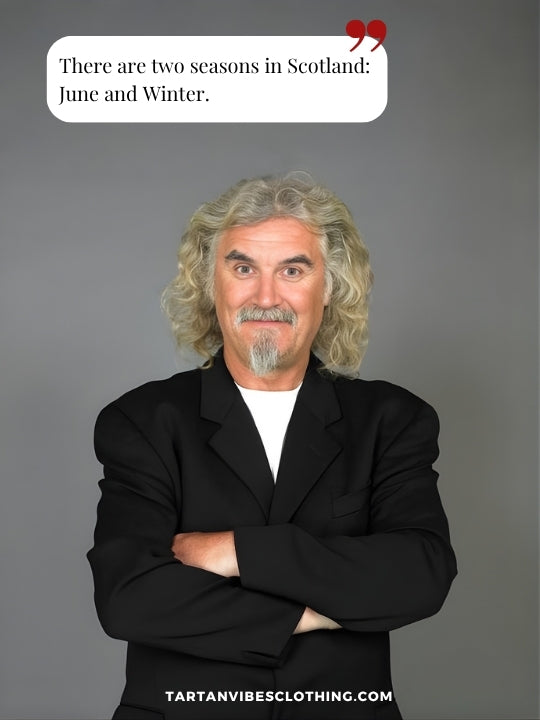
- “There are two seasons in Scotland: June and Winter.” — Billy Connolly
“Glasgow is a very negative place. If Kanye was born there, he’d be called No You Cannae.” — Frankie Boyle
A man walks into a Glasgow pub and asks for a pint of lager with a dash of lime.
“Sorry mate, we don’t do cocktails,” replies the barman.“Why do pipers walk while they play? To get away from the noise.”
A man goes into a butcher’s:
“I’ve got 8 legs of venison for 30 quid.”
“That’s two deer.”“What do you call a Scotsman halfway down his garden path? Hamish.”
“Why does the Clyde run through Glasgow? If it walked, it would get jumped.”
“I’m on a whisky diet… I’ve lost three days.”
Englishman: “Take away your mountains and lochs—what have you got?”
Scot: “England.”Tourist: “I only have enough for the bill, nothing for a tip.”
Waiter: “Let me add that up again, sir.”
Why Scottish Jokes Hit Different (And Why Most Lists Get Them Wrong)
What makes a Scottish joke land isn’t the setup—it’s the logic behind the response. In many cases, the punchline isn’t surprising at all; it’s just unexpectedly honest, delivered so bluntly that it catches you off guard.
This is where concepts like “canny” and “dour” come in. A canny Scot doesn’t try to be funny—they refuse to accept anything that doesn’t make sense. A dour Scot, on the other hand, delivers the line with such dry understatement that the humor almost hides in plain sight.
There’s also a pattern you’ll start to notice: many Scottish jokes feel like real conversations, not constructed punchlines. Someone asks a slightly “daft” question, and the answer comes back literal, logical, and just a bit ruthless. That gap between expectation and reality is where the humor lives.
Once you see this pattern, the jokes stop feeling random—and start feeling intentional.
The “Canny Filter”: How to Pick the Right Joke for Any Situation
Quick Breakdown: What Works Where
Situation |
Best Type of Joke |
Why It Works |
Speech / Wedding |
Clean, clever, light wordplay |
Safe, won’t offend, still feels smart |
Social Media |
Short one-liners |
Fast, easy to share, instantly funny |
Pub / Friends |
Edgy, blunt, slightly brutal |
Matches real Scottish banter |
Mixed Crowd |
Observational (weather, tourist jokes) |
Universal, easy to understand |
The “Slap Scale” (How Hard the Joke Hits)
Think of Scottish humor like levels of intensity:
Light Tap (Clean) → harmless, clever, safe
Firm Slap (Classic banter) → a bit sharp, still acceptable
Full Hit (Pub humor) → blunt, risky, but fun in the right crowd
👉 The mistake most people make? Jumping straight to “full hit” without reading the room.
A Simple Rule That Always Works
If you’re not sure what to say, go with this: Start clean → test reaction → then go sharper if it lands.
Scottish humor is all about timing—not just in the joke, but in the moment you use it. The same line can either get a laugh… or an awkward silence, depending on who’s listening.
Short & Sharp Scottish Jokes That Always Land
Classic One-Liners (Under 20 Words)
- “How many Scotsmen does it take to change a light bulb? Och! It’s no’ that dark!”
“In Scotland, summer is just a rumour.”
“Scottish sunshine: blink and you miss it.”
“Why do Scots never panic? Takes too much effort.”
“Why do Scots hate small talk? It leads to big talk.”
“Why do Scots trust silence? Less chance of nonsense.”
“Why do Scots like straight answers? Saves time.”
“Scottish logic: if it works, stop talking.”
- “Why do Scots avoid drama? It solves nothing.”
“Why do Scots like facts? They don’t argue back.”
“Scottish advice: say less, mean more.”
These land because they feel like casual observations, not jokes.
That’s the beauty of Scottish humor—it doesn’t feel like a joke, just a comment that hits harder than expected.
Slang-Based Punchlines (Aye, Cannae, Wee…)
Scottish slang isn’t just vocabulary—it is the joke. The words are simple, but the meaning often shifts depending on tone, timing, and context.
“I told my pal I was moving to Scotland. He said, ‘Och aye?’ I said, ‘No, just me.’”
“I asked a Scotsman if he plays golf. He said, ‘Aye… but I’m puttin’ it off.’”
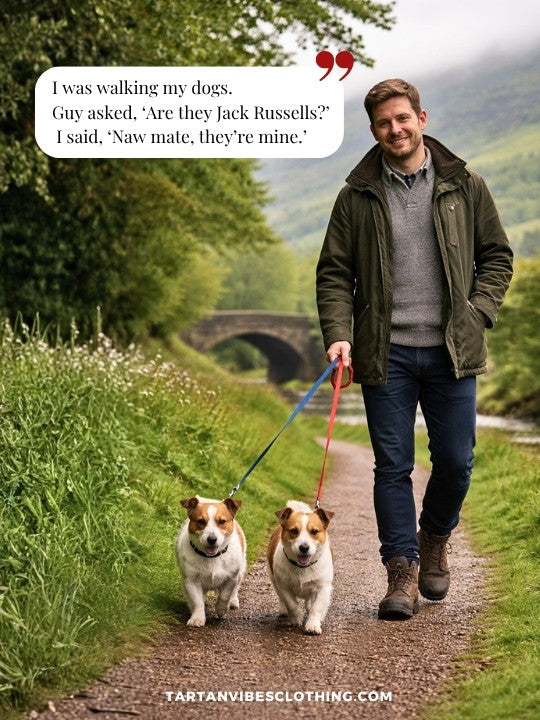
“I was walking my dogs. Guy asked, ‘Are they Jack Russells?’
I said, ‘Naw mate, they’re mine.’”“Comfy?” — “Govan.”
“Just back from France… ordered two pints, they brought me three.”
“They French cannae count – ask for two rolls, they give ye three.”
“Och aye, it’s just a wee problem.”
→ Usually means it’s not a wee problem.
-
“Aye, I’ll do it in a minute.”
→ Could be now… could be never. “Dinnae worry about it.”
→ You should probably worry about it.“Just a wee drink.”
→ You’re not going home anytime soon.“That’s a bold move.”
→ You’ve made a mistake.
In Scottish humor, what’s said and what’s meant are often two different things, and that gap is where the joke lives.
“Scottish translation is easy: what we say… and what we mean are rarely the same thing.”
Scottish Comedian One-Liners
- “Nobody thought Mel Gibson could play a Scot… look at him now.” — Frankie Boyle.
“We had the Commonwealth Games in Glasgow… where people think Hepatitis B is a vitamin.” — Frankie Boyle.
“In Scotland, we call a dog a dug…” — Kevin Bridges.
“Edinburgh vs Glasgow… when a gun goes off in Edinburgh, it’s one o’clock.” — Kevin Bridges.
These lines show how modern Scottish comedians use sharp observation and brutal honesty to get the laugh.
Pub Jokes & Adult Scottish Humor (Whisky, Wit & Brutal Honesty)
Dialogue & Story Jokes
-
A guy asks, “Can I have a mince round?”
“Aye, as long as you don’t knock anything over.” A man walks into a pub and orders a small whisky.
The barman fills the glass to the top.
“That’s not small,” says the man.
“Aye,” says the barman, “but it’s polite.”A tourist asks, “What’s the strongest drink you’ve got?”
Barman: “The one you can still stand after.”
A man orders a whisky.
“Double?” asks the barman.
“Aye,” says the man, “I’m no driving.”A guy walks into a bar and says, “Give me something cheap.”
Barman: “Water’s free… but you won’t like it.”A Scotsman orders one drink and nurses it all night.
Someone asks why.
“I’m waiting for it to appreciate.”Man: “Is that beef local?”
Butcher: “Aye, it lives closer than you.”Customer: “Is this fresh?”
Butcher: “It was this morning.”A man complains about noisy neighbours.
“I just keep playing my bagpipes.”
Thrift & “Canny Logic”
- He called his Scottish father-in-law “The Exorcist”… because every time he visited, he made the spirits disappear.
Sandy sent his friend a bill for the rope that saved his life.
Scottish ad: “Lost £5 note. Sentimental value.”
A Scotsman doesn’t spend money—he negotiates with it.
“I’m not cheap… I just like knowing where my money is.”
These aren’t about being “cheap”—they’re about not being fooled.
Whisky & Pub Humor
- “What do you call a whisky with attitude? A dram queen.”
“How do Scots settle arguments? Over a dram… and another.”
“Why do Scots make great friends? They always lift your spirits.”
“Whisky doesn’t solve problems… but it makes them negotiable.”
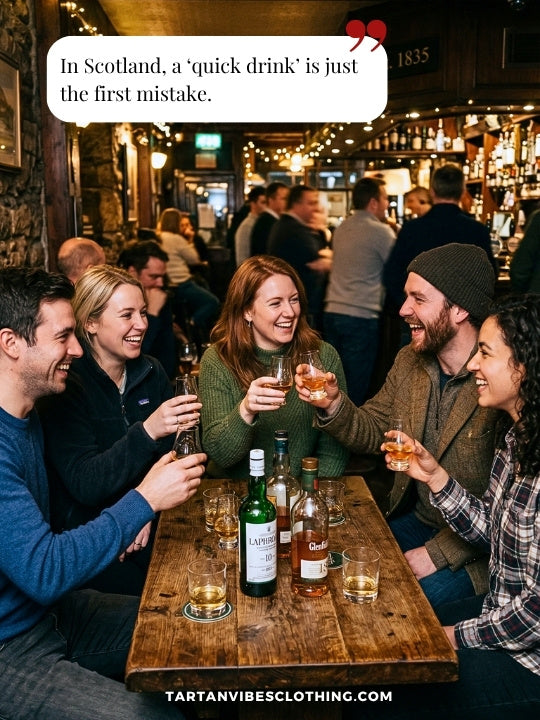
“In Scotland, a ‘quick drink’ is just the first mistake.”
“A Scotsman never leaves early—he just stops arriving.”
Dark / Dour Humor
- “Why don’t Scots fear death? They’ve survived the weather.”
“Why do Scots joke at funerals? Because if you don’t laugh, you’ll greet.”
“Scottish optimism: it might get worse… but probably will.”
“In Scotland, bad news is just confirmation.”
This is classic dour humor—dry, a bit dark, but never overdramatic.
Clean Scottish Jokes (Smart, Family-Friendly Humor)
Not all Scottish humor has to be sharp or risky. Some of the best jokes are clean, simple, and still clever enough to get a real laugh—perfect for speeches, mixed groups, or when you don’t want anything to backfire.
Highland & Weather Humor
- “What do you call a whisky with attitude? A dram queen.”
“How do Scots settle arguments? Over a dram… and another.”
“Why do Scots make great friends? They always lift your spirits.”
“Whisky doesn’t solve problems… but it makes them negotiable.”
“In Scotland, a ‘quick drink’ is just the first mistake.”
“A Scotsman never leaves early—he just stops arriving.”
Tourist vs Scot (Classic Logic Humor)
-
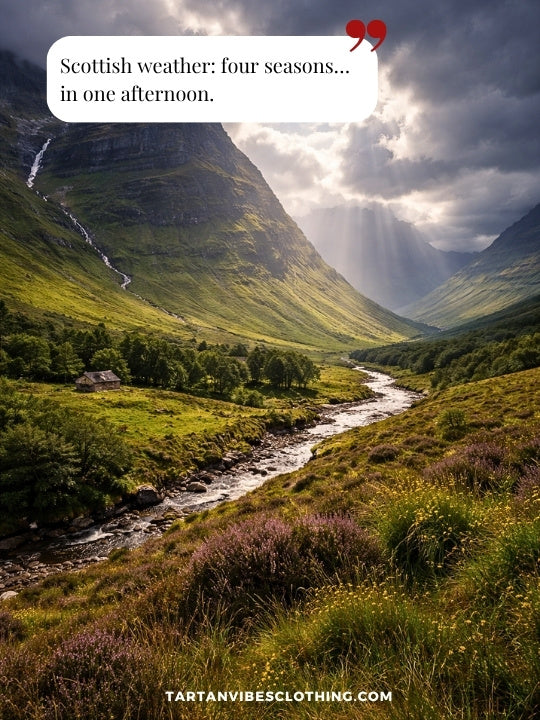
Tourist: “Does it always rain here?”
Scot: “No… sometimes it pours.” Tourist: “Is that Loch Ness?”
Scot: “Aye, unless it moved.”Tourist: “Do you ever see the sun?”
Scot: “We’ve heard of it.”Tourist: “How far is the village?”
Scot: “Closer if you walk.”Tourist: “Is it cold?”
Scot: “For you, aye.”Tourist: “Is that the famous view?”
Scot: “It’s the only one.”
This is where Scottish humor stays polite—but still doesn’t sugarcoat anything.
Light, Family-Friendly Scottish Humor
- “What’s Nessie’s favorite snack? Fish and ships.”
“Why did the Scotsman carry a ladder? To reach new Highland heights.”
“Why do Scots love castles? Plenty of room for stories.”
“Why do Scots enjoy walks? More time to think.”
“Why do Scots like simple jokes? They make sense.”

Thematic Scottish Jokes (Culture, Symbols & Traditions)
Bagpipes Humor
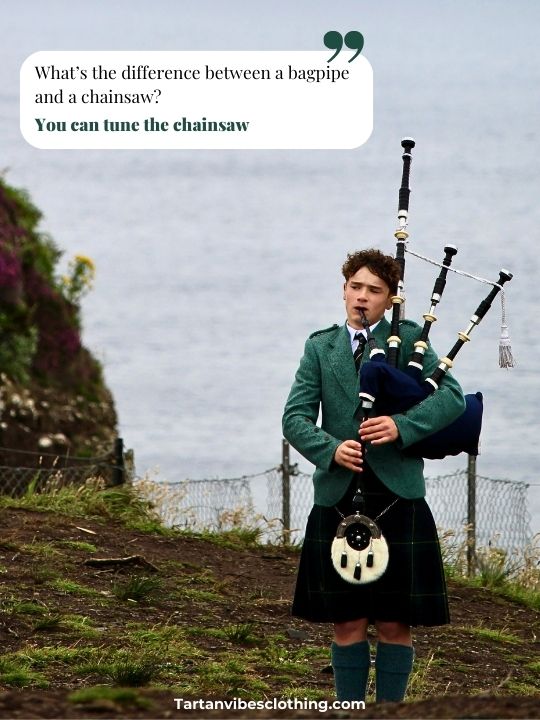
- “What’s the difference between a bagpipe and a chainsaw? You can tune the chainsaw.”
“What’s a bagpipe recital? A test of patience.”
“What’s a bagpipe’s favorite key? None—they prefer chaos.”
“Why are bagpipes loud? So you can’t complain.”
Kilt Humor
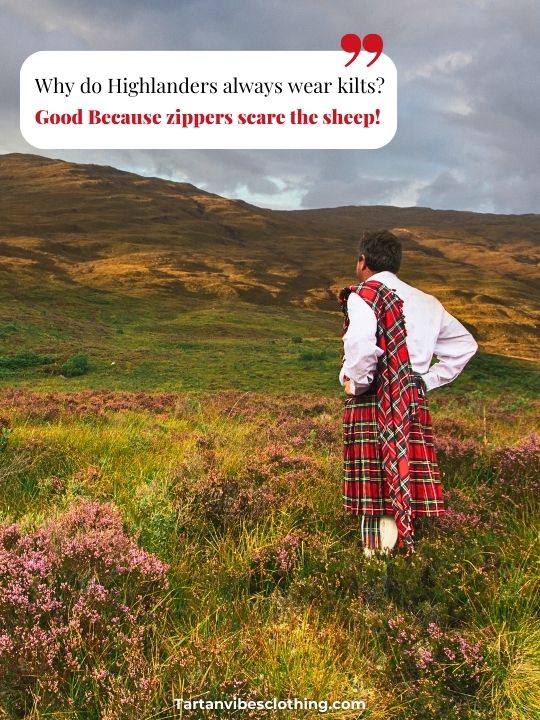
- “Why do Scots wear kilts? Because sheep can hear a zipper a mile away.”
“What’s under a kilt? Depends who’s asking.”
“Why do kilts work in any weather? They don’t argue.”
Burns Night & Haggis Humor
- “Why did the haggis refuse dinner? It didn’t have the stomach for it.”
“Why do Scots celebrate Burns Night? Tradition—and whisky.”
“Haggis: the only meal that dares you to eat it.”
Understanding Scottish Humor Deeply (Culture, Accent & Logic)
Canny vs Dour: The Core of Scottish Wit
Scottish humor sits between two extremes:
Canny → sharp, logical, never easily fooled
Dour → dry, understated, almost emotionless delivery
A canny Scot doesn’t try to be funny—they just refuse to accept anything that sounds daft.
A dour Scot delivers the line so flat it barely sounds like a joke… which is exactly why it lands.
👉 The result: humor that feels accidental, but hits on purpose
Logic Behind the Joke (The Canny Mindset)
At the core of Scottish humor is simple logic—sometimes so direct it feels brutal.
“If it makes sense, a Scot will believe it. If not, they won’t pretend.”
“A Scotsman doesn’t misunderstand—you explained it wrong.”
“Logic isn’t rude. It’s just faster.”
“In Scotland, facts win arguments.”
“If something sounds daft, it probably is.”
This is why many Scottish jokes don’t feel like jokes at all—they sound like someone refusing to accept nonsense.
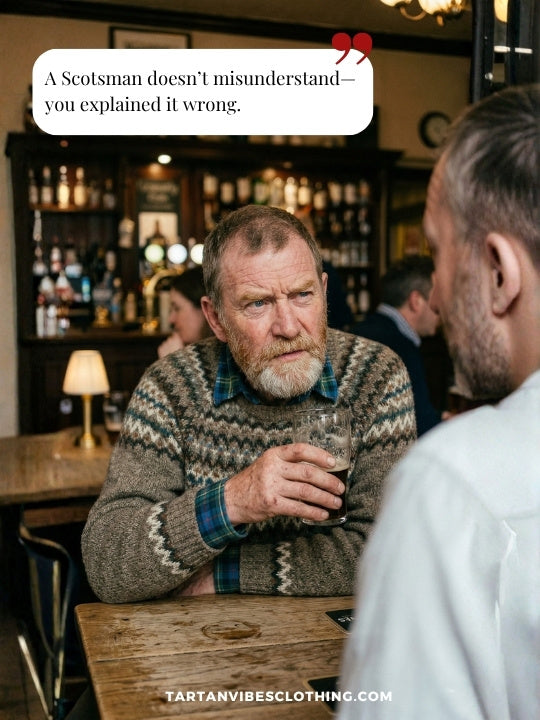
Scots vs The World: Logic Always Wins
You’ll see this pattern a lot: Someone asks a slightly silly question… and the Scot answers it too logically.
“In Scotland, we invented the phone—so we can use the phone box however we like.”
“Global warming? Just means we’ll watch the English drown.” — Frankie Boyle.
The joke works because the Scot isn’t trying to be clever—they’re just cutting straight through the nonsense. In many classic setups, the Scot ends up as the voice of reason, not the fool.
Glasgow vs Highlands: Same Humor, Different Style
Glasgow humor is faster, sharper, and often built around accent and wordplay—sometimes the joke only works when you hear it.
Dentist: “Comfy?”
Patient: “Govan.”Man: “Excuse me, are they Jack Russells?”
Reply: “Naw mate, they’re mine.”
These jokes don’t rely on punchlines—they rely on how the words sound and how quickly they’re delivered.
Accent & Timing: Why It Sounds Funnier Than It Reads
A Scottish joke on paper is only half the experience. The rest comes from accent and rhythm.
Words like “aye,” “wee,” “cannae,” or “glaikit” aren’t just vocabulary—they control the pacing. A slight pause, a clipped word, or a drawn-out vowel can completely change when the punchline hits.
That’s why the same joke can feel average when read… but hilarious when spoken. In Scottish humor, timing isn’t added—it’s built into the language itself.
Once you understand these patterns—logic over exaggeration, delivery over setup, and timing over explanation—you’ll start to see why Scottish jokes hit differently… and why they’re so easy to get wrong if you miss the nuance.
Scottish Slang That Makes the Joke Funniest (With Meanings)
A big part of why Scottish jokes hit harder is the language itself. You can translate the words into standard English—but you’ll lose the rhythm, tone, and timing that actually make the joke funny.
Here are some key Scottish words you’ll see (and hear) all the time:
Aye → yes
Wee → small (but also used for emphasis: “just a wee joke”)
Cannae → cannot
Glaikit → foolish, clueless
Braw → great, excellent
Wheest → be quiet / shut it
Daft → silly, illogical
Why Slang Changes the Joke
Take a simple line:
“It’s not that dark.” → neutral
“Och, it’s no’ that dark!” → suddenly feels sharper, funnier
The meaning doesn’t change—but the delivery does. Scottish slang shortens words, adds rhythm, and creates natural pauses that make the punchline land better.
Slang in Action (Why It Works)
-
“Och aye, it’s just a wee problem.”
→ Sounds casual, but often implies something bigger than it seems. “That’s a bit daft, isn’t it?”
→ A polite way of saying something makes no sense.“Dinnae worry about it.”
→ Reassuring—but often with a hint of “you’ve already messed up”.
The Key Insight
Scottish jokes aren’t just about what’s said—they’re about how it’s said. Slang adds personality, timing, and that slightly dry edge that makes even a simple line feel intentional.
That’s why a joke written in plain English might feel flat… but the same line, with the right Scottish phrasing, suddenly lands.
How to Use Scottish Humor in Real Life
Knowing the joke isn’t enough—timing and context decide whether it lands or not.
Use Clean Jokes for Safe Situations
For speeches or mixed groups, keep it simple and short. Don’t explain—say it and move on.
👉 “There are two seasons in Scotland: June and Winter.”
Use Pub Humor with the Right Crowd
With friends, you can go sharper—but keep it casual, not performative. Deadpan delivery makes it funnier.
👉 “I’m on a whisky diet… I’ve lost three days.”
Read the Room First
Keep It Natural
The Rule That Works Every Time
The Last Laugh: Why Scottish Humor Always Sticks With You
Scottish humor sticks not because it’s loud—but because it’s sharp, logical, and perfectly timed. The best jokes don’t try too hard; they land quietly, then hit you a second later when the meaning clicks.
At its core, it comes down to three things:
Canny thinking → logic over exaggeration
Dour delivery → dry, understated tone
Timing → knowing when to say less
Get those right, and even a simple line can land harder than a long joke.
So the next time you use one, don’t overthink it—drop the line and let it do the work.
👉 Got a favorite Scottish joke? Drop it in the comments and see if it lands.
Frequently Asked Questions
What makes Scottish jokes different from other British humor?
Scottish jokes are known for their dry, direct, and often self-deprecating style. Unlike broader British humor, they rely heavily on sharp logic, cultural references, and subtle delivery rather than exaggerated punchlines.
Why are Scottish accents often used in jokes?
The Scottish accent adds rhythm, tone, and wordplay that can completely change how a joke lands. Many punchlines rely on pronunciation, making the accent a key part of the humor itself.
Are Scottish jokes based on stereotypes or real culture?
Most Scottish jokes are rooted in cultural traits like thriftiness, resilience, and blunt honesty. While exaggerated for humor, many reflect real aspects of Scottish life and identity.
What are common themes in Scottish jokes?
Scottish jokes often revolve around whisky, weather, money (thrift), Highland life, and everyday situations, such as pubs or family conversations. These themes create relatable and recurring punchlines.
Are Scottish jokes easy to understand for non-native speakers?
Some Scottish jokes can be challenging due to slang and accent-based wordplay. However, many are simple one-liners that are easy to understand, especially when context or translations are provided.

Teresa Finn
As someone with a deep passion for clan heritage, especially the intriguing world of tartans and their rich traditions, I'm here to be your companion on this exciting journey. Together, we'll delve into the depths of clan history, uncovering the stories behind these vibrant tartans and making every connection to your heritage more meaningful.


