



Dunollie Castle: A Historic Landmark of the MacDougall Clan
by Aimee Li on Aug 25, 2025
Table of Content
Standing on a rocky hill above the town of Oban, Dunollie Castle is a striking landmark of Scotland’s west coast. Once home to the MacDougall Clan, the castle has witnessed centuries of battles, traditions, and Highland history. Its ruins look out across the Isle of Kerrera and the waters of the Firth of Lorn, offering one of the most scenic views in the area. Today, visitors come to Dunollie Castle not only for the dramatic setting but also for the stories of clan heritage and Scottish culture that are still alive in this historic place.
I. Introduction
1. Brief Overview of Dunollie Castle

Dunollie Castle, also known in Gaelic as “Caisteal Dhùn Ollaigh”, is a small medieval ruin located on a rocky hill north of Oban in Argyll and Bute, on Scotland’s west coast. The structure offers sweeping views over Oban Harbour, Kerrera, and beyond, and today forms part of the visitor experience at Dunollie Museum, Castle & Grounds
2. Dunollie Castle's historical significance
The site has been fortified since the early Middle Ages, originally serving as the royal stronghold of the Cenél Loairn within the Dál Riata kingdom. Records note multiple attacks and rebuilds in the 7th–8th centuries, including reconstruction by King Selbach in 714. In the 12th century, the powerful MacDougall clan—descendants of Somerled—established their lordship from here, constructing the stone fortress that largely survives today.
Over the centuries, Dunollie played a key role in Scottish power struggles, witnessing conflicts involving the MacDougalls, Robert the Bruce, and later the Covenanters and Jacobite Risings. Abandoned in the 18th century in favor of nearby Dunollie House, the castle now stands as a poignant ruin—preserved for public interest and scholarly study.
II. The History of Dunollie Castle
In the early Middle Ages, a fortress existed on this elevated headland when Dunollie served as the royal hub of the Cenél Loairn in the Dál Riata kingdom.

- 686 – “Dun Ollaigh” was attacked or set on fire.
698 – The site was attacked again.
701 – The fortress was destroyed, attributed to Selbach mac Ferchair, King of Dál Riata.
714 – Selbach mac Ferchair reconstructed the site.
10th century: Archaeological findings from the 1970s suggest the initial fort was abandoned.
Afterwards, the region surrounding Dunollie became part of the semi-autonomous Kingdom of the Isles, controlled by Somerled. Following his death, the MacDougalls rose to become the Lords of Lorne.

- 12th century: Dougall, Somerled's son, governed most of Argyll as well as islands including Mull, Lismore, Jura, Tiree, and Coll.
Late 12th or 13th century: Dunollie was reinforced with an earthen castle, possibly by Dougall or his son Duncan.
Mid-13th century: Ewan MacDougall, great-grandson of Somerled, shifted allegiance from Haakon IV of Norway to the Scottish monarchy in the 1250s.
14th century: John MacDougall, Ewan’s grandson, allied with the Comyns and Balliols against Robert the Bruce.
1306: John MacDougall’s forces defeated Bruce at the Battle of Dalrigh.
1308: Bruce retaliated, defeating the MacDougalls at the Battle of the Pass of Brander.
Later 14th century: Although MacDougall lands in Lorne were forfeited to the Campbells, Dunollie and some estates were recovered.
15th century: The remaining castle ruins largely date from this period.
1644: The Marquis of Argyll seized the castle.
1661: Dunollie Castle was restored to the MacDougalls.
1746: The MacDougalls left Dunollie Castle and built Dunollie House just downhill from the ruins.
III. Architecture of Dunollie Castle
1. The castle's unique architectural features
Clan MacDougall Dunollie Castle stands as a classic example of a tower house—a type of fortified residence common in late-medieval Scotland. The four-storey tower measures approximately 12 m by 11.3 m and features impressively thick stone walls, ranging from 2.7 m to 3.4 m at the base, offering formidable defense and structural stability.

Positioned at the northeast corner of a roughly square courtyard (about 24.4 m per side), the tower’s diagonal placement strategically guards the most accessible route to the summit.
Entry to the tower is through a vaulted chamber on the ground floor, with slit windows for observation and defense, and a staircase built into the thick walls leading to the former Lord’s Hall, which once sat above but is now open to the sky.
Beyond the tower, subtle remnants of east and west ranges suggest where the great hall and service areas once stood, though only a two-storey fragment remains today. Defensive earthworks and curtain walls, now partially eroded or concealed by vegetation, hint at the castle’s formidable past.
2. The design elements that make Dunollie Castle distinctive
One striking feature of the castle of the MacDougall clan is its integration into the natural geological formation—the castle is built directly atop a rock promontory, providing natural defensive advantages and panoramic views over Oban Bay.
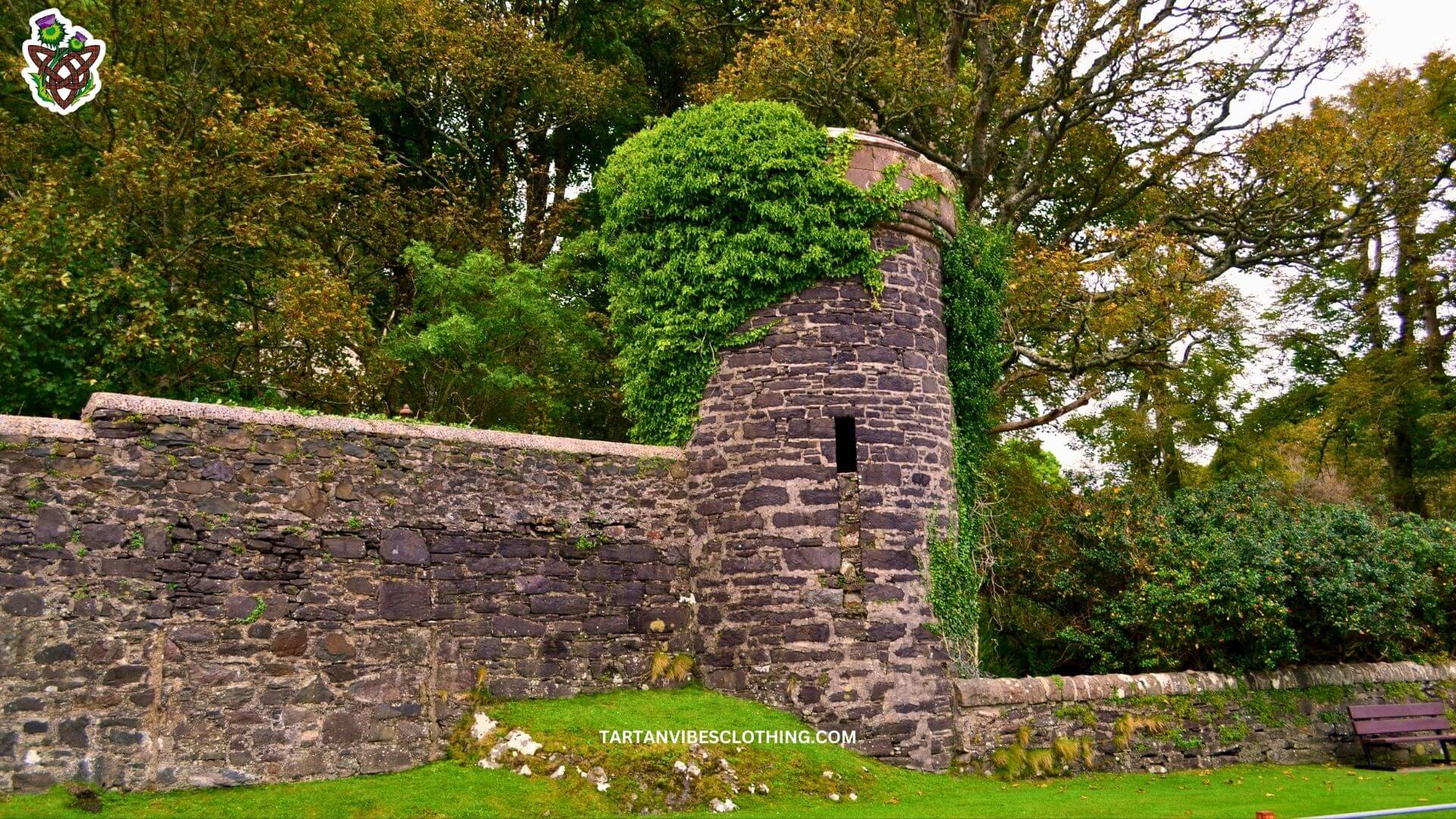
Architecturally, the castle reflects both utilitarian and symbolic design. The barrel-vaulted cellar on the ground floor offered secure storage and reinforcing strength, while the slit windows added light and defence capability. The unroofed upper floor hints at past grandeur—once lending space for domestic quarters and strategic vantage points. Additionally, the courtyard’s defensive layout—with curtain walls and possible earlier ramparts at the site’s summit—suggests continued occupation and fortification through successive historical phases, spanning from an early medieval fort to a 15th-century stronghold.
IV. Dunollie Castle's Role in Scottish Culture and Heritage
1. Dunollie Castle’s Contribution to Scottish Cultural Heritage
Dunollie Castle is a vital landmark in Scotland’s heritage, serving as a tangible link to the region’s medieval past and the legacy of the Clan MacDougall. As part of the Dunollie Museum, Castle & Grounds—operated by the MacDougall of Dunollie Preservation Trust—it preserves and presents over a thousand years of Highland history, including artefacts and exhibits that educate both visitors and future generations.
Recognized as a scheduled monument and a heritage focal point near Oban, the castle engages locals and international visitors alike through storytelling, exhibitions, and site interpretation that nurture interest in Scottish identity and historical continuity.
2. The Impact of Dunollie Castle on Local and National Identity

V. What to See at Dunollie Castle Museum and Grounds
1. The 1745 House Museum
The journey begins at the 1745 House Museum, located just beneath the castle ruins. Inside, visitors can explore:

- Clan MacDougall’s history and highland social artifacts.
Rotating exhibitions such as “Hope Behind the Lens”—a photography series by Hope MacDougall capturing Oban life in the 20th century.
The Hope MacDougall Collection features everyday Highland crafts and tools meticulously documented to preserve regional heritage.
2. The Medieval Castle Ruins
3. Woodland Trails and Grounds
The grounds of Dunollie Castle are equally enchanting, offering:
The World of Trees woodland trail.
The whimsical Faerie Garden.
The serene Willow Hall.
Peaceful nature walks are ideal for relaxation.
With human activity on the site stretching back thousands of years, these landscapes embody both continuity and tranquility, making Dunollie a place where history and nature beautifully intertwine.
VI. How to get to Dunollie Castle from Oban
1. Walking from Oban Town Centre
Dunollie Castle attracts many visitors to Oban and Loch Melfort Hotel largely due to its closeness to the 'Gateway to the Isles.' Located just 1.1 miles from the town center, this path is a simple addition to any outing in Oban. Hikers can stroll along the shore and take in views of the Isle of Kerrera (be sure to spot Hutcheson’s Monument at the island’s tip).
The route also takes walkers past various smaller attractions in Oban, such as The Dog Stone (a large rock pillar left by a flood approximately 415 million years ago, which has an interesting tale associated with an Irish giant) and the Oban War Memorial.
2. By Car or Taxi
3. By Bus or Public Transport
VII. Practical Information for Visitors
1. Dunollie Castle Opening Hours
- Open from Sunday through Friday, 10 a.m. to 4 p.m., from March 16 to October 31, 2025.
The site occasionally welcomes visitors on Saturdays and in the evenings throughout the summer season.
2. Dunollie Castle Tickets
- General admission offers great value: Adults £13, Concessions (e.g., seniors 65+, students, disabled) £11, Children (5–15) £6, and Under‑5s enter free.
Family tickets are available: 2 adults + 2 children for £30, or 2 adults + 3 children for £34.
3. Booking & Additional Info
- Tickets can be purchased online or at the Reception Booth on arrival.
Groups of 10 or more visitors and guests from partner institutions may be eligible for a 10% discount—advance arrangements are required.
Dogs on leads are welcome in outdoor areas, including the castle and grounds (but not inside the 1745 House or Draper’s Shop).
V. Conclusion
Frequently Asked Questions
Where is Dunollie Castle located?
Dunollie Castle sits on a rocky hill just north of Oban, overlooking Oban Bay and the Isle of Kerrera, on Scotland’s west coast.
How do I get to Dunollie Castle from Oban?
You can walk (about 20 minutes from Oban town centre), drive (5 minutes), or take a bus to Ganavan and walk about 10 minutes to reach the castle.
What are the opening times of Dunollie Castle?
It is open from March to October, Sunday through Friday, 10 a.m. to 4 p.m. Summer evenings and occasional Saturdays are also available.
Who built Dunollie Castle?
The stone fortress was established in the 12th century by the MacDougall Clan, descendants of Somerled, although the site itself had been fortified since the early Middle Ages.

Aimee Li
An author dedicated to exploring the rich history, vibrant culture,... of the Scottish clans. As an avid historian and fashion enthusiast, I have always been fascinated by Scotland's heritage and the timeless elegance of its traditional attire. Join me on this journey through the highlands and lowlands, as we delve into the heart of Scottish legacy together.


