



MacLeod Clan Castles: The 800-Year Story of Dunvegan on the Isle of Skye
by Teresa Finn on Jan 10, 2026
Table of Content
For over 800 years, one Scottish clan never lost its castle.
That castle is Dunvegan on the Isle of Skye — the ancestral seat of Clan MacLeod since the 13th century and the most famous of the MacLeod clan castles.
While most Highland strongholds fell to war, politics, or extinction, Dunvegan endured. Why?
Inside its walls are medieval defenses built for a sea kingdom, Victorian illusions layered over stone keeps, and the legendary Fairy Flag said to protect the clan in times of crisis.
In this guide, you’ll see what is original, what is myth, and why Dunvegan still stands when others did not — especially as 2026 draws descendants back to Skye.
Dunvegan Castle — The Oldest Continuously Inhabited Clan Seat in Scotland
Dunvegan Castle has been the seat of the Chiefs of Clan MacLeod since the 13th century, making it the oldest continuously inhabited castle in Scotland.
For over 800 years, the MacLeod family has lived on the same rocky promontory above Loch Dunvegan. In a region where many clan strongholds were destroyed, forfeited, or abandoned after political upheaval, Dunvegan remained in the hands of one lineage.
That continuity — not just its medieval origin — is what makes the castle historically exceptional.
At a glance:
Founded: 13th century
Clan Seat: MacLeod of Harris & Dunvegan
Location: Isle of Skye, Inner Hebrides
Current Chief: Hugh Magnus MacLeod, 30th Chief
Status: Private residence and seasonal heritage site
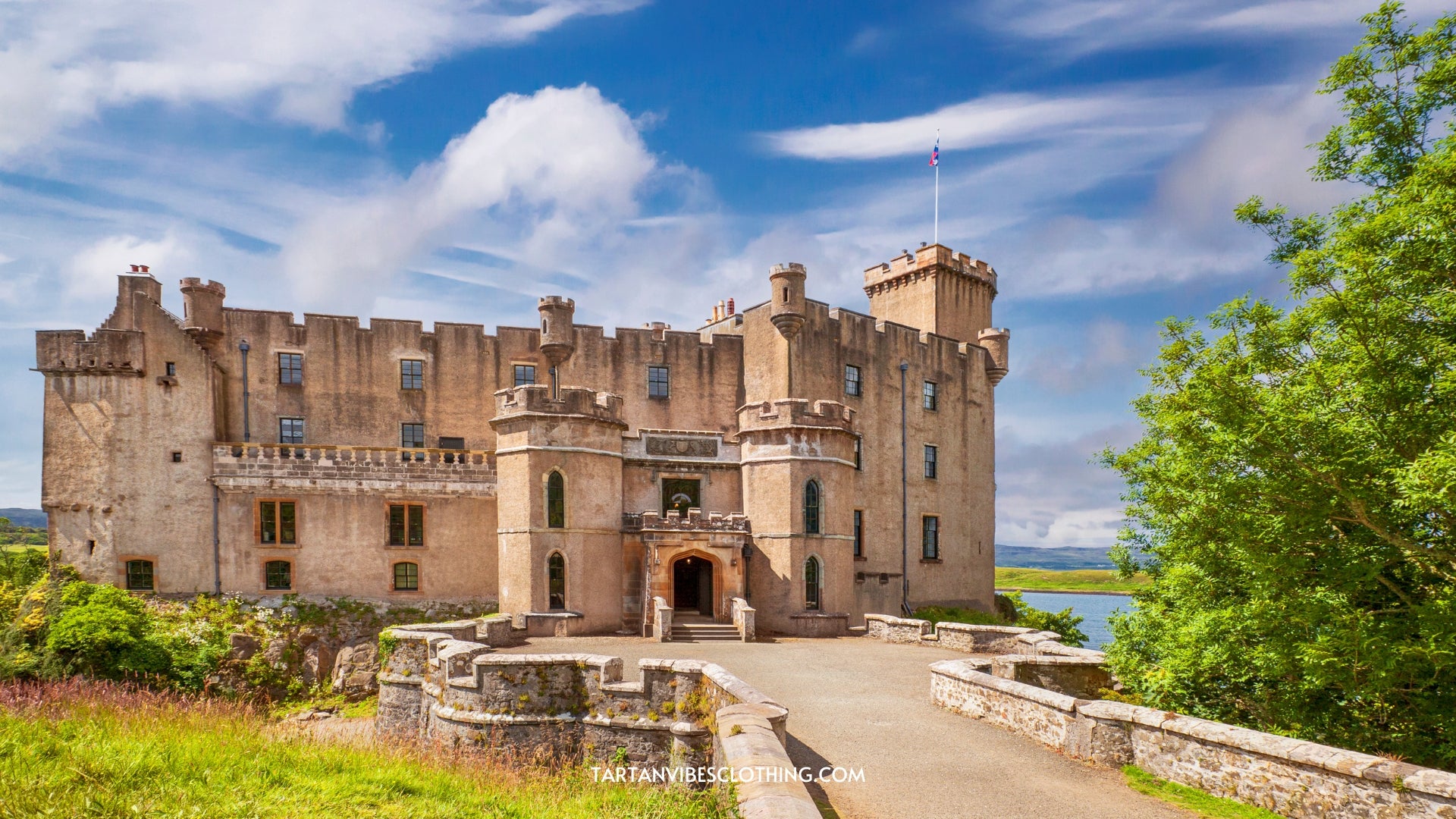
Unlike many Highland castles that later fell into ruin, Dunvegan evolved in place. The defensive towers expanded, interiors adapted, and Victorian alterations reshaped its appearance — but the site itself was never abandoned.
To understand how that was possible and why Dunvegan faces the sea rather than the land, we need to look at the Norse-Gaelic sea dynasty that built it.
How a Norse-Gaelic Sea Dynasty Secured Dunvegan for 800 Years
Dunvegan’s survival was not incidental. It reflects the maritime and political strategy of the early MacLeods.
Before Dunvegan became a stone castle, the family behind it ruled a sea kingdom.
From Olaf the Black to the Treaty of Perth (1266)
Clan tradition traces the MacLeods to Leod, son of Olaf the Black, King of Mann and the Isles. In the 13th century, the Hebrides were part of a Norse-Gaelic world that looked west to the Irish Sea, not east to mainland Scotland.
That changed in 1266, when the Treaty of Perth transferred the Hebrides from Norwegian to Scottish sovereignty.
For many Norse-linked families, this transition meant loss of power. The MacLeods adapted instead.

Rather than resisting outright, they integrated into the emerging Scottish feudal system while maintaining control over key coastal territories in Skye and later Harris. Dunvegan became the fixed seat that anchored that transition from sea-lordship to clan chiefdom.
Their survival began with political flexibility.
The Sea Gate & Maritime Defense Strategy
Dunvegan’s earliest orientation was not toward the land, but toward the water.
For centuries, the primary entrance to the castle was through its Sea Gate, accessible directly from Loch Dunvegan. Until the mid-18th century, arrival by boat was the standard approach.
This was deliberate.
Unlike mainland castles built to control mountain passes, Dunvegan was positioned to:
Monitor sea routes through the Minch
Control access to nearby sea lochs
Project power across Skye’s western coastline
Retreat or reinforce by water when necessary
In a Hebridean landscape defined by islands and inlets, maritime mobility was security.
The castle’s survival is tied directly to that geography.

Norse Seamanship, Gaelic Stonework
Visitors sometimes expect visible traces of Viking architecture at Dunvegan. In reality, the Norse influence of Clan MacLeod was strategic rather than structural.
Their early authority grew from control of maritime routes across the Hebrides. Sea mobility — not inland expansion — defined power in this region. Dunvegan’s position above a sheltered sea loch reflects that maritime logic: it was placed to watch and command the approaches to the water.
However, the castle itself was built according to the prevailing building traditions of medieval Scotland. The Norse heritage shaped how the MacLeods ruled; the Gaelic-Scottish world shaped how they built.
This distinction matters. Dunvegan is not a Viking fortress frozen in time. Still, a Highland stronghold established by a clan whose origins lay in the Norse sea kingdom of the Western Isles.
The Architectural Evolution of Dunvegan Castle
The 14th-Century Keep (Curtain Wall on Basalt Rock)
The earliest surviving core of Dunvegan dates to the 14th century. This was not a sprawling palace but a defensible stronghold built atop a natural basalt outcrop above Loch Dunvegan.
The rock itself served as a defensive advantage, reducing the need for extensive ground fortifications. Early construction focused on height, visibility, and controlled access rather than architectural symmetry. The keep formed the nucleus around which later expansions developed.
Its purpose was practical: withstand coastal threats, project authority, and provide a secure residence for the chief.

The 16th-Century Fairy Tower (Alasdair Crotach)
In the late 15th or early 16th century, under Alasdair Crotach MacLeod (the 8th Chief), Dunvegan expanded vertically with the addition of what is now known as the Fairy Tower.
This marked a shift from purely defensive construction to a more refined tower-house model. The structure provided private chambers separate from the communal Great Hall, reflecting evolving expectations of lordly residence.
While still defensive in character, the tower signaled increased stability. Dunvegan was no longer merely a fortress — it was becoming a hereditary seat.
Victorian Restoration & Romantic Turrets
Much of what gives Dunvegan its dramatic skyline today dates not to the Middle Ages but to the 19th century.
During the 1840s and 1850s, the 25th Chief commissioned renovations in keeping with Victorian romantic taste. Battlements were emphasized, decorative turrets added, and the exterior reshaped to align with the Gothic revival aesthetic popular across Britain.
These additions did not erase the medieval core, but they reshaped its appearance. The castle became part fortress, part stately home — reflecting a new era in which symbolic heritage mattered as much as defense.
What Is Original — And What Is Victorian Illusion?
The 14th-century keep forms the structural core.
The Fairy Tower represents early modern expansion.
Many exterior flourishes are Victorian additions.
Recognizing these layers helps separate medieval construction from later romantic styling.
A Room-by-Room Experience (Great Hall, Dungeon, Drawing Room)
Inside, the evolution becomes even clearer.
The Great Hall reflects the medieval social order — a communal gathering space where hospitality and authority were publicly displayed. The dungeon areas remind visitors of the castle’s defensive origins, though their role was as much deterrent as carceral.
In contrast, the Drawing Room, where the Fairy Flag is preserved, reflects later domestic refinement. Furnishings, portraits of clan chiefs, and curated artifacts shift the atmosphere from fortress to heritage residence.
Moving through these rooms is effectively moving through time — from a coastal stronghold of a sea-based dynasty to the preserved ancestral home of a modern clan chief.

The Fairy Flag — Legend and Legacy at Dunvegan
The Silk Banner’s Origins
Textile analysis suggests the Fairy Flag dates to the 4th-7th centuries and likely originated in the eastern Mediterranean. How it reached Skye is uncertain, but by the late medieval period, it was firmly associated with the MacLeod chiefs at Dunvegan.
Its survival is remarkable — a delicate piece of silk preserved within a stone fortress for generations.

Myth vs Historical Evidence
Legend claims the banner was a supernatural gift that could be unfurled three times to protect the clan in moments of crisis. While no historical evidence supports the miracle itself, records show the flag was treated as a sacred heirloom and displayed during significant events.
Its power was symbolic rather than magical — a visible sign of legitimacy tied to the chief at Dunvegan.
Why It Remains Central to the Clan Seat
The Fairy Flag has never left Dunvegan Castle. Unlike relics scattered into museums, it remains within the ancestral seat, reinforcing the castle’s continuity.
The walls represent endurance. The banner represents authority.
Together, they explain why Dunvegan is remembered not just as a fortress, but as a living clan seat.
Other MacLeod Strongholds Beyond Dunvegan
While Dunvegan remained the hereditary seat of the MacLeods of Harris, other MacLeod strongholds did not survive the upheavals of the 17th century.
These sites reflect the wider reach of the clan — and the instability that affected its cadet branches.
MacLeod Strongholds at a Glance
Castle |
Branch |
Status |
Notable Event |
Ardvreck |
Assynt |
Ruin |
Montrose capture (1650) |
Brochel |
Raasay |
Ruin |
Volcanic pinnacle fortress |
Stornoway |
Lewis |
Destroyed |
Lost to MacKenzies |
Cadboll |
Easter Ross |
Ruin |
Eastern stronghold |
Ardvreck Castle and the Assynt Betrayal
Built in the 16th century, Ardvreck served as the seat of the MacLeods of Assynt. Its defining moment came in 1650, when James Graham, Marquess of Montrose, was captured nearby after defeat and held at the castle before being handed over to Covenanter forces.
The decision damaged the branch’s reputation and influence. Ardvreck was later abandoned, and today it stands as a ruin — a reminder of political miscalculation rather than continuity.

Brochel Castle and the Raasay Frontier
Brochel Castle, perched on a volcanic pinnacle above the sea on Raasay, reflects the same maritime logic that shaped Dunvegan. Its position commanded coastal approaches and offered natural defensive strength.
Yet it never evolved beyond a frontier stronghold. By the late 17th century it was deserted, leaving only a stark ruin that contrasts sharply with Dunvegan’s sustained occupation.

The Fall of the Lewis Branch and the “Wicked Man”
In the early 17th century, internal succession disputes destabilized the MacLeods of Lewis. Under Ruairidh MacLeod, factional conflict weakened the branch, enabling the MacKenzies to assert control over Lewis.
Stornoway Castle was destroyed, and the Lewis MacLeods lost their territorial base.
Unlike these branches, Dunvegan avoided the internal fractures that destabilized other MacLeod territories.
Visiting Dunvegan Castle in 2026 — What Pilgrims Should Know
With the 2026 Clan Parliament expected to draw visitors from across the world, planning is essential. Dunvegan Castle is both a private residence and a public heritage site, and opening details may vary during major events.
Before traveling, always verify opening times, ticket availability, and event updates on the official Dunvegan Castle website.
Opening Season & Tickets
Dunvegan Castle & Gardens typically operate from April through October, with updated seasonal dates confirmed each year on the official site.
For 2026, standard ticket pricing is expected to follow the current structure:
Adult admission: £17.50
Children (5–15): £12.00
Family ticket: £45.00
Group rates: approx. £15 per person (10+ visitors)
Ticket options usually include:
Castle & Gardens access
Gardens-only entry
Tickets are non-transferable, and booking online is strongly recommended, particularly during peak summer weeks.
Clan Parliament (August 1–7, 2026)
The 2026 Clan MacLeod Parliament will take place from August 1 to August 7. This gathering includes formal assemblies, cultural events, and clan-specific ceremonies.
During Parliament week, sections of the castle may be reserved for official functions. Public access may be reduced or adjusted on certain days.
Those attending clan-specific events should coordinate directly through official Clan MacLeod channels rather than relying solely on tourist ticketing platforms.
MacLeod’s Tables & Raasay Day
The nearby hills known as MacLeod’s Tables (Healabhal Mhòr and Healabhal Bheag) are historically linked to the clan and may feature in gathering events.
Raasay — historically associated with the MacLeod maritime frontier — is also connected to Parliament programming. However, travel arrangements vary depending on the event schedule.
Visitors outside formal events can independently explore these sites for panoramic views over Loch Dunvegan.
Access Limitations During Events
Because Dunvegan remains a private residence, temporary restrictions can occur during:
Clan ceremonies
Private bookings
High-volume visitor days
Check opening times and ticket availability near your travel date to avoid disruptions.
When to Book — Avoiding the 2026 Capacity Crunch
Early August is already peak season on the Isle of Skye. With Parliament scheduled for the first week of August 2026, demand for:
Castle tickets
Local accommodation
Rental cars
Guided tours
is expected to be high.
Booking several months in advance is advisable, especially if visiting between late July and early August.
Conclusion — An 800-Year Living Stronghold
Dunvegan Castle stands apart in Highland history because it remained the seat of Clan MacLeod while many other Highland strongholds disappeared.
Today, it functions as both a private residence and a public heritage site. If you plan to visit Skye — especially during the 2026 Clan Parliament — review opening times and book early to avoid peak-season restrictions.
Dunvegan is not simply a medieval castle. It is a stronghold still in use.
Frequently Asked Questions
Is MacLeod Scottish or Irish?
MacLeod is definitely Scottish. The name comes from the Gaelic Mac Leòid, meaning “son of Leòd,” and has Norse roots linked to Viking settlers in the Hebrides. The surname is most strongly associated with Clan MacLeod of Skye and Lewis in the Scottish Highlands.
What are the most notable MacLeod castles?
The most important MacLeod castle is Dunvegan Castle on the Isle of Skye, the ancestral seat of Clan MacLeod for over 800 years. Other notable strongholds historically linked to the clan include Ardvreck Castle (Assynt), Brochel Castle (Raasay), and Stornoway Castle (Lewis), though many of these are now ruins.
Is Dunvegan Castle still owned by Clan MacLeod?
Yes. Dunvegan Castle remains the ancestral seat of Clan MacLeod and is still associated with the hereditary chief. It is both a private residence and a public heritage site open seasonally to visitors.
Who currently lives in Dunvegan Castle?
Dunvegan Castle is linked to Hugh Magnus MacLeod, the 30th Chief of Clan MacLeod. While the Chief is primarily based in London, the castle remains the official clan seat and is occupied for part of the year.
What is the oldest continuously inhabited castle in Scotland?
Dunvegan Castle is widely regarded as the oldest continuously inhabited castle in Scotland, serving as the seat of the MacLeod chiefs since the 13th century.

Teresa Finn
As someone with a deep passion for clan heritage, especially the intriguing world of tartans and their rich traditions, I'm here to be your companion on this exciting journey. Together, we'll delve into the depths of clan history, uncovering the stories behind these vibrant tartans and making every connection to your heritage more meaningful.


