



Clan MacLeod: A Complete Guide to Its Norse Roots, Septs, and Dunvegan Legacy
by Teresa Finn on Feb 10, 2026
Table of Content
If you think Clan MacLeod is just another Highland name wrapped in tartan patterns and Jacobite romance, we need to reset that idea right now.
The MacLeods were never a typical land-based clan of the Scottish Highlands. They were a Norse-Gaelic maritime dynasty. Their power came from sea lochs, island strongholds, and political calibration rather than inland farming estates. Their ancestral seat, Dunvegan Castle on the Isle of Skye, has been continuously occupied for over 800 years.
That single fact changes everything.
And if you are here because your surname may connect to one of the Septs of Clan MacLeod, or because you feel that quiet pull toward Skye, Harris, or Lewis, this guide is for you.
We are going to rebuild the story properly — from sea kingdom to global diaspora.
Clan MacLeod at a Glance
Category |
Key Information |
Origins |
13th century, linked to Leod, son of Olaf the Black |
Cultural Roots |
Norse-Gaelic maritime dynasty |
Primary Branches |
MacLeod of Dunvegan (Sìol Thormoid) & MacLeod of Lewis (Sìol Thorcaill) |
Ancestral Seat |
Dunvegan Castle, Isle of Skye |
Continuous Tenure |
Over 800 years at Dunvegan |
Notable Symbol |
The Fairy Flag (Am Bratach Sìth) |
Clan Motto |
Hold Fast |
Crest |
Bull’s head between two flags |
Major Territories |
Skye, Harris, Lewis |
Current Chief |
Hugh Magnus MacLeod of MacLeod (30th Chief) |
Modern Presence |
Global clan societies in Scotland, USA, Canada, Australia |
Who Are the MacLeods? The Norse-Gaelic Origin Story
Most clan histories begin in the misty Highlands.
Clan MacLeod begins in the Kingdom of the Isles.
Leod, Son of Olaf the Black — A Royal Norse Lineage
The founder of the clan, Leod, was traditionally identified as the son of Olaf the Black, Norse King of Mann and the Isles in the thirteenth century. This places the MacLeods inside the political orbit of the Kingdom of the Isles, not mainland feudal Scotland.
That distinction matters.
The Kingdom of the Isles included the Hebrides and the Isle of Man. It operated under Norse maritime power structures. Governance reflected Scandinavian influence, including thing-style assemblies rather than a purely Gaelic chief hierarchy.
In other words, the MacLeods were not born as agricultural Highland chiefs. They were heirs to a Norse sea kingdom.
That “outsider” status shaped everything that followed.
From Viking Maritime Power to Gaelic Integration
The early MacLeods dominated sea lochs around Skye, Harris, and Lewis. Control of maritime corridors meant control of trade, defense, and communication.
Sea lochs acted like natural fortresses. A fleet could move faster than any land army. Coastal watchpoints mattered more than inland castles.
Over time, the MacLeods gradually Gaelicized. Language shifted. Alliances with mainland clans formed. Landholding patterns became more structured. But the core identity remained hybrid.
They were Norse-rooted and Gaelic-adapted. This fusion is not a footnote. It is the foundation.
Norse Governance vs Highland Clan Structure
Clan MacLeod developed within a different political culture from that of many mainland Highland clans.
Most inland clans were rooted in land, inheritance, and tightly bound territorial authority. Power flowed from soil and bloodline.
The MacLeods emerged from a Norse maritime system where leadership operated across islands. Authority relied more on alliance and regional balance than on fixed inland control.
That structural difference shaped instinct.
A land-bound clan defends borders. A sea-based clan manages networks.
This distinction helps explain why Clan MacLeod often chose strategic positioning over dramatic confrontation in the centuries that followed.
Why This Origin Changes Everything
Understanding this Norse foundation reframes Clan MacLeod in three critical ways:
They were not originally a land-based farming clan.
Naval mobility gave them survival advantages.
Political flexibility was embedded in their DNA.
That instinct to adapt may be the reason the Clan MacLeod story never truly ended. Unlike rigid feudal systems of mainland Scotland, maritime aristocracies had to adapt quickly. That adaptability would later define which branch survived.
Understanding this Norse foundation is critical because it explains why the clan later split in two very different political directions.

The Great Split in Clan MacLeod — Dunvegan vs. Lewis
Leod’s legacy did not remain unified.
His descendants divided into two principal branches.

Sìol Thormoid — The MacLeods of Dunvegan and Harris
The line of Tormod, often associated with MacLeod of MacLeod, established dominance on the Isle of Skye and in Harris.
Their stronghold became Dunvegan Castle, perched strategically beside a sea loch. From here, the Clan Chiefs maintained an unbroken line of succession for more than eight centuries.
Their strategy leaned toward measured restraint rather than expansion. They endured not through spectacle but through careful risk assessment.
That calibration would prove decisive in 1745.
Sìol Thorcaill — The MacLeods of Lewis
The line of Torquil, known as MacLeod of Lewis, expanded aggressively across the island of Lewis.
For a time, they were powerful. But feuds, internal instability, and rising pressure from the Mackenzies culminated in dispossession in the early seventeenth century.
Where Dunvegan endured, Lewis collapsed.
This was not merely geography. It was strategy, vulnerability, and internal competition.

Comparative Breakdown Table (Lewis vs Dunvegan)
Factor |
MacLeod of Dunvegan |
MacLeod of Lewis |
Founder Line |
Tormod |
Torquil |
Core Territory |
Skye and Harris |
Lewis |
Political Strategy |
Calculated neutrality |
Aggressive territorial expansion |
Outcome |
Continuity |
Dispossession |
Loyalty vs. Survival — The 1745 Jacobite Rising Reexamined
Popular culture paints all clans as Jacobite rebels.
Clan MacLeod complicates that narrative.
Chief Norman MacLeod’s Strategic Neutrality
During the Jacobite risings, particularly in 1745, Chief Norman MacLeod of Dunvegan did not support Bonnie Prince Charlie.
This was not apathy. It was estate preservation calculus.
After Culloden, many clans faced the confiscation of their land. The MacLeods of Dunvegan retained their estate. Their lands were not seized. Their castle remained in family hands.
That makes them an anomaly in Highland history.

Internal Fractures Within the Clan
Neutrality did not mean unity.
For many MacLeods, the choice was not simple. It meant balancing pride with survival.
Individual MacLeods joined the Jacobite cause. Loyalty to Stuart ideals conflicted with loyalty to the Chief.
This created tension within the clan's memory. Some descendants celebrate Jacobite bravery. Others recognize the survival logic of neutrality.
The psychological legacy of this “loyalty versus survival” divide still echoes in clan storytelling.
The Long-Term Consequence
Post-Culloden Scotland was brutal for many Clan Chiefs. Estates were destroyed, and identities fractured.
The MacLeods of Dunvegan retained their land and structure. It was continuity, not short-term glory, that defined their legacy.
It was not a dramatic legacy. But it was a lasting one.
But survival alone does not create identity. Identity requires a physical anchor.
Dunvegan Castle — Power, Myth, and Maritime Defense
On the western edge of the Isle of Skye, Dunvegan Castle rises beside its sea loch.
First fortified in the 1200s, Dunvegan Castle has been occupied by Clan MacLeod for more than 800 years and remains the most prominent of the historic Clan MacLeod castles across the Hebrides.
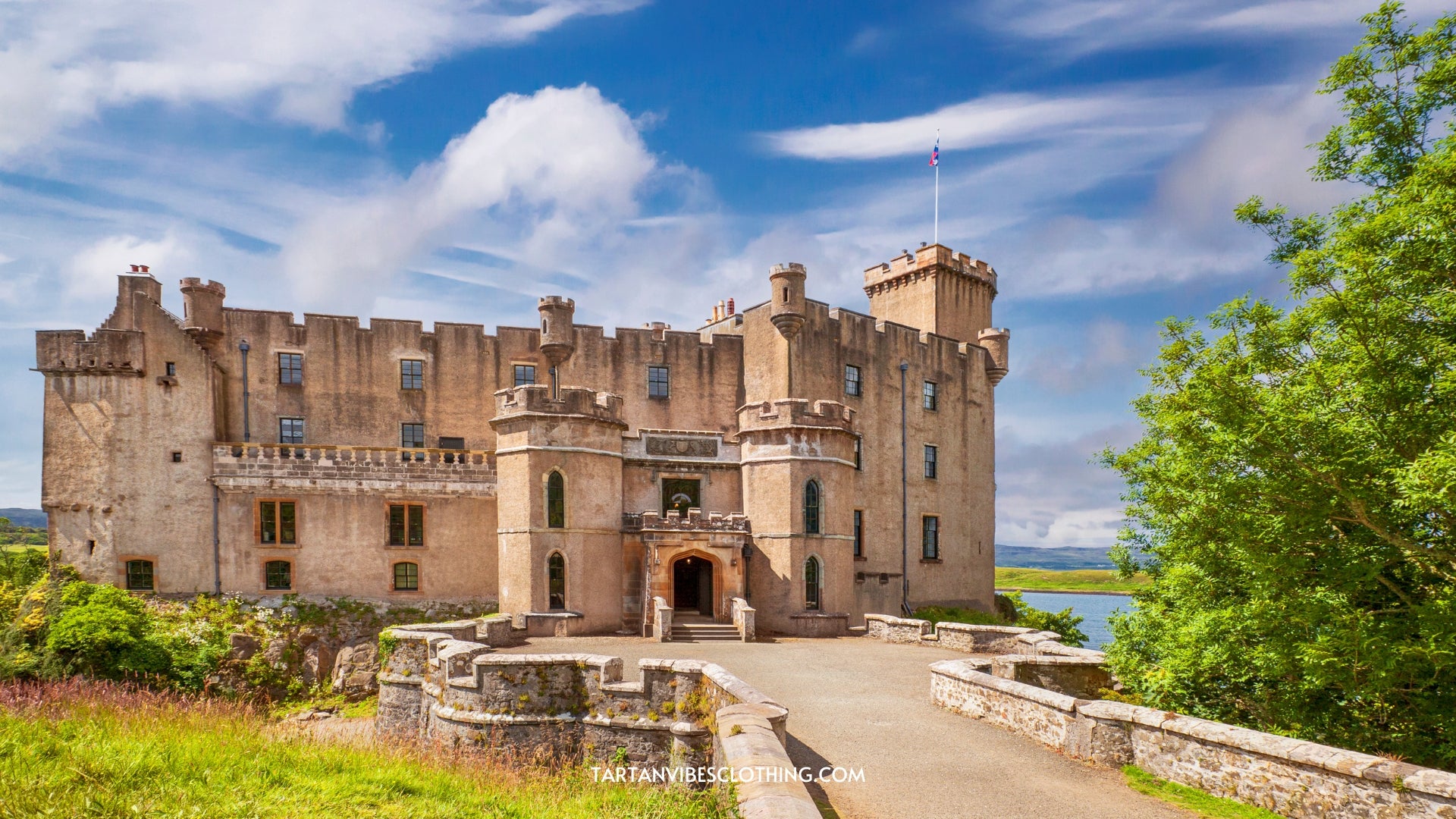
800 Years of Continuous Occupation
For over 800 years, the line of MacLeod of MacLeod has occupied this ancestral seat. Few clans can claim such an unbroken tenure.
This continuity is why navigational searches for Clan MacLeod often lead directly to Dunvegan.
For many in the diaspora, it is proof that their story still stands.
Sea-Loch Military Architecture
Unlike inland fortresses, Dunvegan was built with maritime logic in mind.
Approach by water was controlled. The sea loch acted as both a highway and a defense barrier. This reflects Norse-influenced coastal strategy more than mainland feudal warfare.
Geography here is not scenery. It is a strategy.
The Fairy Flag (Am Bratach Sìth)
The Fairy Flag, known as Am Bratach Sìth, is one of Scotland’s most mysterious clan relics. Scientific textile analysis suggests the surviving silk dates to the 13th century. However, some scholars believe fragments may originate from earlier Mediterranean or Crusader-era trade routes.
From a research perspective, it represents the intersection of Norse Gaelic folklore and physical artifact.

Alongside it are other clan treasures:
The Dunvegan Cup
Sir Rory Mor's Horn
These objects function like a Crest badge in material form. They symbolize authority, legitimacy, and what might be called a supernatural mandate.
Compare this to the Stone of Scone, which was used by the Scottish monarchy. Clan relics operate as symbolic anchors of continuity.
For many heritage seekers, Dunvegan is not just stone walls. It is validation.
Clan Branches & Associated Families — Beyond a Single Bloodline
The Two Primary Lineages
The two foundational branches remain historically distinct:
MacLeod of MacLeod in Skye and Harris
MacLeod of Lewis in Lewis
Understanding which line you connect to shapes the accuracy of your genealogy.
The Sept System Explained
A sept was not automatically blood-related to Leod.
It was a functional alliance.
Smaller families were required to provide military or labor service. In return, the Chief offered protection. Allegiance defined membership more than DNA.
Many modern heritage seekers confuse clan allegiance with biological descent.
They are not the same.
Why DNA Doesn’t Always Give Clear Answers
Modern DNA testing can be helpful — but it doesn’t always provide a simple “yes or no” answer.
In the Hebrides, Norse and Gaelic families lived, intermarried, and aligned with one another for centuries. Over time, those lines blended. That means genetic results today may show regional connections without proving descent from a specific clan chief.
Historically, belonging to a clan was often about allegiance and protection, not just blood.
For modern descendants, DNA should support your research — not replace traditional records such as parish documents and migration records.
Belonging has always been more complex than a single test result.
Major Septs of Clan MacLeod
Common sept names include:
MacAskill
MacAulay
Tolmie
Harold
Lewis
Sept lists vary across sources because political absorption and surname shifts occurred over centuries.
Modern DNA testing in Hebridean populations often cannot definitively prove clan linkage due to overlapping lineages.
This is where many seekers feel either affirmed or confused.
Clan MacLeod Tartan & Symbols
Tartan Variations
As the clan evolved, visual identity became an important part of cultural expression. The most recognizable tartan associated with Clan MacLeod is the bold yellow pattern often called “Loud MacLeod”, traditionally linked to the Dunvegan line. A separate tartan is associated with the MacLeods of Lewis, reflecting the historical distinction between the two primary branches.
Recognized variations include:
MacLeod of Harris Tartan
MacLeod of Lewis Tartan
MacLeod of Raasay Tartan
MacLeod of Skye Tartan
MacLeod of Californian Tartan


These tartans appear in multiple colorways and weClan MacLeodave styles, including red, black-based, and green palettes, as well as ancient, modern, or weathered finishes.
While tartan patterns function as powerful symbols of identity, they represent affiliation and heritage rather than proof of direct lineage. Historical documentation remains the foundation of genealogical research.
Clan MacLeod Crest & Motto
Gaelic name: MacLeòid
Crest: A bull’s head between two flags
Motto: Hold Fast
Plant badge: Juniper
Traditional lands: Skye & Harris
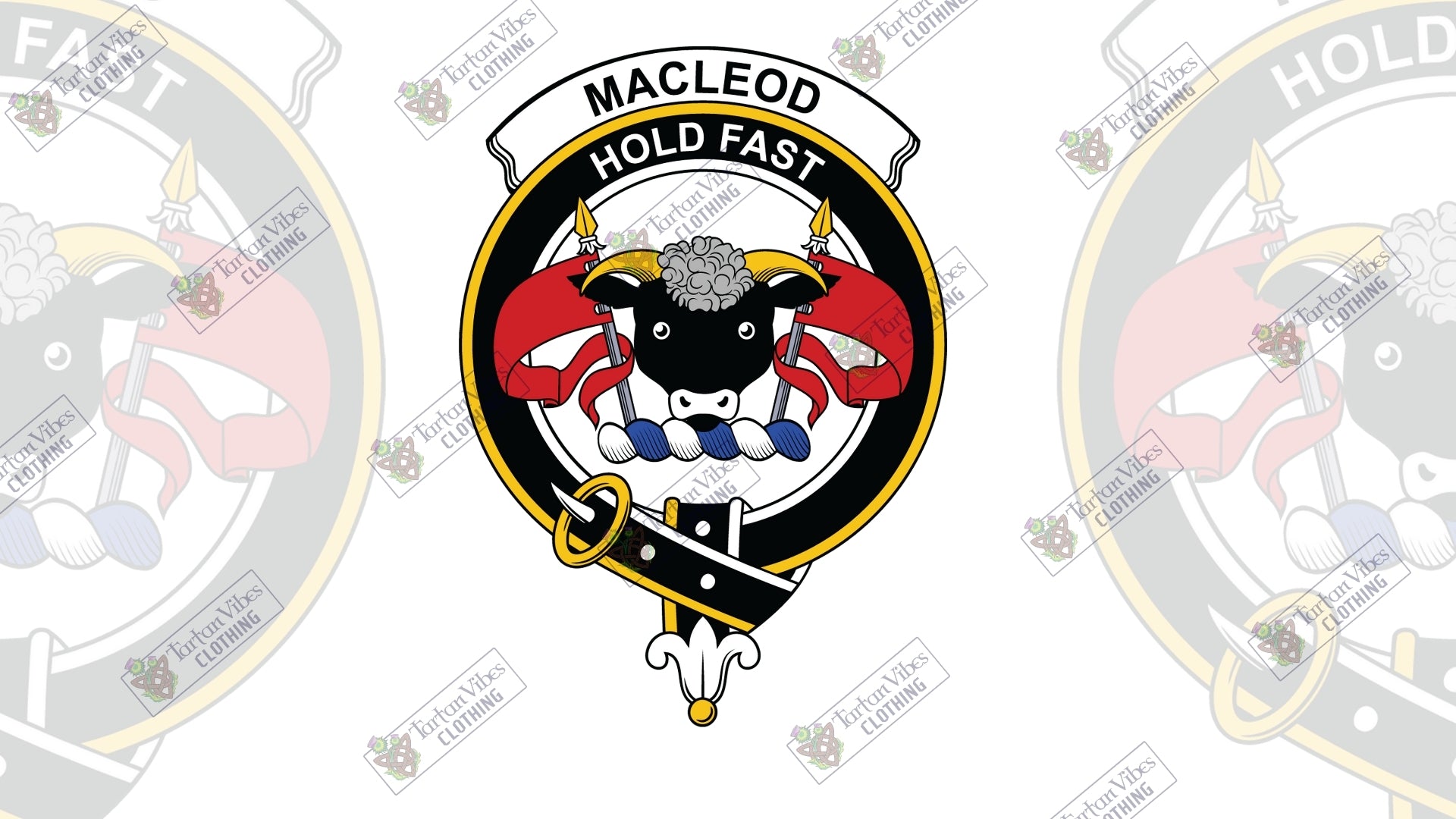
What it means:
The bull’s head symbolizes strength, courage, and steadfast resolve in Highland tradition.
Two flags represent clan identity and the defense of ancestral lands.
Hold Fast reflects the enduring spirit of Clan MacLeod — to stand firm, remain loyal, and never let go, whether in battle or in life.
The Clan MacLeod family crest and MacLeod clan motto together express a legacy rooted in resilience and continuity, especially the clan’s 800-year presence at Dunvegan Castle.
From Clan Territory to Global Diaspora — The Clearances to 2026
Economic Restructuring and the Highland Clearances
The transition from warrior society to sheep-based economic restructuring displaced many families.
The clan system weakened. Migration increased.
Migration Corridors
MacLeods emigrated to:
North Carolina
Nova Scotia
Ontario
Australia
The modern “Heritage Seeker” often descends from these migration corridors.
Clan as a Global Network
Today, Clan MacLeod operates as a global non-profit network under a recognized Chief. Clan societies in North America and Australia provide structure and continuity.
The motto remains simple and powerful: Hold Fast.
For many descendants, that phrase bridges eight centuries of change.
The Current Chief of Clan MacLeod
Clan MacLeod is currently led by Hugh Magnus MacLeod of MacLeod, born in 1973, the 30th Chief of the clan and head of Sìol Thormoid. He succeeded his father in 2007.
Based in London while maintaining ties to Dunvegan Castle, he works to preserve the ancestral estate and support the clan’s global network.

The Revival of Clan Parliament in the 20th Century
While the clan system weakened during the Clearances, the twentieth century saw a renewed effort to reconnect the global diaspora. Under Chief Dame Flora MacLeod, clansfolk were encouraged to rediscover their ancestral ties to Skye and Dunvegan.
This revival culminated in the first modern Clan MacLeod Parliament in 1956, held at Dunvegan Castle in the presence of Her Majesty Queen Elizabeth II. Since then, clan gatherings have continued at regular intervals, drawing MacLeods from across the world back to their ancestral seat.

Visiting the Isle of Skye in 2026 — A Responsible Heritage Guide
Visiting Dunvegan Castle
The best seasons are late spring and early autumn to avoid overtourism peaks. Booking in advance is wise.
Remember, this is not just a tourist site. It is a living ancestral seat.

Exploring MacLeod Landscapes
The Cuillin mountains and surrounding sea lochs frame the historic territories of the clan.
Seeing the landscape from elevated perspectives, even aerial photography where permitted, helps understand maritime defense logic.
Respecting Gaelic Heritage & Ecology
Engage respectfully. Support local Gaelic culture. Follow environmental guidance.
Heritage tourism should sustain the land, not strain it.
Your Next Step as a MacLeod Descendant
1️⃣ Research Your Parish and Migration Records
2️⃣ Connect with the Official Clan MacLeod Society
3️⃣ Attend a Gathering or Highland Games Event
4️⃣ Visit Dunvegan — Respectfully
Explore the Clan MacLeod collection today and carry 800 years of Dunvegan legacy wherever you go — Hold Fast.


Conclusions
Clan MacLeod is not only a name in history. It is a Norse-Gaelic legacy rooted in sea power, shaped by political judgment, and anchored for over eight centuries at Dunvegan Castle.
Belonging has never been defined only by blood. It has always involved allegiance, memory, and place.
If you carry the MacLeod name, or one of its septs, your heritage is not abstract. It can be lived.
Research your lineage. Connect with your clan. Stand on the shores of Skye if you can.
And when you wear the MacLeod tartan, wear it with understanding. Express your heritage with intention, not costume.
Hold Fast.
Frequently Asked Questions
What is the MacLeod clan known for?
Clan MacLeod is known for its Norse-Gaelic origins, maritime power in the Hebrides, and over 800 years of continuity at Dunvegan Castle on the Isle of Skye. The clan also played roles in Highland conflicts, including the Jacobite era, and is associated with the historic Fairy Flag.
Is McLeod a Viking name?
The surname MacLeod has Viking roots. It comes from the Scottish Gaelic “Mac Leòid,” meaning “son of Leòd,” a personal name believed to derive from Old Norse. The clan traces its origins to Norse influence in the Kingdom of the Isles during the 13th century.
What is the difference between McLeod and MacLeod?
There is no difference in meaning between McLeod and MacLeod. “Mc” is simply an abbreviation of “Mac,” the Gaelic word for “son of.” Variations such as Macleod, McLeod, and McCloud reflect spelling differences over time but refer to the same surname.
Is MacLeod an Irish or Scottish name?
MacLeod is primarily a Scottish surname. It derives from the Scottish Gaelic “Mac Leòid,” meaning “son of Leòd,” and is historically associated with the Isle of Skye and the Hebrides. While similar Gaelic naming patterns exist in Ireland, the MacLeod clan is distinctly Scottish.
Did the MacLeods fight at Culloden?
Some members of Clan MacLeod fought at the Battle of Culloden in 1746, particularly the MacLeods of Raasay, who supported the Jacobite cause. However, the chief of Clan MacLeod of Dunvegan did not officially support the rebellion, leading to divided participation within the clan.

Teresa Finn
As someone with a deep passion for clan heritage, especially the intriguing world of tartans and their rich traditions, I'm here to be your companion on this exciting journey. Together, we'll delve into the depths of clan history, uncovering the stories behind these vibrant tartans and making every connection to your heritage more meaningful.


