



Traditional Irish Clothing: From Gaelic Dress to Modern Heritage
by Teresa Finn on Aug 01, 2026
Table of Content
Traditional Irish clothing has its roots in practical garments shaped by Ireland’s climate, materials, and way of life. From the linen léine and woolen brat of Gaelic Ireland to Aran knitwear, Donegal tweed, flat caps, and wool shawls, Irish dress reflects centuries of changing culture and craftsmanship.
But not everything commonly labeled “traditional Irish” is historically ancient. Kilts, dance costumes, and modern heritage styles belong to different periods and traditions.
This guide explores what Irish people actually wore, how clothing differed for men and women, and which Irish heritage styles are still worn today.
What Does Traditional Irish Clothing Include?
Traditional Irish clothing is not one fixed national costume. It refers to clothing worn across different periods of Irish history, from the léine and brat of Gaelic Ireland to practical rural garments and later heritage pieces such as Aran sweaters, Donegal tweed, grandfather shirts, flat caps, and wool shawls.
What counts as “traditional” therefore depends on the period. Some garments document how Irish people actually dressed centuries ago, while others became symbols of Irish craftsmanship and cultural identity much later.
Ancient Gaelic Clothing vs Modern Irish Heritage Wear
The clothing of ancient and medieval Gaelic Ireland looked very different from what many people now picture as traditional Irish dress. A typical Gaelic wardrobe centered on the léine, a long linen tunic, and the brat, a woolen cloak or mantle worn for warmth and protection. Other garments, including trousers known as triúbhas, appear in later Gaelic dress traditions.
By contrast, many familiar symbols of Irish style belong to later periods. Grandfather shirts, tweed waistcoats, flat caps, and wool shawls are more closely associated with rural Ireland, while Aran knitwear and Donegal tweed clothing became enduring expressions of regional craftsmanship and Irish heritage.
This distinction also helps clear up a common misconception: the modern pleated kilt was not a core garment of ancient or medieval Irish dress. Its association with Irish identity developed much later. We’ll explore that history in more detail below.
Traditional Irish Clothing at a Glance
Garment |
Associated period/tradition |
Common material |
Traditional role |
Léine |
Gaelic Ireland |
Linen |
Long tunic and foundational garment |
Brat |
Gaelic Ireland |
Wool |
Cloak or mantle for warmth and protection |
Triúbhas |
Later Gaelic dress |
Wool/fabric |
Close-fitting trousers |
Grandfather shirt |
Rural/heritage Ireland |
Linen or cotton |
Practical collarless shirt |
Galway shawl |
Rural Ireland |
Wool |
Warm outer layer traditionally associated with women |
Aran sweater |
Irish heritage knitwear |
Wool |
Warm knitwear associated with Ireland's western islands |
Donegal tweed clothing |
Rural and heritage wear |
Wool tweed |
Durable jackets, waistcoats, caps, and outerwear |
Flat cap |
Rural/heritage Ireland |
Tweed or wool |
Practical headwear that became an Irish style icon |
Together, these garments show why traditional Irish clothing is better understood as an evolving tradition rather than a single outfit. Gaelic dress, rural workwear, regional textile crafts, and modern heritage clothing each represent a different chapter in the history of Irish dress.
The History of Traditional Irish Clothing
Ancient and Medieval Gaelic Dress
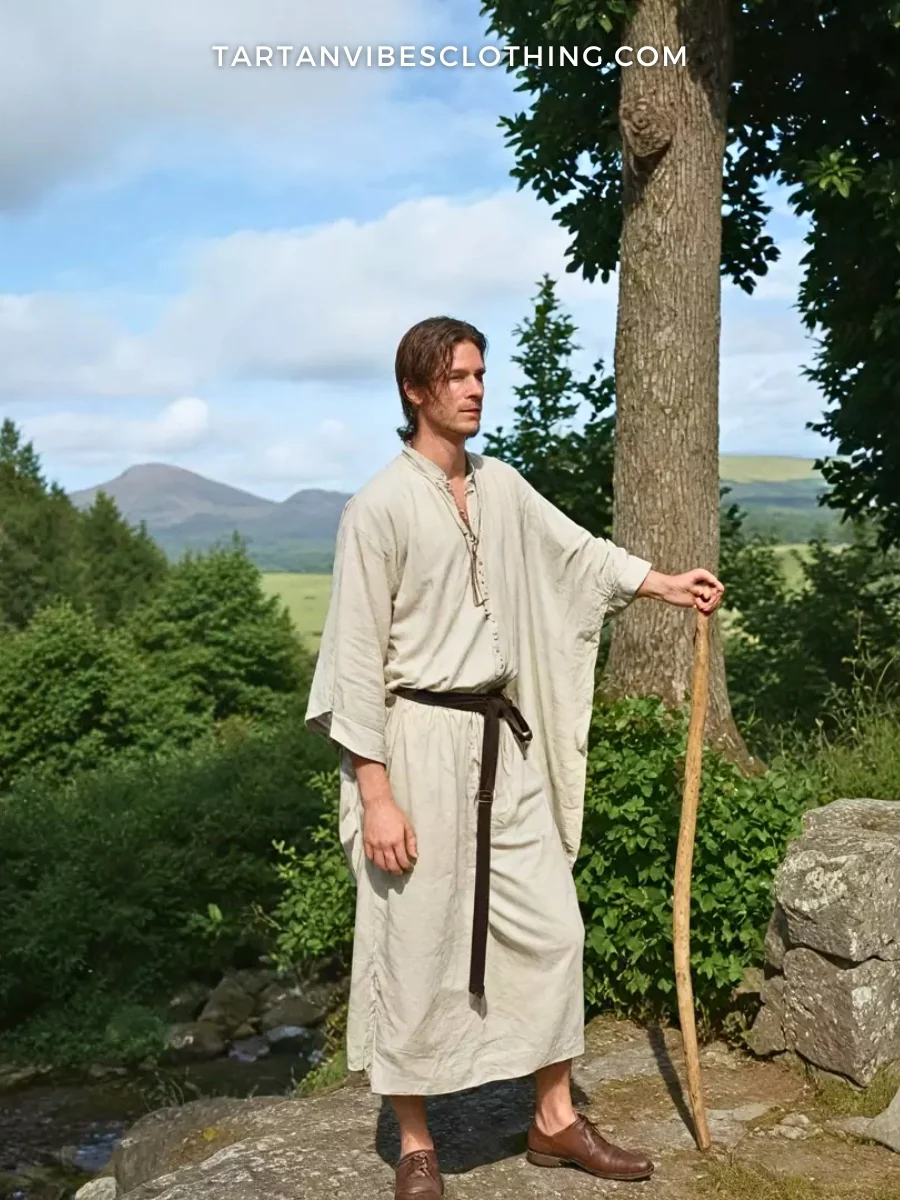
Before English styles became dominant, Gaelic Irish dress had its own recognizable garments. One of the most important was the léine, a long linen tunic worn in different forms by both men and women. Historical descriptions are particularly associated with long, generously cut léinte and yellow or saffron-colored examples.
Over the léine, people could wear a brat, a rectangular woolen cloak or mantle fastened around the shoulders. Ireland's cool, wet climate made wool valuable for outerwear. Clothing could also reflect social status: the quality and quantity of fabric, color, and decoration varied according to wealth and rank. Clothing also varied by period and region, as reflected in the National Museum of Ireland’s costume collections and research.
Trousers known as triúbhas also appear in accounts of Gaelic dress, particularly in later periods and among men. Together, garments such as the léine and brat provide a more historically grounded picture of Gaelic Irish clothing than the modern green costumes or kilts often used to represent Ireland today.
How Irish Clothing Changed Under English Rule
As English authority expanded in Ireland, distinctive Gaelic customs—including clothing—were sometimes targeted by laws encouraging English cultural practices. The Statutes of Kilkenny (1366) and later Tudor policies attempted to regulate aspects of Irish dress and identity.
These measures did not transform Irish clothing overnight. Over time, however, political, economic, and cultural change contributed to the decline of older Gaelic styles as English and broader European fashions became increasingly influential.
19th-Century Rural Irish Clothing
By the 19th century, everyday Irish dress looked very different from medieval Gaelic clothing. For most rural communities, durability, warmth, affordability, and practicality mattered more than preserving an ancient national costume.
Men commonly wore combinations of shirts, trousers, waistcoats, jackets, and practical headwear. Collarless shirts—later popularly associated with the Irish grandfather shirt—became part of the image of traditional rural menswear, while wool and tweed were well suited to Ireland's climate.
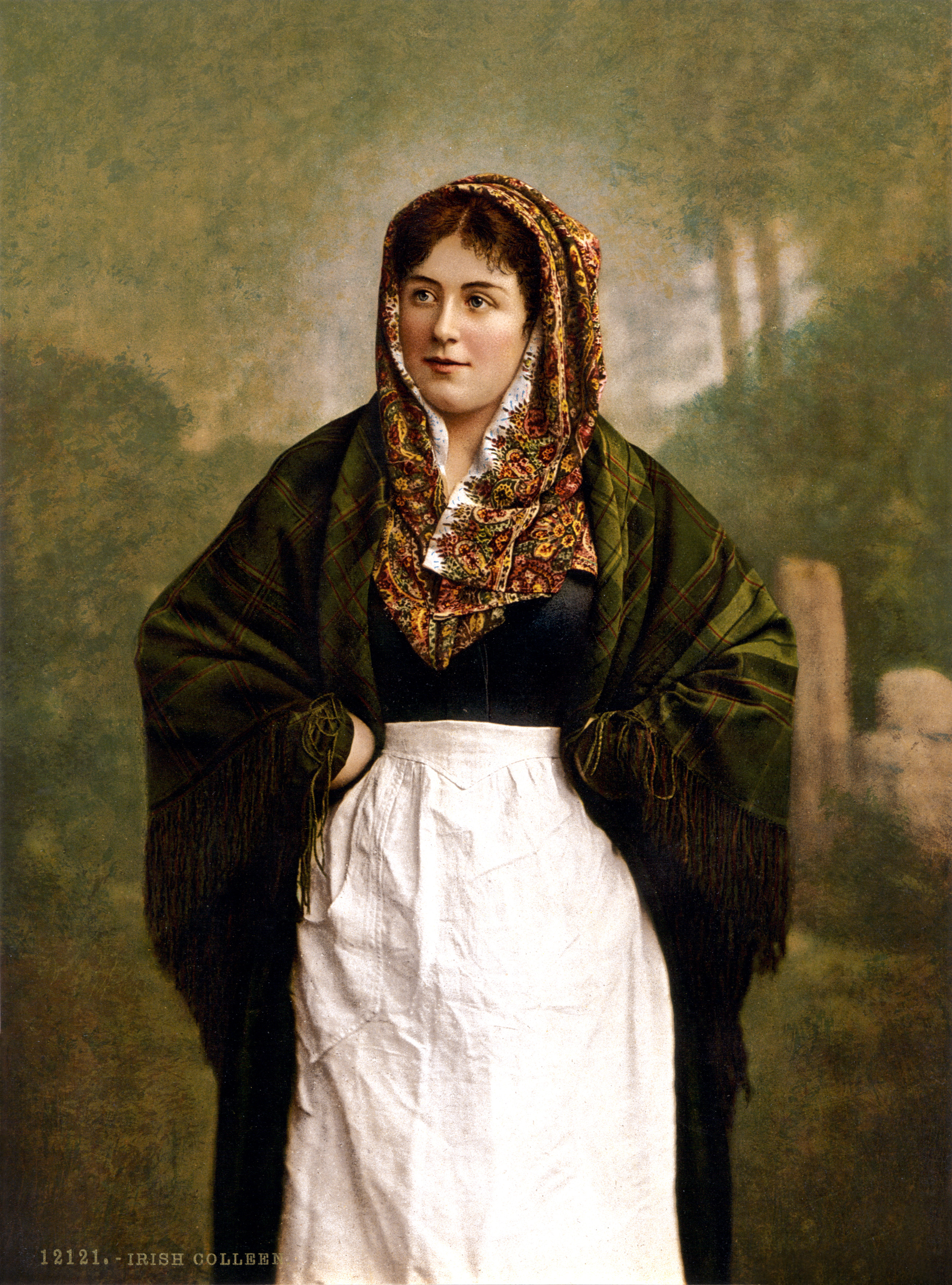
Women generally wore long skirts or dresses with aprons, cloaks, and shawls layered for warmth. The Galway shawl, particularly associated with western Ireland, later became one of the best-known symbols of rural Irish women's dress.
This period is important because much of what people now visualize as “traditional Irish clothing” actually draws from rural 19th- and early-20th-century Ireland rather than ancient Gaelic dress.
Celtic Revival and Modern Heritage Dress
During the Celtic Revival of the late 19th and early 20th centuries, renewed interest in Irish language, folklore, art, sport, and national identity also influenced how Irish heritage was represented through clothing.
Some older traditions were rediscovered, while other styles were adapted or newly associated with Irish identity. This distinction matters: not every garment marketed today as “traditional Irish” can be traced unchanged back to medieval Ireland.
The Irish kilt, for example, belongs more to this later revival and heritage context than to ancient Gaelic everyday dress. Irish dance costumes likewise developed into highly distinctive performance clothing rather than preserving an unchanged medieval national costume.
At the same time, genuine regional crafts and practical garments—including Aran knitwear, Donegal tweed, woolen outerwear, grandfather shirts, and flat caps—became enduring symbols of Irish heritage.
Traditional Irish clothing today is therefore best understood as layers of history: Gaelic dress at its oldest roots, rural clothing shaped by everyday life, and modern heritage wear that keeps Irish materials, craftsmanship, and cultural identity visible in contemporary fashion.
Traditional Irish Clothing for Men and Women
Traditional Irish clothing for men and women varied by period, region, social status, and daily life. In Gaelic Ireland, men and women shared garments such as the léine and brat, while later rural dress developed more recognizable differences between men's shirts, waistcoats, and trousers and women's dresses, skirts, aprons, and shawls.
What did a Traditional Irish Outfit Look Like? There was no single traditional Irish outfit, as clothing varied by period and region. A Gaelic man might wear a léine, belt, and brat, while a 19th-century rural man typically wore a shirt, waistcoat, wool trousers, and cap. A rural Irish woman commonly wore a long dress or skirt with an apron and woolen shawl.
Traditional Irish Clothing for Men
Historically, traditional Irish clothing for men was practical, layered, and suited to Ireland's climate. In Gaelic Ireland, the léine formed a basic layer of dress. This long linen tunic could be worn beneath a brat, a woolen cloak that provided warmth and protection from the weather.
By the 19th century, men's rural clothing had changed considerably. Common garments included:
Grandfather shirts: Collarless or band-collar shirts associated with practical Irish rural wear.
Waistcoats: Worn over shirts as an everyday layer, often beneath a heavier jacket or coat.
Wool trousers: Durable clothing suited to agricultural work and cool weather.
Tweed jackets and flat caps: Woolen pieces that became strongly associated with Irish country style, particularly through regional textile traditions such as Donegal tweed.
Aran sweaters: Distinctive wool knitwear associated with the Aran Islands and Ireland's western coast, later becoming an internationally recognized symbol of Irish craft.

A historical Irish man's outfit, therefore, should not automatically be pictured as a tartan kilt with a green shirt. Depending on the period, a more representative image would be a léine and brat in Gaelic Ireland, or a shirt, waistcoat, wool trousers, jacket, and cap in later rural Ireland.
Traditional Irish Clothing for Women
Traditional Irish clothing for women changed considerably over time. In Gaelic Ireland, women wore forms of the léine, often with outer garments such as a gown or woolen brat. By the 19th century, rural Irish women were more commonly associated with long dresses or skirts, aprons, shawls, and practical outer layers suited to everyday work and Ireland’s climate.
In later rural Ireland, women's clothing typically centered on long, functional layers rather than the elaborate green dresses sometimes presented today as an Irish “national costume.” Common elements included:
Long dresses and skirts: Practical garments that formed the foundation of everyday rural dress.
Aprons: Frequently worn over dresses or skirts for domestic and working life.
Woolen cloaks and shawls: Used as warm outer layers in Ireland's damp and windy climate.
The Galway shawl: A particularly recognizable example of Irish women's heritage clothing, associated with Galway and western Ireland.
The result was clothing shaped primarily by work, weather, available textiles, and local customs, rather than by a single standardized women's national costume.

Modern Irish-inspired women's fashion may draw on these traditions through woolens, tartan patterns, Celtic motifs, shawls, skirts, and other heritage details. These pieces are better described as Irish heritage or Irish-inspired clothing when they are modern interpretations rather than historical garments.
Irish Dancing Dresses vs Historical Women's Clothing
One of the most common misconceptions about traditional female Irish clothing is that today's elaborate Irish dancing dress represents what Irish women historically wore in everyday life.
It does not.
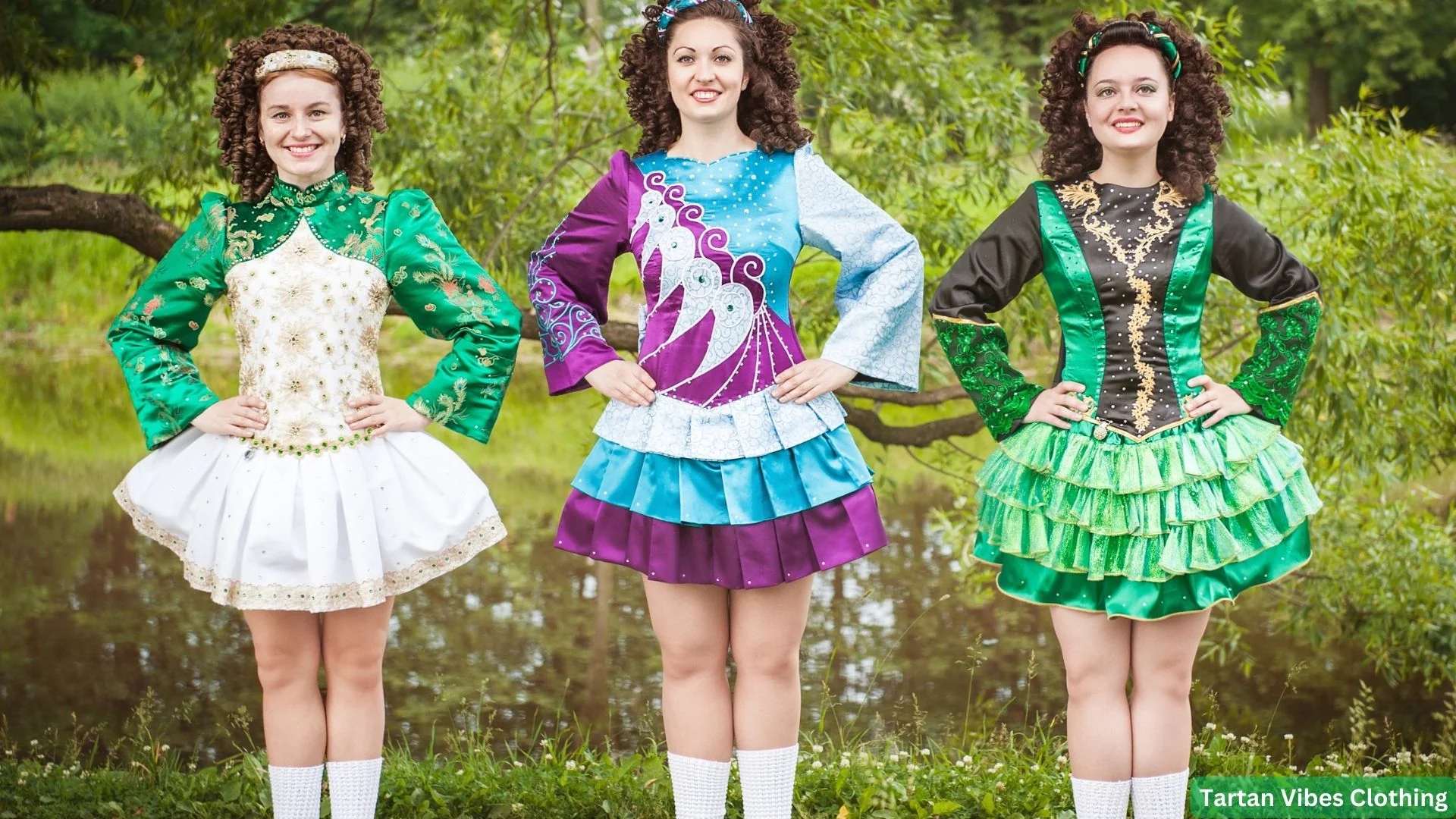
Historical Irish women's clothing was generally practical and layered, using garments such as the léine, long skirts or dresses, aprons, cloaks, and woolen shawls depending on the period. Modern Irish dance dresses, by contrast, are specialized performance costumes designed for Irish step dancing.
Contemporary competition dresses are recognizable for their structured silhouettes, vivid colors, Celtic-inspired decoration, embroidery, and increasingly elaborate designs. Their appearance developed alongside the evolution of organized Irish dance rather than surviving unchanged from ancient Gaelic clothing.
Historical Irish Women's Clothing |
Modern Irish Dancing Dress |
Designed primarily for everyday life and weather |
Designed for dance and stage performance |
Linen and wool were important materials |
Uses modern performance fabrics and decoration |
Léine, dresses, skirts, cloaks, aprons, shawls |
Structured competition or performance dress |
Generally practical construction |
Designed for visual impact and movement |
Changed across centuries and regions |
Developed through modern Irish dance culture |
So, when researching what Irish women traditionally wore, it is important to separate historical everyday dress from Irish dance costume. Both form part of Ireland's cultural story, but they represent different periods, purposes, and traditions.
Iconic Irish Clothing, Fabrics, and Craftsmanship
Aran Sweaters
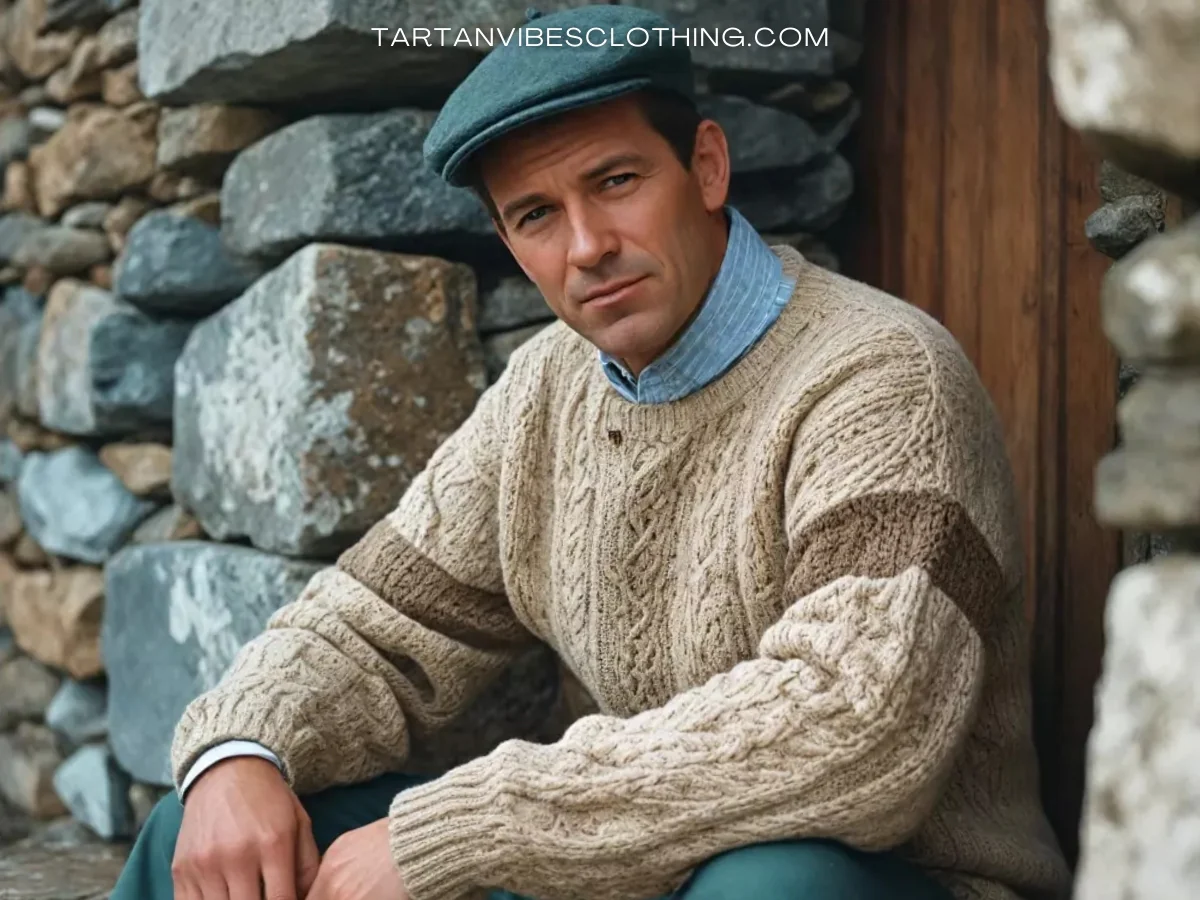
The Aran sweater, associated with the Aran Islands off County Galway, developed into its familiar cable-patterned form during the early 20th century. Traditionally associated with cream or natural-colored wool, it is known for textured cable, diamond, and geometric stitches.
Although popular stories give these stitches symbolic meanings—such as cables representing fishermen’s ropes—many elaborate interpretations are modern folklore. The Victoria and Albert Museum (V&A) likewise dates the familiar Aran jumper to the 20th century.
Today, Aran sweaters bridge traditional craft and contemporary fashion, making them one of the clearest examples of Irish heritage clothing still worn in everyday life.
Donegal Tweed and Flat Caps
Donegal tweed, associated with County Donegal, is a durable woolen textile often recognized by colorful flecks woven through the fabric. Its warmth made it well suited to jackets, waistcoats, coats, trousers, and flat caps.
The flat cap is not uniquely Irish, but its association with rural Irish dress and Ireland’s tweed tradition helped make the Irish tweed cap an enduring heritage symbol.
Modern Donegal tweed clothing preserves that connection between place, material, craftsmanship, and function.

Grandfather Shirts
The Irish grandfather shirt is a loose-fitting shirt recognized by its collarless or band-collar neckline and short buttoned placket. Commonly made from cotton or linen, its simple construction made it comfortable for work and easy to layer beneath waistcoats, sweaters, or jackets.
Today, the grandfather shirt remains an understated and wearable symbol of Irish rural heritage.
Galway Shawls and Woolen Outerwear
The Galway shawl, associated with Galway and western Ireland, was a large woolen outer layer worn by rural women for protection from cold and wind.
Along with woolen cloaks and capes, it reflects the importance of practical layered outerwear in Ireland’s damp climate. Modern shawls and capes continue this heritage, although they should not be presented as exact reproductions of historical garments.
Irish Linen and Wool
Linen and wool are two of the most important materials in Irish clothing history. Linen was lightweight and breathable, making it suitable for garments such as the Gaelic léine, while wool provided the warmth and weather protection needed for cloaks, shawls, and later textiles such as Donegal tweed and Aran knitwear.
Together, these materials show how Irish clothing evolved around climate, function, local resources, and craftsmanship—a connection that continues in Irish heritage clothing today.
Did Irish People Traditionally Wear Kilts?
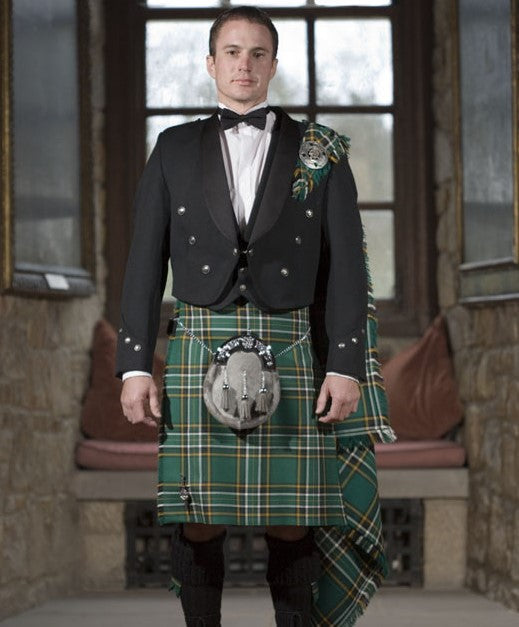
Ancient and medieval Irish people did not traditionally wear the modern pleated kilt as a core part of native Irish dress. Gaelic clothing was instead associated with garments such as the léine, a long linen tunic, and the brat, a woolen cloak. Kilts became associated with Irish identity much later, particularly through military, piping, and cultural revival traditions.
This distinction matters because modern images of “Celtic clothing” often blend Irish and Scottish dress traditions that developed differently.
The Metropolitan Museum of Art’s history of the kilt likewise traces the recognizable modern kilt to 18th-century Scottish Highland dress, while noting that earlier Scottish Gaels shared garments such as the léine and brat with their Irish counterparts.
What Ancient Irish People Actually Wore
In Gaelic Ireland, the léine and brat were far more representative of traditional clothing than the kilt.
The léine was a long linen tunic worn in various forms, while the brat was a woolen cloak or mantle used as an outer layer. Historical accounts also refer to garments such as triúbhas, or trousers, particularly in later Gaelic dress.
So, if the question is “Did ancient Irish people wear kilts?”, the most historically accurate short answer is that they did not wear the modern tailored kilt commonly recognized today.
This does not mean Ireland lacked distinctive dress. Rather, Ireland had its own Gaelic clothing traditions, which should not be reconstructed simply by applying later Scottish Highland clothing to medieval Irish people.
When Kilts Became Associated With Ireland
The association between Ireland and kilts developed considerably later than ancient Gaelic dress.
During the Gaelic Revival of the late 19th and early 20th centuries, renewed interest in Celtic identity encouraged the adoption and reinterpretation of cultural symbols. Kilts began appearing in Irish nationalist, military, and piping contexts, where they offered a visible expression of Gaelic identity.
One particularly recognizable form is the saffron kilt, a solid yellow or mustard-colored kilt associated with some Irish regiments and pipe bands. Its color evokes the saffron or yellow tones historically associated with Gaelic dress, but the garment itself should not be confused with the earlier saffron léine.
Today, Irish kilts may be worn at weddings, Highland games, Celtic festivals, pipe-band events, and heritage celebrations. Modern Irish tartans associated with counties, organizations, surnames, or other identities are also available, but these should not automatically be interpreted as ancient Irish clan tartans.
In other words, the Irish kilt can be a meaningful form of modern Irish heritage dress without being presented as an unchanged garment from medieval Ireland.

Irish Kilts vs Scottish Kilts
The biggest difference between Irish and Scottish kilts is their historical context. The kilt has a much deeper and more central connection to Scottish Highland dress, while its widespread Irish association developed later.
Feature |
Irish Kilts |
Scottish Kilts |
Historical role |
Later heritage, military, piping, and cultural dress |
Deeply associated with Highland dress |
Ancient Gaelic Ireland |
Modern kilt was not a core garment |
Modern kilt also developed from earlier forms of Highland dress |
Traditional predecessor |
Léine and brat are more representative of historical Gaelic Irish dress |
Earlier Highland dress included the belted plaid |
Common modern styles |
Saffron kilts and various tartan kilts |
Tartan kilts |
Tartan association |
County, organizational, surname, and modern heritage associations may be used |
Strong clan, district, military, and other established tartan traditions |
Modern occasions |
Weddings, pipe bands, festivals, heritage events |
Weddings, formal Highland dress, ceremonies, festivals, pipe bands |
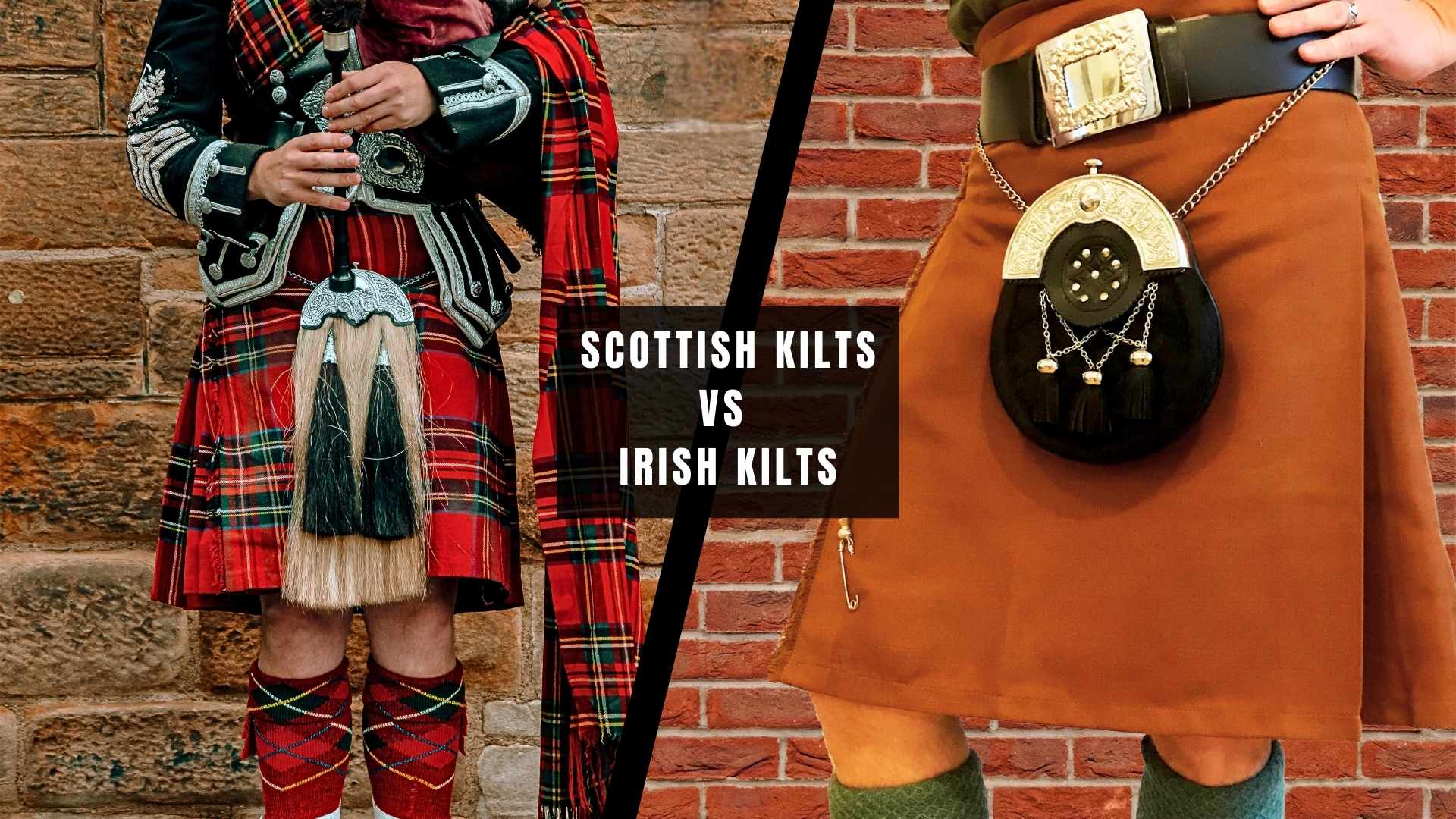
Therefore, saying “Irish people don't wear kilts” is too simplistic—but saying “the kilt is ancient traditional Irish clothing” is also misleading.
The key distinction is simple: the léine and brat belong to older Gaelic Irish dress, while Irish kilts primarily belong to later heritage traditions.
For a closer comparison of construction, tartans, history, and modern use, see our guide to Irish Kilts vs Scottish Kilts.
How to Wear Irish Heritage Style Today

Irish Heritage Outfits for Men
For men, focus on texture, layering, and understated heritage details:
Everyday: Aran sweater + dark jeans or wool trousers + leather boots.
Smart casual: Grandfather shirt + tweed waistcoat + tailored trousers.
Country-inspired: Donegal tweed jacket + neutral shirt + flat cap.
Celtic heritage: Add a subtle tartan, Celtic knot, or Irish-inspired accessory rather than combining multiple motifs at once.
For most occasions, one strong heritage piece creates a more authentic look than an outfit built entirely around Irish symbols.
Irish Heritage Outfits for Women
Modern Irish heritage outfits for women can draw from traditional fabrics and silhouettes without attempting to reproduce historical dress.
Try combinations such as:
Aran knitwear with jeans, trousers, or a simple skirt.
A wool shawl or cape over a neutral dress.
A tartan skirt with a plain knit top or coat.
Donegal tweed as a jacket, skirt, or accessory.
Subtle Celtic or Irish-inspired details as an accent.
The goal is to reference Irish materials, craftsmanship, colors, or patterns while keeping the overall outfit practical and contemporary.
Weddings, Festivals, and St. Patrick’s Day
The occasion determines how strongly heritage elements should feature.
For an Irish or Celtic wedding, men might choose a tweed waistcoat, heritage-inspired kilt, or tartan accessory, while women can incorporate tartan, wool, Celtic jewelry, or heritage colors into formal clothing.
At cultural festivals and heritage events, more expressive pieces—including Irish kilts and Celtic-inspired designs—can be appropriate because cultural identity is part of the occasion.
For St. Patrick’s Day, Irish style does not have to mean head-to-toe bright green. Aran knitwear, tweed, tartan accents, or colors inspired by the Irish landscape can create a more wearable connection to Irish heritage.
How to Choose Authentic Irish-Inspired Clothing
“Traditional,” “heritage,” and “Irish-inspired” do not mean exactly the same thing. When choosing clothing, consider:
Material: Wool, linen, and tweed have genuine connections to Irish textile traditions.
Craftsmanship and origin: Check where and how an item was made rather than relying only on Celtic-looking decoration.
Historical accuracy: A modern tartan jacket or Celtic-print hoodie can celebrate Irish heritage without being historical Irish clothing.
Tartan claims: County, surname, and modern Irish tartans should not automatically be described as ancient Irish clan tartans.
Purpose: Decide whether you want an everyday heritage piece, ceremonial clothing, or a historically inspired garment.
The best modern Irish heritage style does not need to imitate the past exactly. It understands the history, distinguishes tradition from modern interpretation, and carries meaningful Irish elements into clothing that can actually be worn today.


Conclusion
Traditional Irish clothing is an evolving heritage rather than a single national costume. From the léine and brat of Gaelic Ireland to rural shawls, grandfather shirts, Aran knitwear, and Donegal tweed, each garment reflects a different period of Irish history, craftsmanship, and everyday life.
Today, that heritage can be celebrated without recreating historical dress.
Explore Tartan Vibes Clothing’s Irish-inspired clothing to bring Irish and Celtic influences into a modern wardrobe.
FAQs About Traditional Irish Clothing
What Is a Celtic Dress Called?
There is no single historical garment called a “Celtic dress.” Celtic cultures developed different clothing traditions across regions and periods. In Gaelic Ireland, characteristic garments included the léine, a long linen tunic, and the brat, a woolen cloak or mantle.
Does Ireland Have a Traditional National Costume?
Ireland does not have one standardized national costume representing every period of its history. Irish dress evolved from Gaelic garments such as the léine and brat to later rural clothing and regional heritage traditions, including Aran knitwear and Donegal tweed.
Did Irish Women Wear the Same Clothing as Irish Men?
Men and women in Gaelic Ireland could share garments such as forms of the léine and brat, although dress varied by gender, period, status, and region. By the 19th century, rural women were more commonly associated with long dresses or skirts, aprons, shawls, and practical outer layers.
What Colors Were Traditionally Worn in Irish Clothing?
Traditional Irish clothing was not limited to green. Historical garments appeared in natural and dyed colors depending on the material, available dyes, period, and social status. Yellow or saffron is particularly associated with descriptions of some Gaelic Irish clothing, while wool garments could appear in a variety of shades.
Is Tartan Traditional Irish Clothing?
Tartan can be part of modern Irish heritage clothing, but it should not automatically be considered an ancient Irish clan tradition. Tartan has a much stronger historical association with Scotland, while many Irish county, surname, and heritage tartans worn today reflect later expressions of Irish identity.

Teresa Finn
As someone with a deep passion for clan heritage, especially the intriguing world of tartans and their rich traditions, I'm here to be your companion on this exciting journey. Together, we'll delve into the depths of clan history, uncovering the stories behind these vibrant tartans and making every connection to your heritage more meaningful.


