



Scottish Slang Words, Phrases & Insults Explained: Speak Like a True Scot
by Teresa Finn on Jun 12, 2026
Table of Content
Scottish slang refers to the informal words and expressions commonly used in everyday conversations across Scotland. Popular examples include wee (small), aye (yes), ken (know), bairn (child), and bonnie (beautiful). While many of these terms come from Scots, they remain widely used in modern Scottish speech.
Whether you're planning a trip to Scotland, exploring your Scottish heritage, or simply curious about local expressions, understanding Scottish slang can help you better connect with Scottish culture and communication. This guide covers the most common Scottish slang words, phrases, insults, and sayings, along with examples of how they're used in real life.
Most Common Scottish Slang Words at a Glance
Scottish Slang |
Meaning |
Aye |
Yes |
Naw |
No |
Wee |
Small |
Ken |
Know |
Bairn |
Child |
Bonnie |
Beautiful |
Blether |
Chat |
Braw |
Excellent |
Crabbit |
Grumpy |
Gallus |
Bold, cheeky |
Most Common Scottish Slang Words
Aye
Meaning: Yes.
Example: "Aye, I'll meet you there later."
Usage: One of the most recognizable Scottish words and a common alternative to "yes."
Naw
Meaning: No.
Example: "Naw, I don't think so."
Usage: Frequently used in casual conversations throughout Scotland.
Wee
Meaning: Small or little.
Example: "Let's have a wee break."
Usage: Perhaps the most famous Scottish slang word, used to describe anything small or short.
Ken
Meaning: To know.
Example: "D'ye ken what time it is?"
Usage: Commonly heard in both casual conversations and traditional Scottish speech.
Bairn
Meaning: Child.
Example: "She's got three bairns."
Usage: A traditional Scottish word still widely understood across the country.
Wean
Meaning: Child.
Example: "The weans are playing outside."
Usage: Particularly common in Glasgow and western Scotland.
Bonnie
Meaning: Beautiful, attractive, or lovely.
Example: "That's a bonnie view."
Usage: Often used to describe people, landscapes, and places.
Lass
Meaning: Girl or young woman.
Example: "She's a friendly lass."
Usage: A common Scottish alternative to "girl."
Lad
Meaning: Boy or young man.
Example: "He's a good lad."
Usage: Often used informally among friends and family.

Pish
Meaning: Nonsense, rubbish, or something of poor quality.
Example: "That movie was pure pish."
Usage: Often used to dismiss an idea, opinion, product, or experience as worthless or disappointing.
Blether
Meaning: To chat for a long time.
Example: "We had a wee blether over coffee."
Usage: Usually refers to friendly conversation or gossip.
Braw
Meaning: Excellent, fine, or impressive.
Example: "It's a braw day today."
Usage: Used to describe something particularly good or enjoyable.
Crabbit
Meaning: Grumpy or bad-tempered.
Example: "He's a bit crabbit this morning."
Usage: Commonly used when someone is in a bad mood.
Gallus
Meaning: Confident, cheeky, or bold.
Example: "She's quite gallus for her age."
Usage: Often carries a positive sense of confidence and personality.
Dreich
Meaning: Cold, dull, wet, and gloomy weather.
Example: "It's a dreich day outside."
Usage: A uniquely Scottish way to describe miserable weather.
Drookit
Meaning: Completely soaked.
Example: "I got drookit walking home in the rain."
Usage: Commonly used after heavy rain.
Peely Wally
Meaning: Pale or unhealthy-looking.
Example: "You're looking a bit peely wally today."
Usage: Often used when someone looks tired or unwell.

Scran
Meaning: Food or a meal.
Example: "Let's grab some scran."
Usage: Popular informal slang, especially among younger generations.
Shoogle
Meaning: To shake or wobble.
Example: "The chair's a bit shoogly."
Usage: Often used to describe something unstable.
Keek
Meaning: A quick look or peek.
Example: "Have a keek out the window."
Usage: A traditional Scots word still heard in everyday speech.
Oxter
Meaning: Armpit.
Example: "He carried the newspaper under his oxter."
Usage: One of the more distinctive Scots body-related terms still in use today.
Hoachin'
Meaning: Extremely crowded or packed with people.
Example: "The pub was hoachin' on Saturday night."
Usage: Frequently used to describe busy pubs, festivals, concerts, and public gatherings.
Common Scottish Slang Phrases
Ah Dinnae Ken
Meaning: I don't know.
Example: "Ah dinnae ken where he went."
Usage: One of the most recognizable Scottish expressions, used whenever someone is unsure about something.

It’ll Be a Skoosh
Meaning: It'll be easy.
Example: "Don't worry about the exam—it'll be a skoosh."
Usage: Used to reassure someone that a task won't be difficult.
Ma Heid’s Mince
Meaning: I'm confused.
Example: "After reading all those instructions, ma heid's mince."
Usage: A humorous way to describe feeling mentally overwhelmed.
Am Pure Done In
Meaning: I'm exhausted.
Example: "I've been working all day—am pure done in."
Usage: Commonly used after a long or tiring day.
Pure Dead Brilliant
Meaning: Extremely good or impressive.
Example: "That concert was pure dead brilliant."
Usage: One of Scotland's most famous modern expressions.
Gonnae No Dae That?
Meaning: Please stop doing that.
Example: "Gonnae no dae that? You're making too much noise."
Usage: Often said jokingly among friends and family.

Yer Lookin' a Bit Peely Wally
Meaning: You look pale or unwell.
Example: "Are you feeling alright? You're lookin' a bit peely wally."
Usage: A common phrase used when someone appears tired or sick.
Whit's Fur Ye'll No Go By Ye
Meaning: What's meant for you won't pass you by.
Example: "Don't worry about missing that opportunity—whit's fur ye'll no go by ye."
Usage: A traditional Scottish saying about fate and destiny.
Haud Yer Wheesht
Meaning: Be quiet.
Example: "Haud yer wheesht, I'm trying to listen."
Usage: Can be playful or slightly forceful depending on context.
Haste Ye Back
Meaning: Come back soon.
Example: "Thanks for visiting—haste ye back!"
Usage: A warm and traditional Scottish farewell.
Nae Bother
Meaning: No problem.
Example: "Thanks for helping." "Nae bother."
Usage: One of the most common responses in everyday Scottish conversation.
Away An' Bile Yer Heid
Meaning: Go away and stop bothering me.
Example: "Away an' bile yer heid!"
Usage: Usually said jokingly, although it can also express irritation.

Yaldi!
Meaning: An exclamation of excitement, celebration, or enthusiasm.
Example: "Yaldi! We won the match!"
Usage: Commonly shouted when celebrating good news, a victory, or an exciting event. It's similar to saying "awesome!" or "hooray!" in English.
Scottish Insults Dictionary
Scottish insults are known for being clever, humorous, and often less serious than they sound. While some are genuinely offensive, many are used playfully among friends and family. The meaning often depends on tone, context, and who is saying it.
Scottish Insult |
Meaning |
Severity |
Example |
Numpty |
A foolish or silly person |
Mild |
"Don't be such a numpty." |
Eejit |
An idiot; someone acting stupidly |
Mild |
"Ya eejit, you forgot your keys again." |
Dafty |
A silly person |
Mild |
"Stop being a dafty." |
Dobber |
A foolish, annoying, or unpleasant person |
Medium |
"Stop acting like a dobber and help us out." |
Gowk |
A fool or simple-minded person |
Mild |
"Only a gowk would do that." |
Feartie |
A coward; someone easily scared |
Mild |
"Don't be a feartie." |
Rocket |
Someone behaving foolishly or irrationally |
Mild |
"That guy's an absolute rocket." |
Gommy |
A silly, awkward, or clueless person |
Mild |
"Don't stand there looking all gommy." |
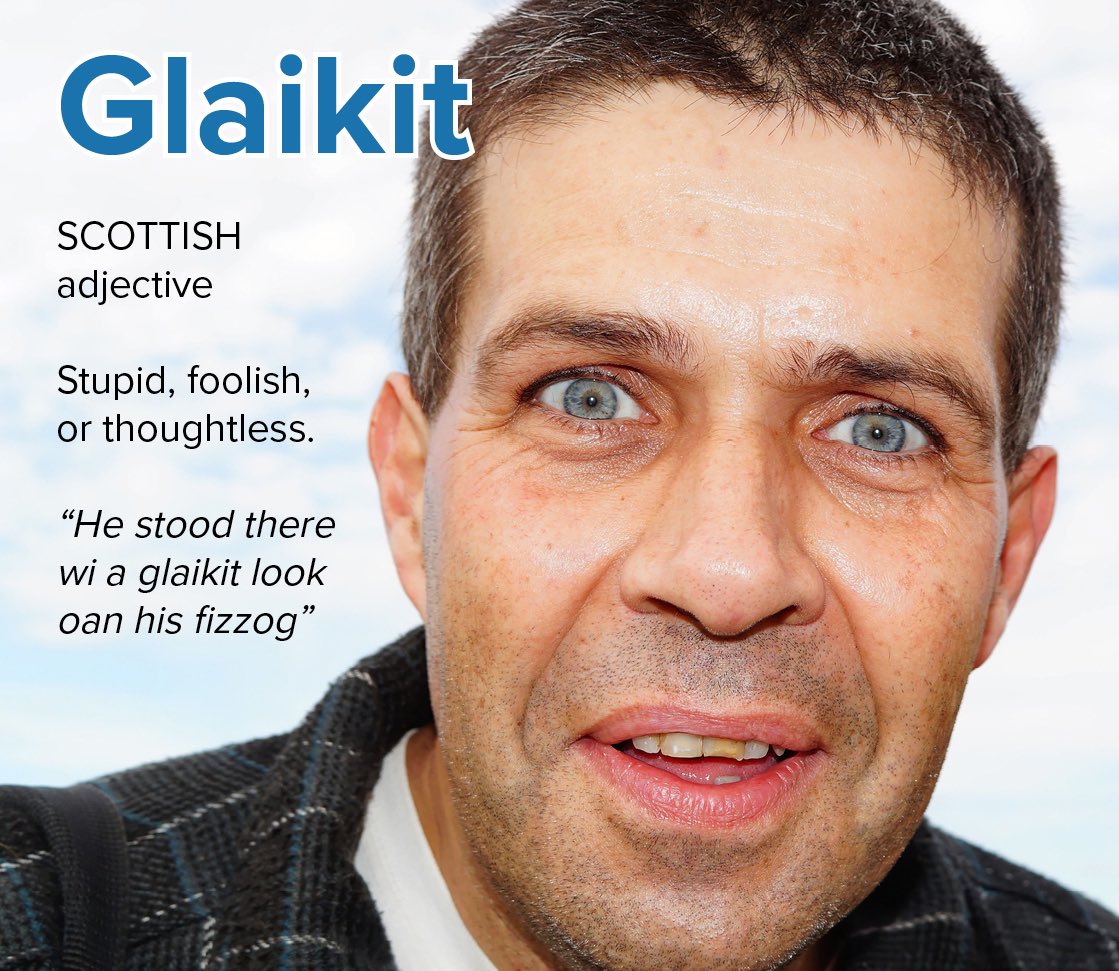
Glaikit |
Thoughtless, vacant-looking, or lacking awareness |
Mild |
"You look a bit glaikit today." |
Nyaff |
An annoying, irritating, or insignificant person |
Medium |
"Ignore him, he's a nyaff." |
Roaster |
Someone embarrassing, ridiculous, or socially awkward |
Medium |
"He's making a fool of himself. What a roaster." |
Lavvy Heid |
Literally 'toilet head'; a joking insult for someone acting foolishly |
Medium |
"Don't be such a lavvy heid." |
Bahookie |
A humorous word for someone's backside; sometimes used teasingly |
Medium |
"Get your bahookie over here." |
Scabby |
Dirty, cheap, or unpleasant |
Medium |
"That's a bit scabby." |
Naff |
Boring, uncool, or lacking style |
Medium |
"That joke was pretty naff." |
Hackit |
Ugly or unattractive |
Medium |
"That's a hackit old jumper." |
Bawbag |
A crude insult for an annoying or unpleasant person |
Strong |
"Stop being a bawbag." |
Fud |
A vulgar insult aimed at someone foolish or irritating |
Strong |
"Don't be a fud." |
Bampot |
A foolish, eccentric, or crazy person |
Medium |
"He's an absolute bampot if he thinks that'll work." |
Are Scottish insults always offensive?
Not always. Many Scottish insults are part of everyday banter and are often used jokingly among friends rather than as genuine insults. Words such as numpty, eejit, dafty, and rocket are usually considered light-hearted. At the same time, stronger terms like bawbag and fud may be offensive in certain contexts. As with most slang, tone and intent are often just as important as the words themselves.

Scottish Swear Words Explained
Scottish swear words range from mild expressions used in everyday frustration to stronger terms that may be considered offensive. Like many forms of Scottish slang, their meaning often depends on tone, context, and who you're speaking to. Some words are commonly used as friendly banter, while others are best avoided in formal situations.
Scottish Swear Word |
Meaning |
Severity |
Common Today? |
Bawbag |
A crude insult for an annoying or unpleasant person |
Strong |
Yes |
Fud |
A vulgar insult aimed at someone foolish or irritating |
Strong |
Yes |
Jobby |
Poo; often used humorously |
Mild |
Yes |
Boggin |
Disgusting, unpleasant, or foul-smelling |
Mild |
Yes |
Bowfin |
Unpleasant, dirty, or foul-smelling |
Mild |
Yes |
Away an' bile yer heid |
Go away and stop bothering me |
Medium |
Yes |
Get tae... |
A dismissive phrase telling someone to leave |
Medium |
Yes |
Yer bum's oot the windae |
You're talking nonsense |
Mild |
Yes |
Mild Scottish Swear Words
Moderate Scottish Swear Words
Strong Scottish Swear Words
Bawbag and fud are among the best-known Scottish swear words. Although they frequently appear in jokes, on television, and in everyday banter, they can still be offensive depending on the audience and situation.
So what's the difference between a Scottish insult and a Scottish swear word? A Scottish insult is primarily used to mock or criticize someone, while a swear word is often used to express frustration, anger, or strong emotion. Some expressions—such as bawbag and fud—can function as both, depending on how they're used.
Scottish Slang Meanings Explained
What Does Gommy Mean?
Gommy is a Scottish slang term for someone who appears foolish, awkward, clueless, or unaware of what's happening around them. It's usually a mild insult, often used humorously rather than aggressively.
For example: "Don't just stand there looking all gommy."
The term is closely related to other Scottish insults such as glaikit, numpty, and eejit, although gommy often suggests awkwardness or confusion rather than outright stupidity.
What Does Wee Lass Mean?
A wee lass means a young girl or little girl in Scottish slang. The phrase combines wee, meaning "small" or "little," with lass, a traditional Scottish word for "girl."
For example: "The wee lass was playing in the garden."
While commonly associated with Scotland, both words are still widely used in everyday Scottish speech. They are often heard in family conversations, local communities, and traditional storytelling.
What Does See You Jimmy Mean?
See You Jimmy is a humorous Scottish expression most commonly associated with Glasgow and the famous tartan bonnet known as the See You Jimmy hat. The phrase is often used as a playful farewell, similar to saying "see you later."
Today, many people recognize the expression because of its connection to Scottish popular culture rather than everyday conversation. While it isn't used as frequently as phrases like haud yer wheesht or nae bother, it remains a well-known part of Scottish identity and humor.

Bairn vs Wean: What's the Difference?
Both bairn and wean mean child, but they're more commonly used in different parts of Scotland.
Bairn is widely used across Scotland and northern England.
Wean (short for wee one) is especially common in Glasgow and western Scotland.
For example:
"She's got two bairns."
"The weans are playing outside."
In modern Scottish speech, the choice often comes down to regional preference rather than meaning. Both terms remain popular and are instantly understood by most Scots.
Scots Language vs Scottish Slang
Many people use the terms Scots language and Scottish slang interchangeably, but they are not the same thing.
Scots is a distinct language variety spoken in Scotland, with its own vocabulary, grammar, and history. It developed from early Germanic languages and has been used in Scotland for centuries.
Scottish slang, on the other hand, refers to informal words, phrases, and expressions commonly used in everyday conversation. Some Scottish slang comes from Scots, while other terms have developed through regional dialects, popular culture, and modern speech.
Scots Language |
Scottish Slang |
A language variety with its own linguistic history |
Informal words and expressions used in conversation |
Includes vocabulary, grammar, and sentence structures |
Focuses on casual speech and local expressions |
Used in literature, poetry, and traditional writing |
Mostly used in everyday conversations |
Examples: bairn, ken, dinnae, haud |
Examples: numpty, nae bother, pure dead brilliant, rocket |
For example, words such as bairn (child), ken (know), and dinnae (don't) originate from Scots and remain widely used today. Meanwhile, modern expressions like pure dead brilliant or insults such as numpty and rocket are generally considered Scottish slang rather than part of the traditional Scots language.
Understanding the difference helps explain why some Scottish words have centuries of history, while others are simply part of modern Scottish everyday speech.
Funny Scottish Sayings
Lang May Yer Lum Reek
Meaning: May you enjoy a long, prosperous, and happy life.
Literal translation: "Long may your chimney smoke."
Usage: Traditionally used as a warm blessing or good wish.

Whit's Fur Ye'll No Go By Ye
Meaning: What's meant for you won't pass you by.
Usage: A popular Scottish saying about fate and destiny.
Ye Cannae Shove Yer Grannie Aff a Bus
Meaning: Treat older people with respect.
Usage: One of Scotland's most famous humorous sayings, often taught to children.
Laugh an' the Warld Laughs Wi' Ye; Greet an' Ye Greet Alane
Meaning: Positivity attracts company, while negativity can leave you isolated.
Usage: A traditional proverb encouraging optimism.
It's Better Felt Than Telt
Meaning: Some experiences are better lived than explained.
Usage: Often used when words cannot fully capture an experience.

He's Got Paralysis of the Galluses
Meaning: Someone is extremely lazy.
Usage: A humorous Scottish expression suggesting a person can't be bothered doing anything.
That's Gee-in Me the Boak
Meaning: That's making me feel sick or disgusted.
Usage: Commonly used when reacting to something unpleasant.
Skinny Malinky Longlegs
Meaning: A playful nickname for someone tall and thin.
Usage: Often used teasingly and is well known throughout Scotland.
Regional Scottish Slang
Glasgow
Glasgow is known for its distinctive slang and fast-paced speech. Some of the most recognizable Glasgow expressions include:
Wean – Child (short for "wee one")
Pure dead brilliant – Extremely good
Gonnae no dae that? – Please stop doing that
Mad wae it – Very drunk
Many modern Scottish slang terms popularized through television and social media have roots in Glasgow speech.
Edinburgh
Edinburgh slang tends to be slightly less distinctive than Glasgow slang, but traditional Scots words remain common.
Bairn – Child
Ken – Know
Blether – Chat
Bonnie – Beautiful
These words are widely understood across Scotland but are often associated with traditional Scottish speech.
Aberdeen and the North-East
The north-east of Scotland has strong linguistic influences from Doric, a regional Scots dialect.
Loon – Boy
Quine – Girl
Fit like? – How are you?
Bide – Live or stay
Many Doric expressions are unique to the region and may be unfamiliar to people from other parts of Scotland.
Highlands and Islands
Slang in the Highlands and Islands often reflects historical Gaelic influence.
Coorie – To snuggle or settle comfortably
Ceilidh – A traditional social gathering with music and dancing
Slàinte – Cheers or good health
Loch – Lake
While some of these words have entered mainstream Scottish vocabulary, they remain closely connected to Highland culture and heritage.
Do Scots Use the Same Slang Across the Country?
Not always. Words such as wee, aye, ken, and bonnie are widely understood throughout Scotland, but regional expressions can vary considerably. For example, someone in Glasgow may talk about their weans, while someone elsewhere might refer to bairns. These local differences are part of what makes Scottish slang so rich, diverse, and uniquely tied to regional identity.
Conclusion
From everyday favorites like wee, aye, and ken to playful insults such as numpty, eejit, and rocket, Scottish slang reflects the humor, personality, and identity that make Scotland unique. Whether you're learning common phrases, decoding local sayings, or trying to understand a bit of Scottish banter, these expressions offer a glimpse into how Scots communicate in everyday life.
And if you're still learning, dinnae worry—it'll be a skoosh.
Haste ye back!
FAQs About Scottish Slang
What are the most common Scottish slang words?
Some of the most common Scottish slang words include wee (small), aye (yes), ken (know), bairn (child), bonnie (beautiful), and blether (chat). These words remain widely used in everyday conversations throughout Scotland.
What does aye mean in Scotland?
Aye means "yes." It is one of the most recognizable Scottish words and is commonly used in both casual conversations and traditional Scottish speech.
What does wee mean in Scottish slang?
Wee means "small" or "little." It's one of the most frequently used Scottish slang words and can describe people, objects, or periods of time, such as "a wee lass" or "a wee break."
What does gommy mean?
Gommy is a Scottish slang term for someone who appears awkward, clueless, or unaware. It's usually considered a mild insult and is often used playfully among friends rather than as a serious criticism.
What's the difference between Scots and Scottish slang?
Scots is a language variety with its own vocabulary, grammar, and history, while Scottish slang refers to informal words and expressions used in everyday conversation. Although many slang terms originate from Scots, the two are not the same thing.

Teresa Finn
As someone with a deep passion for clan heritage, especially the intriguing world of tartans and their rich traditions, I'm here to be your companion on this exciting journey. Together, we'll delve into the depths of clan history, uncovering the stories behind these vibrant tartans and making every connection to your heritage more meaningful.


