



How to Style Tartan for St. Patrick’s Day: A Modern Guide to Wearing Irish Plaid with Confidence
by Teresa Finn on Feb 28, 2026
Table of Content
Avoid the Costume Trap (And Still Wear Green with Pride)
Every March 17th, the same question resurfaces: How do you celebrate St. Patrick’s Day without looking like a walking novelty shop?
You want to honor Irish heritage. You want to wear green. But you also want to look polished, modern, and intentional — not like you grabbed the nearest leprechaun tee on sale.
To style Tartan for St. Patrick’s Day, choose one bold Irish County or National tartan piece as your Chromatic Anchor, then ground it with neutral tones like navy, charcoal, or cream. Avoid layering multiple green-heavy items, and treat tartan as a premium textile—not a costume.
That one principle changes everything.
Today, wearing Irish tartan on St. Patrick’s Day isn’t about novelty. It’s about belonging, pride, and precision styling.
Let’s build your look the right way.

Why Tartan Is the Ultimate Statement for St. Patrick’s Day
The Cultural Shift: From Leprechaun Tees to Authentic Irish Identity
For years, St. Patrick’s Day fashion leaned heavily into disposable trends:
Neon green slogan tees
Oversized shamrocks
Plastic accessories
But something has shifted.
Modern celebrators — especially those between 25–40 who care about travel, culture, and sustainability — are gravitating toward authentic Irish expression instead.
Instead of cartoon graphics, they’re choosing:
Aran knit sweaters
County tartan skirts
Tailored plaid waistcoats
Structured green outerwear
This evolution is why learning how to style tartan for St. Patrick’s Day properly matters. It reflects a deeper desire: connection without cliché.
The Emotional Power of the Sett
A tartan isn’t just green fabric. It carries identity.
Scottish tartans historically represented clans. Irish tartans, however, emerged largely during the Gaelic Revival (late 1800s–early 1900s) and are organized by:
Province (Leinster, Munster, Connacht, Ulster)
County (Cork, Galway, Dublin, Kerry, Mayo, and more)
Instead of lineage, Irish tartan represents location and cultural unity.
When you understand that, you realize how to style tartan for St. Patrick’s Day isn’t about wearing plaid — it’s about wearing place.

Irish vs. Scottish Tartan — Understanding the Difference Before You Wear It
The Origin Gap: Scottish Clans vs. Irish Counties
Understanding this distinction elevates your styling credibility.
Scottish tartans
Clan-based lineage identifiers
Dating back centuries
Historically worn as feileadh mór (the great kilt)

Irish tartans
Popularized during the Gaelic Revival (late 1800s–early 1900s)
Organized by Province (Leinster, Munster, Connacht, Ulster) and County (Cork, Galway, Dublin, Kerry)
Designed as identity-by-design rather than inherited clan markers
Before 1900, Ireland’s traditional garment was often the saffron kilt — a solid mustard-yellow tone rather than patterned plaid.
By 1900–1920, Irish County tartans became symbols of cultural pride and independence.
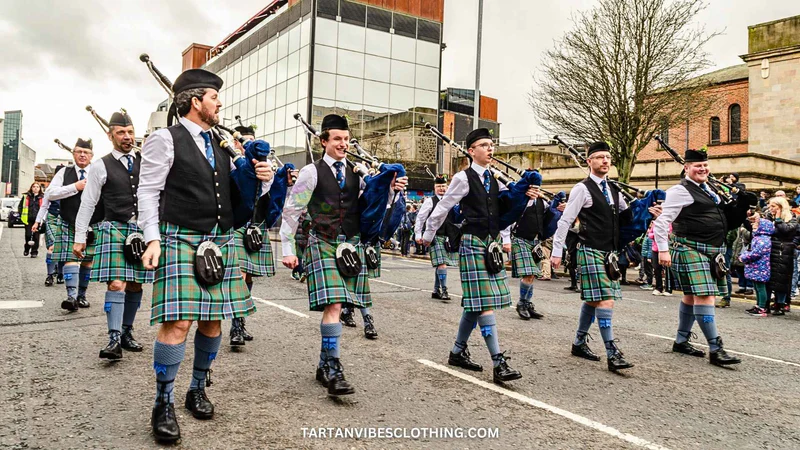
Today, they’ve evolved from ceremonial pipe-band wear into heritage streetwear — making them ideal for styling green plaid for St. Paddy’s in a modern way.

The Irish National Tartan — A Non-Sectarian Symbol
Unlike Scottish clan tartans, the Irish National Tartan was intentionally designed in the early 20th century as a unifying emblem.
During the Gaelic Revival, Ireland sought cultural symbols that transcended religious and regional divisions. The result was a tartan built on shared identity rather than lineage.
Its color logic is deliberate:
Emerald Green – the Irish landscape
White – peace and unity
Gold/Orange – historical and cultural tradition
Because it isn’t tied to a single county or family, the Irish National tartan remains the most inclusive choice for St. Patrick’s Day — especially for those unsure of their ancestral roots.
Wearing it signals participation in heritage without claiming a specific county affiliation.

The Black Watch Fallacy
You’ll often see Black Watch tartan recommended for St. Patrick’s Day. It’s a deep green-and-navy plaid that visually fits the holiday.
But here’s the nuance: Black Watch originated as a Scottish military tartan (42nd Royal Highland Regiment) — not Irish.
Is it acceptable to wear? Absolutely.
Is it authentically Irish? Not exactly.
If you want maximum heritage alignment, choose an Irish County tartan or the Irish National instead.

The Golden Rule — Make Tartan Your Chromatic Anchor
Why “Green-on-Green” Fails
Green is visually dominant. When layered excessively, it creates chromatic saturation — the eye has nowhere to rest. The result feels loud rather than luxurious.
To truly understand how to style tartan for St. Patrick’s Day, think in terms of balance.
The Irish-Inspired Palette for March 17
For a balanced, elevated look, build around:
Emerald or Forest Green (heritage anchor)
White or Cream (nod to the Irish flag & Aran knit tradition)
Saffron or Gold accents (traditional Irish dress influence)
Use Navy or Charcoal as grounding neutrals — not symbolic colors, but styling stabilizers.
Then stabilize with:
Aran white
Charcoal gray
Cream
Sand tones
Black
Neutralizing Agents That Elevate Tartan
Tartan Base |
Best Neutrals |
Recommended Metal |
Ulster (Green + Yellow) |
Cream, Navy |
Gold / Brass |
Irish National |
Charcoal, White |
Silver / Pewter |
Cork |
Sand, Light Grey |
Choose one dominant metal tone |
Matching hardware to thread accents subtly elevates the entire look without adding extra color.
How to Style Tartan for St. Patrick’s Day: Step-by-Step Formula
Step 1: Choose Your Tartan
Pick:
An Irish County tartan if you know your roots
Irish National tartan for inclusive styling
Browse authentic Irish tartans at Tartan Vibes Clothing to start with real woven wool rather than printed fast fashion.
Step 2: Decide Your Focal Piece
Choose only one dominant tartan item:
Kilt
Pleated skirt
Waistcoat
Blazer
Scarf
Tartan trousers
This becomes your Chromatic Anchor.
Step 3: Add 1–2 Neutrals
Balance the bold pattern with grounding tones:
Navy
Charcoal
Cream
Sand
Avoid stacking multiple greens.
Step 4: Match Your Hardware
Look at the accent threads in your tartan:
Gold/yellow lines → Brass or gold accessories
Blue/green dominant → Silver or pewter
Matching metals subtly elevates your outfit.
Step 5: Ground the Look with Footwear
Tartan wool is visually weighty. Best footwear:
Brogues
Chelsea boots
Lug-sole boots
Structured loafers
Avoid thin-soled dress shoes — they look disconnected.
Footwear balance is an underrated detail in mastering how to style tartan for St. Patrick’s Day.
Fabric Weight & Textile Logic — Why 16oz Feels Different Than 10oz
Most blogs skip this. We won’t.
If you truly care about how to style tartan for St. Patrick’s Day with authority, you need to understand fabric.
Understanding the Sett, Worsted Wool & Selvedge
Sett: The repeated pattern unit of a tartan.
Worsted wool: Smooth, tightly spun yarn used in high-quality tartan cloth.
Selvedge: The finished edge of the woven fabric.
Authentic wool tartan:
Holds structure.
It is naturally more flame-resistant than most synthetics.
Has slight water resistance.
Drapes with visual authority.
16oz vs. 10/11oz Weight
- 16oz (Heavyweight / Strome): Ideal for kilts. It swings, holds pleats, and feels substantial.
10–11oz (Lightweight / Reiver): Perfect for trousers, waistcoats, scarves, and hoodies. Ideal for unpredictable March weather.
Choosing the right fabric weight prevents your outfit from looking stiff or flimsy.
There’s also a visible difference in how tartan photographs. Synthetic plaid often looks flat under daylight, while worsted wool reflects light with subtle depth and dimension. That woven texture gives the sett a richer, more elevated appearance — especially in outdoor parade photos.

If you care how your outfit looks both in person and on camera, fabric composition matters.
5 Styling Formulas for Every Persona
1. The Modern Heritage Man
Formula: Irish County tartan waistcoat + white Oxford shirt + sand chinos + brogues
Why It Works:
Structured vest anchors the look.
Neutral chinos prevent color overload.
Brogues or suede boots add visual grounding.
Add-On: Jeff cap, Flat cap in a complementary tone.
Pro Tip: If the tartan has gold threads, choose brass cufflinks or a warm-tone watch.


2. The Streetwear Rebel
Formula: Irish tartan hoodie + denim or leather jacket + boots
Texture Contrast: Rough leather vs refined wool creates edge.
Detail Move: Roll up jeans to reveal tartan socks.
Cold Weather Solution: Layer with a tartan gilet for mobility and warmth.


3. The Celtic Goddess
Formula: Pleated tartan midi skirt + black turtleneck + wide belt + structured boots
Why It Works:
Pleats enhance the flow of the sett.
Black provides a strong contrast.
Gold jewelry complements saffron lines.
For evening events, try a velvet emerald top for elevated contrast.


4. The Office Minimalist
Formula: Irish tartan shirt + navy or charcoal blazer + dark trousers.
Why It Works:
The blazer tones down the bold tartan pattern.
Dark trousers keep the outfit professional.
The tartan only appears subtly when the blazer opens — perfect for office-appropriate St. Patrick’s Day style.
Pro Tip: Choose a smaller sett tartan pattern for office wear. Large bold plaid can look too casual.


5. The Matchy-Matchy Family
Formula: Coordinated County tartan pajamas or sweaters
Keep:
Same base color
Slight variation in scale
Perfect for home gatherings or family photos.

Pro-Tips: How to Avoid the “Costume Look”
1. Balance Is Key
If your skirt or kilt is bold, keep the top solid.
If your blazer is tartan, choose neutral trousers.
2. Ground the Look with Proper Footwear
Heavy wool visually requires grounding.
Best choices:
Brogues with perforated detailing
Lug-sole boots
Chelsea boots
Avoid thin-soled dress shoes — they look disconnected from the fabric’s weight.
3. Smart Accessorizing (Less Is More)
Accessories should echo the tartan — not compete with it.
Refined options:
Tartan quartz watch
Leather wallet
Minimal shamrock lapel pin (small scale)
Celtic knot cufflinks
Leather belt in warm brown
4. The Scale Rule (Mixing Tartans)
Mixing tartans is advanced-level styling.
Only do it if:
Both patterns share the same base green hue
One uses a large-scale sett
The other is a micro-check or a subtle
Otherwise, the eye experiences pattern overload.
The Biggest Mistakes People Make
Let’s save you from regret.
When learning how to style tartan for St. Patrick’s Day, avoid these:
❌ Head-to-toe plaid
❌ Neon green overload
❌ Costume-grade accessories
❌ Poor tailoring
Sustainability: Wear Tartan Beyond March 17th
Tartan shouldn’t live in your closet 364 days a year. Pair it with:
Camel coats in autumn
Cream knits in winter
Light denim in spring
Linen shirts on summer evenings
When you invest in authentic tartan, you’re buying a heritage garment — not holiday décor.
That’s why at Tartan Vibes Clothing, our Irish tartan pieces are designed for year-round wear, not one-time photos.

Conclusion: Wear Your Pride with Precision
St. Patrick’s Day style doesn’t require exaggeration.
It requires:
One bold tartan anchor
Neutral grounding
Respect for heritage
Balanced texture and weight
Tartan represents more than a pattern. It’s the meeting point of past and present — Gaelic Revival identity meeting modern street style.
This March 17th, celebrate with intention.
Explore your County roots. Choose your sett wisely. And wear green like it means something.
Sláinte. 🍀
FAQs About Tartan for St. Patrick’s Day
Is it okay to wear Scottish tartan on St. Patrick’s Day?
Yes. It’s culturally accepted. But for authenticity, Irish County or National tartans are more aligned with the holiday.
What is the official Irish National tartan?
Designed in the early 20th century, it combines emerald green, white, and gold to symbolize land, peace, and heritage.
How do you style a tartan shirt?
To style a tartan shirt, pair it with neutral basics like jeans and white sneakers for a casual look. For a sharper outfit, layer it under a solid blazer or wear it open over a plain tee with dark denim and boots. Keep the rest of the outfit simple to let the plaid stand out.
What do Scottish people wear on St. Patrick’s Day?
Scottish people who celebrate St. Patrick’s Day often wear traditional Highland dress, including a kilt, sporran, kilt jacket (such as a Prince Charlie), kilt hose, and ghillie brogues. However, many opt for a simplified version with just a kilt and tailored jacket for modern events.
Is there such a thing as an Irish tartan?
Yes, there is an Irish National Tartan as well as County-specific Irish tartans. Unlike Scottish clan tartans, Irish tartans are typically organized by province or county. The Irish National Tartan features green, white, and gold tones symbolizing Ireland’s landscape, unity, and heritage.

Teresa Finn
As someone with a deep passion for clan heritage, especially the intriguing world of tartans and their rich traditions, I'm here to be your companion on this exciting journey. Together, we'll delve into the depths of clan history, uncovering the stories behind these vibrant tartans and making every connection to your heritage more meaningful.


